The Internet of Things (IoT) is transforming how businesses collect data, monitor equipment, track assets, and connect physical products to digital platforms.
At the same time, Bluetooth Low Energy (BLE) has become an important connectivity technology for devices that need reliable short-range communication with low power consumption.
When BLE and IoT are combined, businesses can build connected products that collect real-world data and transfer it to applications, gateways, and cloud platforms.
This combination is especially useful for asset tracking, healthcare devices, smart buildings, retail, industrial monitoring, wearables, logistics, and connected consumer products.
In this guide, we explain how BLE IoT solutions work, where they are used, and what businesses should consider when developing a BLE-enabled IoT product.
What Is BLE IoT?
BLE IoT refers to the use of Bluetooth Low Energy technology within an Internet of Things ecosystem.
A typical BLE IoT system can include:
- BLE sensors
- Connected devices
- Smartphones or tablets
- BLE gateways
- IoT gateways
- Cloud platforms
- Mobile applications
- Web dashboards
- APIs
- Data analytics systems
BLE devices collect information such as temperature, movement, location-related signals, battery status, equipment conditions, or user interactions.
That information can then be transferred to another device or gateway and eventually processed by an IoT platform.
The result is a connected system where physical devices can communicate with software applications and cloud infrastructure.
How Does a BLE IoT System Work?
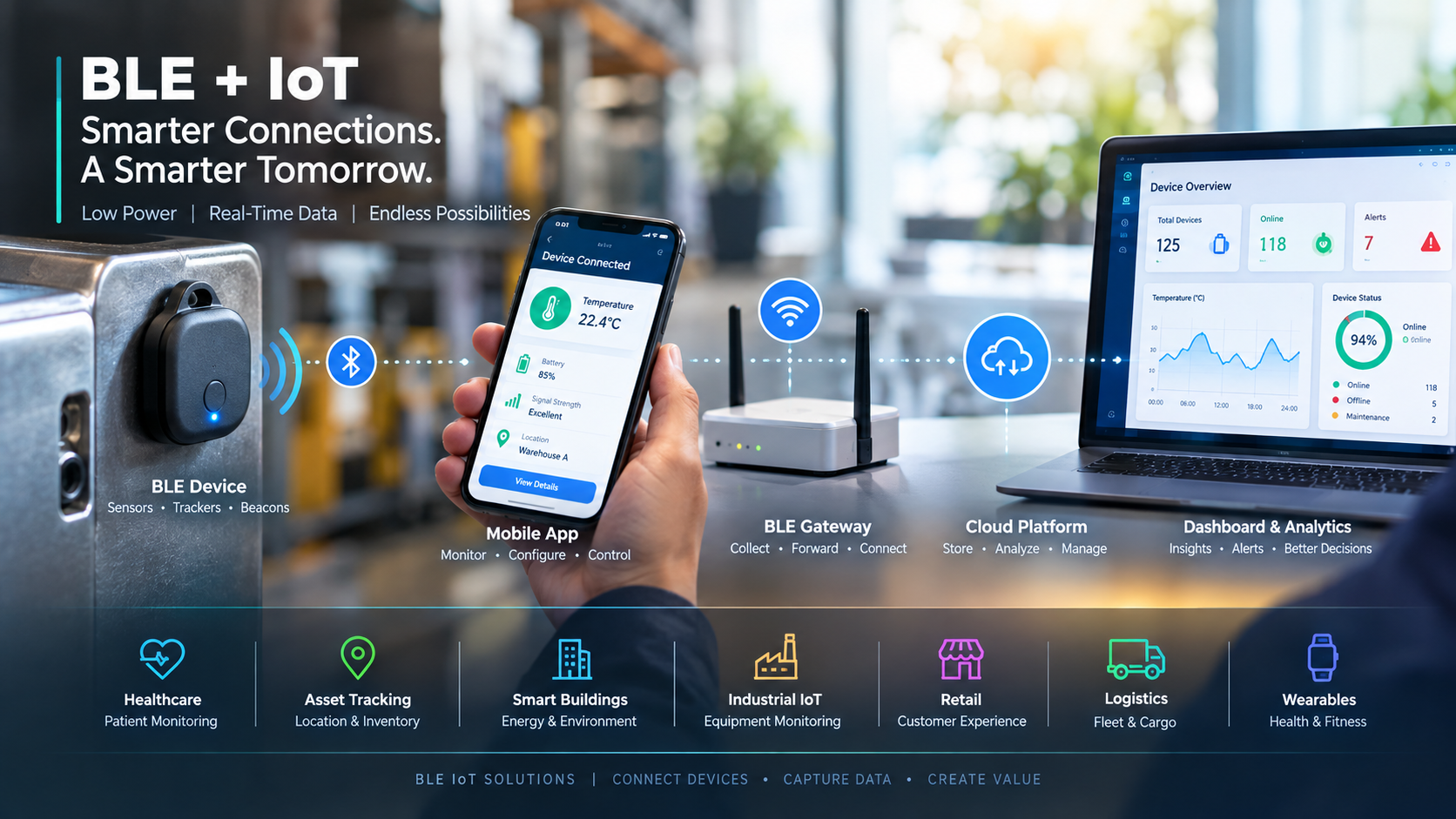
A BLE IoT architecture generally follows a simple data flow:
BLE Device → Smartphone/Gateway → Internet → Cloud Platform → Application/Dashboard
For example, imagine a company monitoring equipment inside a warehouse.
BLE sensors can collect equipment data and communicate with a nearby gateway.
The gateway sends the information to a cloud platform, where the data can be stored and analyzed.
A dashboard can then show equipment status to managers in real time.
If a sensor detects an unusual condition, the system can trigger an alert.
This creates a complete connected workflow instead of simply collecting Bluetooth data locally.
Why Is BLE Useful for IoT Devices?
BLE was designed with low-power wireless communication in mind.
This makes it particularly useful for battery-powered IoT devices that need to operate for extended periods.
Low Power Consumption
Many IoT devices are small and battery-powered.
BLE can support communication requirements without the same power demands associated with some other wireless technologies.
This makes BLE suitable for sensors, beacons, wearables, trackers, and other compact devices.
Short-Range Wireless Communication
BLE is designed for short-range communication.
This can be useful when sensors communicate with smartphones, tablets, gateways, or nearby connected equipment.
Smartphone Compatibility
Modern smartphones commonly support Bluetooth Low Energy.
This means a BLE-enabled product can potentially communicate directly with a mobile application without requiring specialized hardware for