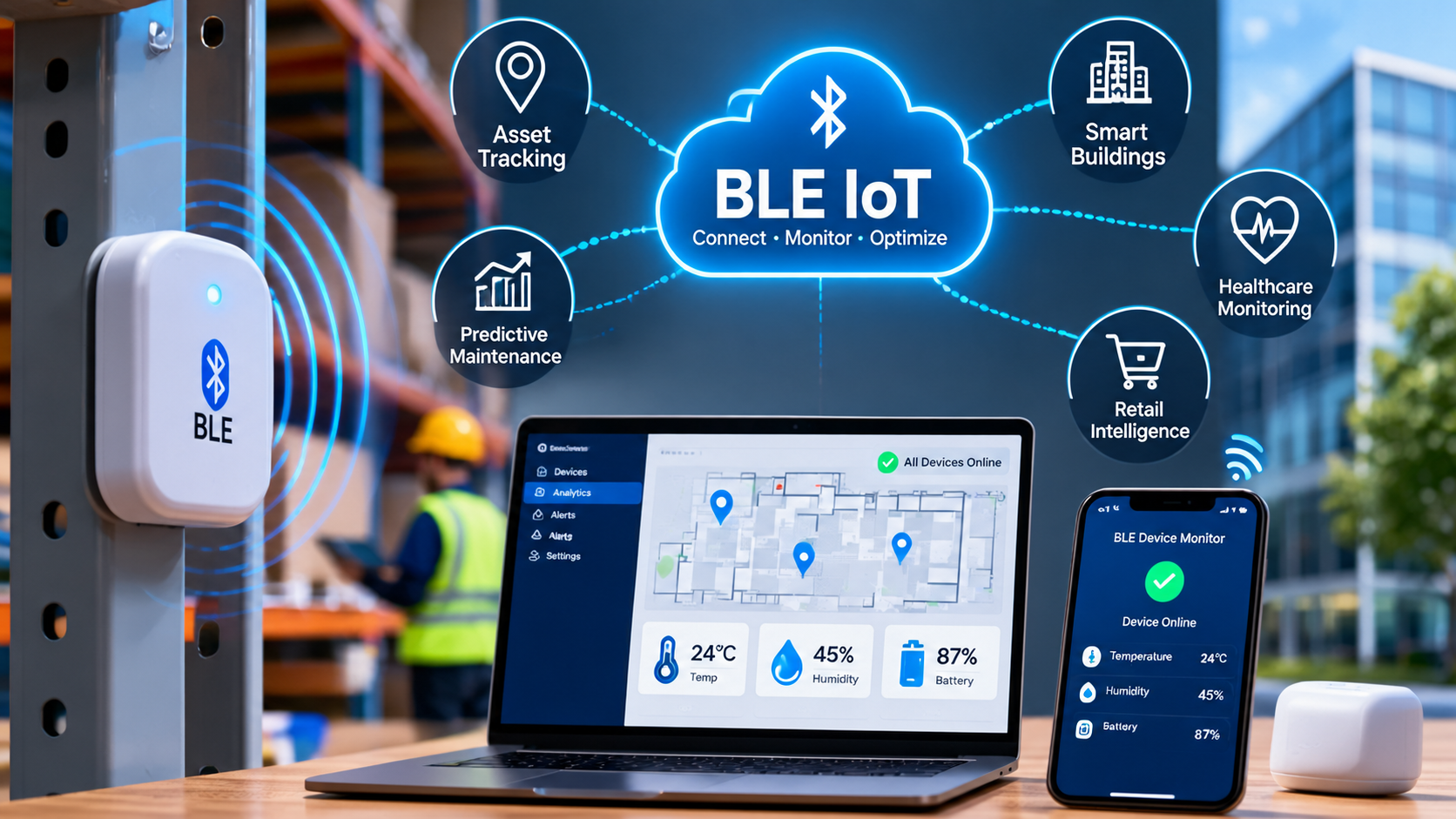
Introduction: What If Your Devices Could Tell You More?
Imagine a warehouse where employees can locate equipment without searching every aisle. A commercial building that adjusts lighting based on occupancy. A manufacturer that detects unusual equipment conditions before they cause downtime.
These scenarios demonstrate the potential of combining Bluetooth Low Energy (BLE) with the Internet of Things (IoT).
Businesses are moving beyond simply connecting devices. They want connected systems that collect useful information, communicate efficiently, and help people make better decisions.
In 2026, BLE IoT technology offers a practical way to develop these systems, particularly where low power consumption, wireless connectivity, and proximity-based interactions matter.
For companies building connected products, the opportunity is clear: transform everyday devices into valuable sources of real-time business intelligence.
What Is BLE IoT?
BLE IoT refers to connected devices and applications that use Bluetooth Low Energy technology to exchange information while keeping power consumption relatively low.
A typical BLE IoT solution may include:
- Sensors: Collect information such as temperature, movement, humidity, or equipment status.
- BLE devices: Transmit data wirelessly using Bluetooth Low Energy.
- Gateways or smartphones: Receive device data and forward it when required.
- Cloud platforms: Store and process information from connected devices.
- Mobile or web applications: Present data, alerts, reports, and controls to users.
- Analytics and AI: Identify patterns and support decisions where appropriate.
Not every BLE solution requires continuous cloud connectivity. Some systems operate locally through a smartphone or gateway, while others combine edge processing with cloud services.
The right design depends on the application’s range, data volume, latency, security, and battery-life requirements.
Why Businesses Are Exploring BLE IoT in 2026
Bluetooth technology is expanding beyond consumer accessories into industrial monitoring, asset tracking, building automation, and connected infrastructure. The Bluetooth SIG’s recent sustainability research highlights applications such as intelligent lighting, equipment monitoring, electronic shelf labels, and resource optimization.
Source: Bluetooth technology and sustainable IoT applications.
Several capabilities make BLE particularly useful for suitable IoT applications.
1. Energy-Efficient Wireless Connectivity
Battery-powered devices often need to operate for long periods without frequent maintenance.
BLE supports low-power communication patterns that can help extend battery life when devices are designed around appropriate advertising intervals, connection parameters, data rates, and sleep modes.
This makes it useful for wearables, environmental sensors, electronic tags, and certain industrial monitoring devices.
Actual battery life depends on hardware, firmware, usage patterns, transmission frequency, and operating conditions.
2. Convenient Smartphone Connectivity
Many smartphones already support Bluetooth, making them useful interfaces for compatible connected products.
A mobile application can help users configure devices, view sensor readings, receive alerts, or perform supported operations without requiring a dedicated control terminal.
For product manufacturers, this can simplify the user experience and create opportunities for new mobile services.
3. Flexible Connected Product Development
BLE can support applications ranging from a single sensor connected to a mobile app to a larger deployment involving multiple devices and gateways.
Businesses can begin with a focused use case and expand functionality as operational needs develop.
However, larger deployments require careful planning for device discovery, network coverage, interference, data synchronization, and device management.
Five Practical BLE IoT Applications Businesses Should Consider
1. Smart Asset Tracking
Finding equipment, tools, inventory, and reusable containers can consume valuable employee time.
BLE beacons and tags can help businesses identify nearby assets when used with compatible scanners, smartphones, or fixed gateways.
A tracking platform may display the last detected location, asset status, and movement history. With a suitable deployment, businesses can improve inventory visibility and reduce the time spent searching for equipment.
Example: A logistics company deploys BLE tags on reusable containers and uses gateways at key warehouse locations to record their movement.
The system can flag containers that have not appeared at an expected checkpoint. It does not necessarily provide GPS-like, continuous positioning; accuracy depends on the tracking architecture and installation.
2. Predictive Maintenance for Industrial Equipment
Unexpected equipment failures can disrupt production and increase maintenance costs.
BLE-enabled sensors can collect information such as temperature, vibration, and operating conditions. A connected application can analyze this information to identify unusual readings and notify maintenance teams.
For more advanced deployments, historical sensor data can feed anomaly-detection models that help identify possible maintenance issues.
Example: A manufacturing facility monitors the temperature of selected machines and alerts technicians when readings exceed configured thresholds.
Predictive maintenance requires suitable sensors, reliable data, and validated detection methods. A sensor reading alone cannot guarantee that a failure will be predicted.
3. Smart Buildings and Energy Management
Offices, hotels, retail locations, and commercial facilities can use BLE-enabled sensors and controls to support more efficient building operations.
Potential applications include:
- Occupancy-aware lighting.
- Environmental monitoring.
- Temperature and humidity sensing.
- Room and equipment status monitoring.
- Integration with building management systems.
Example: Occupancy sensors provide data to a compatible building automation platform, allowing lighting controls to respond to room usage.
The energy savings depend on the building, existing controls, sensor placement, and operating policies. BLE provides connectivity; the wider automation system determines how that data is used.
4. Healthcare and Wearable Devices
Healthcare products may use BLE to transfer measurements from compatible wearable devices and sensors to a smartphone, tablet, or monitoring platform.
Possible applications include wellness monitoring, activity tracking, device configuration, and remote collection of selected measurements.
For medical products, development must account for applicable privacy, security, reliability, usability, and regulatory requirements. BLE connectivity alone does not make a product medically validated or compliant.
5. Retail and Customer Experiences
Retailers can use BLE beacons and compatible devices to support proximity-based experiences and operational workflows.
Potential applications include indoor navigation, product information, inventory visibility, and location-aware notifications when customers have granted the necessary permissions.
BLE can also connect electronic shelf labels and other retail devices to suitable management systems.
Example: A retailer deploys beacons in selected store zones and uses a mobile application to deliver relevant product information when shoppers opt in.
Effective implementations must respect user privacy and avoid excessive or unwanted notifications.
BLE IoT vs. Traditional IoT Connectivity
Choosing a wireless technology is a design decision, not a competition with a universal winner.
| Requirement | BLE | Wi-Fi | LoRaWAN |
|---|---|---|---|
| Typical use | Short-range device connectivity | Higher-bandwidth local networking | Long-range, low-data-rate sensing |
| Power profile | Often low | Generally higher for comparable small battery-powered devices | Designed for low-power wide-area deployments |
| Data transfer | Low to moderate, depending on configuration | Suitable for high data rates | Generally limited data rates |
| Common applications | Wearables, beacons, sensors | Cameras, gateways, connected appliances | Remote monitoring, agriculture, metering |
Actual performance varies by implementation, hardware, environment, and protocol configuration. Some systems combine several technologies to meet different requirements.
Challenges to Address Before Building a BLE IoT Product
BLE IoT development involves more than connecting a sensor to a mobile application.
Connectivity and interference: Walls, metal structures, crowded radio environments, and device placement can affect communication.
Battery optimization: Poorly chosen advertising intervals or connection settings can reduce battery life.
Security: Pairing, authentication, authorization, firmware updates, and sensitive-data handling must be designed appropriately.
Interoperability: Devices, mobile operating systems, gateways, and cloud platforms must exchange data reliably.
Scalability: A prototype with five devices may behave differently from a deployment with thousands of devices.
Testing: Developers should test real hardware under realistic conditions, including weak signals, interrupted connections, and low-battery scenarios.
Addressing these challenges early helps businesses avoid expensive redesigns after deployment.
How to Develop a BLE IoT Solution: A Practical Roadmap
A structured development process helps turn a business idea into a working connected product.
Step 1: Define the Business Problem
Identify what the product should measure, control, track, or improve. Establish measurable goals before selecting hardware or software.
Step 2: Select Compatible Hardware
Evaluate sensor requirements, BLE capabilities, processing resources, battery capacity, physical constraints, and environmental conditions.
Step 3: Develop Device Firmware
Implement communication, data collection, power management, error handling, and appropriate security mechanisms.
Step 4: Build the Application
Create the mobile or web interface for device setup, monitoring, configuration, and alerts.
Step 5: Integrate Gateways and Cloud Services
Where needed, design secure data ingestion, device management, storage, analytics, and integration with existing business systems.
Step 6: Test and Optimize
Validate performance, range, reliability, battery life, usability, and security on actual devices.
Step 7: Plan Deployment and Maintenance
Prepare for firmware updates, device replacement, monitoring, support, and future feature development.
How BLEIoT Can Support Your Connected Product Journey
Building a reliable connected product requires coordination between hardware, embedded firmware, wireless communication, mobile applications, and backend systems.
BLEIoT focuses on the connected-device development space, where selecting the right architecture and integrating the different components are essential to product success.
Whether your idea involves smart sensors, asset tracking, industrial monitoring, wearable connectivity, or a custom BLE-enabled device, begin with a clear use case and a realistic technical plan.
The goal is not to add connectivity for its own sake. It is to create a product that delivers useful information, improves an existing workflow, or solves a meaningful customer problem.
Frequently Asked Questions
What is BLE IoT used for?
BLE IoT is used in applications such as asset tracking, wearable devices, environmental sensing, smart buildings, industrial monitoring, and proximity-based services.
Is BLE suitable for battery-powered IoT devices?
Yes. BLE is designed to support low-power wireless communication, although battery life depends on hardware design, firmware, communication frequency, and usage.
Does BLE IoT require internet access?
No. Some BLE applications work locally between devices and smartphones. Internet connectivity is required only when the solution needs remote access, cloud processing, or other internet-dependent features.
Can BLE IoT integrate with AI?
Yes. Sensor data can be processed by edge or cloud systems to support anomaly detection, forecasting, classification, and automation. The usefulness of AI depends on data quality and the specific application.
How much does BLE IoT development cost?
Costs depend on hardware selection, firmware complexity, mobile and cloud requirements, integrations, testing, production volume, and compliance needs. A defined proof of concept can help establish a realistic budget.
Conclusion: Build Connected Products That Deliver Real Value
BLE IoT is helping businesses connect physical products with digital services while supporting power-conscious device design and flexible application experiences.
From tracking assets to monitoring industrial equipment and improving building operations, the technology offers opportunities across multiple industries.
Successful solutions combine the right wireless architecture with reliable firmware, intuitive applications, security, and thorough real-world testing.
Planning a BLE-enabled product? Explore BLEIoT to learn more about connected-device possibilities and the technologies that can help bring your idea to life.