Connected technology is changing how businesses design, operate, and manage modern products. From wearable devices and smart healthcare equipment to industrial sensors and asset-tracking systems, connected products are becoming an important part of everyday business operations.
At the center of this transformation are Bluetooth Low Energy (BLE) and the Internet of Things (IoT).
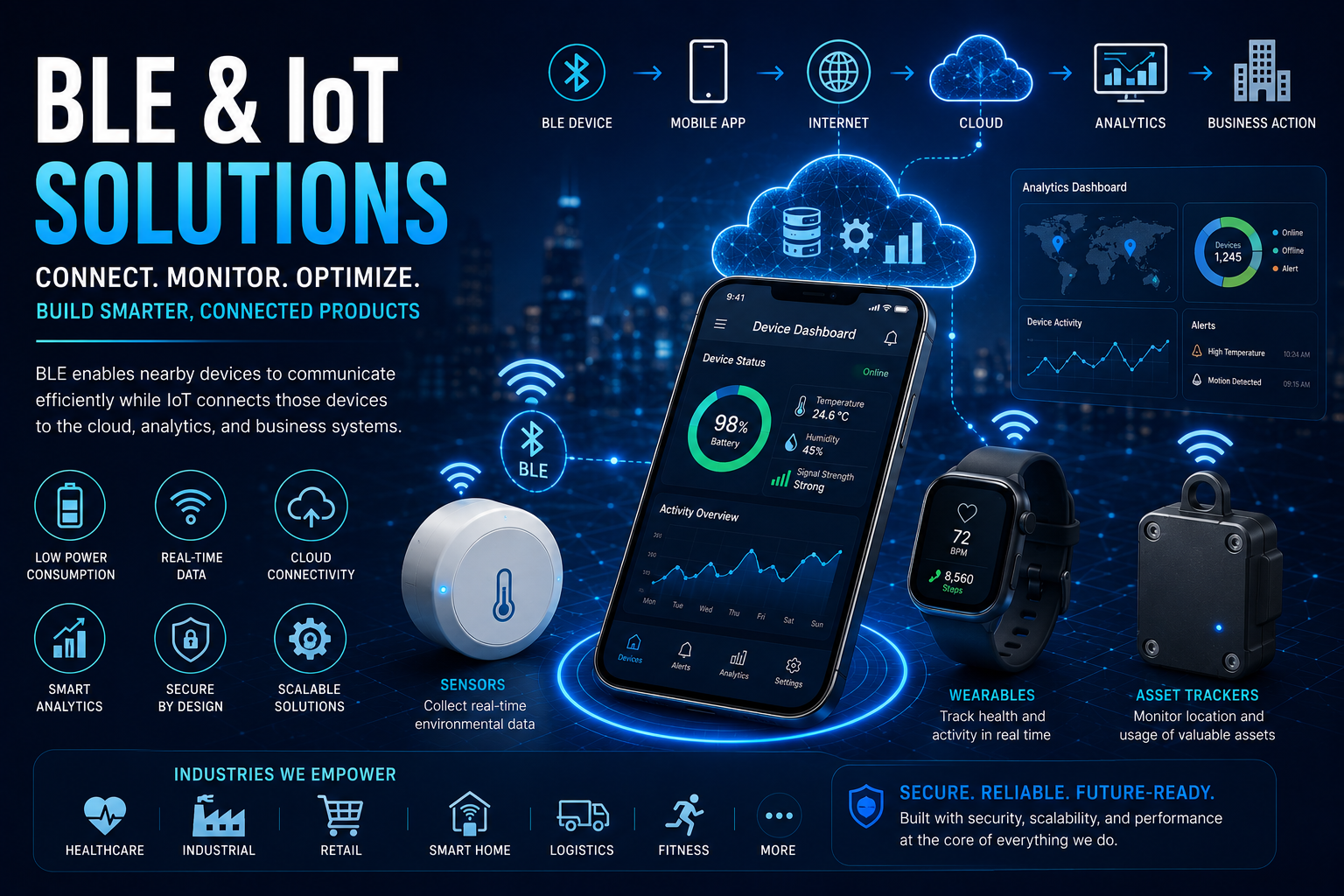
BLE enables nearby devices to communicate efficiently while IoT connects those devices to applications, cloud platforms, analytics systems, and business workflows. When combined, these technologies can help businesses create smarter, more efficient, and more responsive products.
What Is BLE IoT?
BLE IoT refers to the use of Bluetooth Low Energy technology within broader IoT ecosystems.
A typical BLE IoT solution may connect:
BLE Device → Mobile App → Internet → Cloud → Analytics → Business Platform
BLE is particularly useful for short-range communication and battery-powered devices. IoT provides the infrastructure needed to collect, process, monitor, and act on the information generated by those devices.
This combination is useful for businesses developing connected products that need reliable communication without excessive power consumption.
Why Businesses Are Adopting BLE IoT Solutions
Businesses are increasingly looking for ways to connect physical products with digital platforms.
BLE IoT solutions can help organizations:
- Monitor connected devices remotely
- Collect real-time device information
- Reduce manual monitoring
- Improve operational visibility
- Automate repetitive processes
- Track assets and equipment
- Improve customer experiences
- Support predictive maintenance
- Build data-driven products
Instead of treating hardware and software as separate systems, businesses can create a connected ecosystem where both work together.
Major BLE IoT Applications
BLE and IoT technology can be applied across a wide range of industries.
1. Healthcare and Medical Devices
Healthcare devices can use BLE to communicate with smartphones, tablets, gateways, or specialized systems.
Potential applications include:
- Patient monitoring devices
- Fitness and health trackers
- Connected medical equipment
- Smart thermometers
- Glucose monitoring systems
- Rehabilitation devices
Collected information can then be transferred to cloud-based platforms for monitoring and analysis.
2. Smart Home Applications
Smart home products are another important use case for BLE IoT development.
Connected locks, sensors, lighting systems, thermostats, and security devices can communicate with mobile applications and other smart devices.
A BLE-enabled smart lock, for example, could allow a smartphone to communicate with the lock while an IoT platform manages users, access records, notifications, and device information.
3. Industrial IoT
Industrial businesses can use BLE sensors to collect information from equipment and machinery.
Sensors may monitor:
- Temperature
- Vibration
- Machine activity
- Operating conditions
- Equipment status
- Environmental conditions
The information can be sent to an IoT platform where businesses can monitor equipment and identify unusual patterns.
This can support predictive maintenance and potentially reduce unexpected equipment downtime.
4. Asset Tracking
Businesses often need to know where equipment, inventory, or valuable assets are located.
BLE beacons and tags can provide location-related information within facilities such as:
- Warehouses
- Hospitals
- Manufacturing plants
- Retail stores
- Offices
- Logistics centers
When combined with IoT software, businesses can build centralized systems for monitoring connected assets.
5. Retail and Proximity Solutions
BLE beacons can enable proximity-based experiences in retail environments.
For example, a mobile application could detect a nearby beacon and trigger relevant content, notifications, or offers.
Retailers can use connected systems to create more personalized customer experiences while gathering useful operational data.
BLE IoT and Mobile Applications
Mobile applications are often a critical component of BLE IoT ecosystems.
A mobile application can act as a communication layer between BLE devices and cloud systems.
Users may be able to:
- Discover nearby devices
- Connect and pair devices
- Configure device settings
- View sensor information
- Receive alerts
- Synchronize data
- Monitor device status
- Manage multiple devices
For consumer IoT products, the mobile application can effectively become the main interface between the user and the connected device.
The Role of Cloud Technology
BLE can efficiently handle nearby communication, but many modern IoT solutions require a larger infrastructure for storing and processing data.
Cloud platforms can provide:
- Data storage
- APIs
- Device management
- User management
- Analytics
- Notifications
- Remote monitoring
- Integration with business applications
This creates a complete architecture where data collected locally through BLE can eventually become useful information for users and businesses.
BLE IoT + AI: The Next Opportunity
One of the biggest opportunities for connected products is combining BLE IoT development with artificial intelligence.
IoT systems can generate large amounts of information.
AI can analyze that information to identify patterns and support better decisions.
For example, an industrial IoT system could analyze equipment data and identify unusual operating behavior.
A healthcare application could identify trends in collected information.
A smart building could analyze occupancy patterns and optimize energy usage.
The combination can move connected products from simple monitoring systems toward intelligent IoT solutions.
Security in BLE IoT Development
Security should be considered from the beginning of an IoT project.
A connected ecosystem may include multiple layers:
Device → BLE → Mobile App → API → Cloud → Database
Each layer needs appropriate security controls.
Important considerations include:
- Secure device pairing
- Authentication
- Authorization
- Encryption
- Secure APIs
- Access control
- Secure firmware updates
- Cloud security
- Data protection
- Monitoring and logging
Businesses should also consider how devices will be secured throughout their entire lifecycle.
Challenges of BLE IoT Development
Although BLE provides many advantages, developing a reliable BLE IoT solution can be technically challenging.
Developers may need to address:
Device Compatibility
Different hardware manufacturers may implement BLE features differently.
Android and iOS Differences
BLE behavior and background communication can vary between mobile operating systems.
Connectivity Issues
Devices may disconnect because of distance, interference, battery limitations, or environmental conditions.
Power Consumption
Battery-powered devices need carefully optimized communication strategies.
Scalability
An architecture that works for a few hundred devices may require significant changes when supporting thousands or millions of devices.
Data Synchronization
Applications need reliable mechanisms for handling data when devices temporarily lose connectivity.
These challenges make proper architecture and testing essential.
How to Build a Successful BLE IoT Product
Businesses planning a connected product should consider the entire ecosystem before development begins.
Step 1: Define the Business Problem
Start by identifying the problem the product needs to solve.
Step 2: Select the Communication Technology
Determine whether BLE, Wi-Fi, cellular, or multiple communication technologies are appropriate.
Step 3: Design the Device Architecture
Define sensors, hardware components, firmware, BLE services, and communication requirements.
Step 4: Develop the Mobile Application
Build applications that can securely communicate with the connected devices.
Step 5: Build the IoT Backend
Develop APIs, databases, device-management systems, and cloud infrastructure.
Step 6: Add Analytics and AI
Use analytics or AI where they can provide meaningful business value.
Step 7: Test at Scale
Test connectivity, performance, security, battery consumption, and device compatibility under real-world conditions.
Why BLEIoT Development Requires an Ecosystem Approach
Successful IoT products are rarely built using a single technology.
A complete connected product may require:
- BLE development
- Embedded software
- Mobile app development
- IoT development
- Cloud infrastructure
- Backend APIs
- Database architecture
- Data analytics
- AI integration
- Security
- Device management
The goal should therefore be to design the complete ecosystem rather than focusing only on the BLE connection.
The Future of BLE IoT
The future of connected technology will likely involve increasingly intelligent and automated products.
BLE can provide efficient communication between nearby devices, while IoT platforms can connect those devices to larger digital ecosystems.
AI can then turn the resulting data into useful insights.
This creates a powerful technology chain:
Connected Devices → BLE Communication → IoT Platform → Cloud → AI → Intelligent Decisions
As businesses continue investing in connected products, this combination can create opportunities across healthcare, retail, manufacturing, logistics, smart homes, fitness, automotive, and many other industries.
Final Thoughts
BLE and IoT are no longer technologies limited to experimental connected-device projects.
They are becoming important building blocks for modern digital products.
With the right architecture, BLE IoT development can help businesses connect physical devices with mobile applications, cloud platforms, analytics systems, and intelligent software.
The real opportunity isn’t simply connecting a device.
It is creating a system where devices collect information, software understands that information, and businesses use it to make better decisions.
For companies planning their next connected product, BLE and IoT can provide the foundation for building smarter, scalable, and more useful digital experiences.