Modern businesses generate more data than ever before.
Machines produce performance information. Sensors track environmental conditions. Wearable devices monitor health and activity. Smart equipment reports its status. Yet data alone does not create value.
The real value comes from collecting the right information, delivering it quickly, and turning it into useful action.
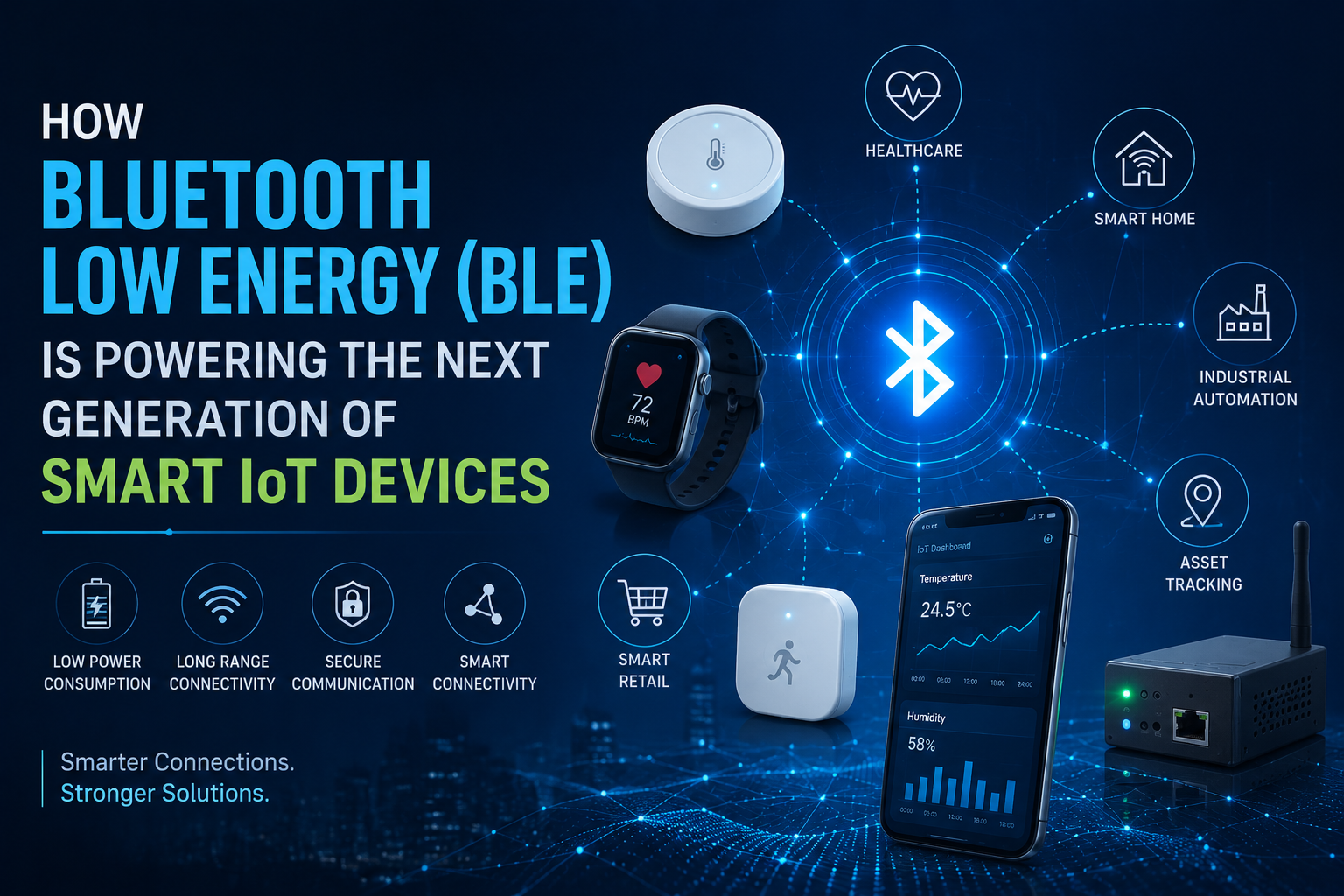
This is where Bluetooth Low Energy (BLE) and the Internet of Things (IoT) are creating new opportunities.
BLE-enabled IoT systems allow businesses to connect physical devices with mobile applications, cloud platforms, and intelligent dashboards. These connected solutions can provide real-time visibility, automate alerts, improve operational efficiency, and support faster decision-making.
At BLEIoT, we develop custom BLE and IoT solutions that help businesses transform sensor data into smarter digital experiences.
What Is a BLE IoT Monitoring System?
A BLE IoT monitoring system connects physical devices with software.
The system usually includes:
- Sensors that collect information
- BLE-enabled devices that transmit data
- Mobile applications or gateways that receive information
- Cloud platforms that store and process data
- Web dashboards that display insights
- Alerts that notify users about important events
For example, a temperature sensor can collect environmental data and send it through BLE to a nearby mobile device or gateway.
The information can then be transferred to a cloud platform, where users can view temperature trends and receive alerts when conditions move outside an acceptable range.
This creates a connected flow:
Sensor → BLE Device → Mobile App or Gateway → Cloud → Dashboard → Action
The result is a system that helps businesses understand what is happening without relying entirely on manual inspections.
Why BLE Is Ideal for Smart Monitoring
Many IoT monitoring devices need to operate for long periods without frequent charging or battery replacement.
BLE is designed for low-power wireless communication, making it useful for battery-powered sensors and connected devices.
Low Energy Consumption
BLE devices can remain in low-power states and communicate only when necessary.
This can help extend battery life and reduce maintenance requirements.
Fast Data Communication
BLE can quickly transfer small amounts of information between devices.
This is useful for monitoring applications where sensor readings must be updated regularly.
Smartphone Connectivity
Modern smartphones support BLE, allowing mobile applications to communicate directly with compatible devices.
A smartphone can act as:
- A device controller
- A data viewer
- A configuration tool
- A local gateway
- A notification platform
Compact Hardware
BLE modules can be integrated into small devices, wearables, sensors, medical products, and smart equipment.
Flexible Integration
BLE systems can connect with mobile apps, cloud platforms, web dashboards, APIs, and enterprise software.
Real-Time Monitoring Across Industries
BLE IoT technology can support a wide range of industries.
Smart Healthcare Monitoring
Connected healthcare devices can collect and share information such as:
- Heart rate
- Blood pressure
- Oxygen levels
- Body temperature
- Physical activity
A BLE-enabled device can send information to a mobile application, allowing users to review data and share it with authorized healthcare professionals.
Healthcare solutions require careful attention to security, privacy, accuracy, and regulatory requirements.
Industrial Equipment Monitoring
Factories and industrial facilities can use BLE sensors to monitor equipment conditions.
Sensors may track:
- Temperature
- Vibration
- Pressure
- Machine activity
- Energy usage
- Equipment status
When unusual patterns are detected, the system can notify maintenance teams.
This can support preventive and predictive maintenance strategies.
Smart Building Management
BLE-enabled sensors can help monitor:
- Room occupancy
- Temperature
- Humidity
- Lighting conditions
- Air quality
- Energy consumption
Building managers can use this information to improve comfort, reduce waste, and optimize energy usage.
Cold-Chain Monitoring
Businesses that transport or store temperature-sensitive products may need continuous visibility into environmental conditions.
BLE sensors can collect temperature information and send it to nearby gateways or mobile applications.
The system can generate alerts when readings exceed defined limits.
Asset and Equipment Tracking
BLE tags can help businesses identify the location or proximity of important equipment.
Possible applications include:
- Hospital equipment
- Warehouse tools
- Retail inventory
- Manufacturing assets
- Office devices
Asset tracking can reduce search time and improve equipment utilization.
Smart Retail Experiences
Retail businesses can use BLE technology to create connected customer experiences.
Potential applications include:
- Proximity-based notifications
- Indoor navigation
- Smart inventory monitoring
- Connected loyalty experiences
- Location-aware services
Turning Sensor Data into Useful Insights
Collecting data is only the first step.
A useful IoT platform should help people understand what the data means.
For example, a dashboard may show:
- Current device status
- Historical trends
- Battery levels
- Sensor activity
- Device locations
- Connection quality
- Alert history
Analytics can help users identify patterns that may not be obvious from individual readings.
A sudden increase in machine vibration may indicate a possible maintenance issue.
A repeated temperature change may reveal an equipment problem.
A pattern of low occupancy may help optimize building operations.
The goal is not simply to display numbers.
The goal is to support better decisions.
The Role of AI in BLE IoT Systems
Artificial Intelligence can make connected systems more intelligent.
AI models can analyze large volumes of sensor data and identify patterns, anomalies, or possible future outcomes.
AI-powered BLE IoT systems may support:
Anomaly Detection
AI can identify unusual device behavior or sensor readings.
This may help teams investigate potential issues earlier.
Predictive Maintenance
Machine data can be analyzed to identify patterns associated with equipment wear or failure.
This can help organizations schedule maintenance before a serious problem occurs.
Intelligent Alerts
Traditional systems may send an alert for every event.
AI can help prioritize alerts based on risk, context, and historical behavior.
Automated Responses
Connected systems can trigger actions when specific conditions occur.
For example, a smart building system may adjust equipment settings based on occupancy or environmental data.
Key Challenges in BLE IoT Development
Developing a reliable connected solution requires more than connecting a sensor to a mobile application.
Device Compatibility
Different mobile devices and operating systems may handle BLE connections differently.
Testing across relevant hardware is important.
Connection Management
The application should manage:
- Device discovery
- Pairing
- Connection changes
- Unexpected disconnections
- Automatic reconnections
- Background activity
Battery Optimization
Connection settings, advertising intervals, transmission frequency, and sensor activity can affect battery performance.
The system should be optimized for the intended use case.
Data Security
Connected devices may collect sensitive or business-critical information.
Security considerations may include:
- Secure pairing
- User authentication
- Data encryption
- Access permissions
- Secure cloud communication
- Protected firmware updates
Cloud Scalability
A system designed for ten devices may require major changes to support thousands.
Cloud architecture should consider future growth from the beginning.
How BLEIoT Develops Connected Monitoring Solutions
At BLEIoT, we help businesses build connected products from concept to deployment.
Our development process includes:
1. Product Discovery
We study the business objective, target users, device requirements, data needs, and expected outcomes.
2. BLE and IoT Architecture
We define how sensors, devices, mobile applications, gateways, cloud platforms, and dashboards will communicate.
3. Mobile Application Development
We build Android and iOS applications that connect with BLE devices and provide clear, user-friendly controls.
4. Device and Sensor Integration
We support BLE hardware, embedded systems, sensors, wearables, and connected products.
5. Cloud Platform Development
We create secure cloud systems for data storage, device management, analytics, and remote monitoring.
6. Dashboard Development
We build web dashboards that help businesses view device activity, analyze data, and manage connected systems.
7. Testing and Optimization
We test connectivity, performance, battery usage, compatibility, security, and real-world behavior.
The Future of BLE IoT Monitoring
The next generation of connected systems will be more intelligent, automated, and responsive.
Future BLE IoT solutions may include:
- AI-powered predictive analytics
- Smarter industrial automation
- Advanced healthcare monitoring
- More efficient smart buildings
- Improved asset visibility
- Automated maintenance systems
- Intelligent energy management
- Better device interoperability
As connected technologies evolve, businesses will be able to move from reactive operations to more proactive and data-driven strategies.
Instead of discovering problems after they occur, organizations may be able to identify warning signs earlier and respond more effectively.
Build a Smarter Connected Solution with BLEIoT
BLE and IoT technology can help businesses connect devices, monitor operations, and turn real-time information into meaningful action.
Whether you are developing a smart sensor, wearable device, industrial monitoring system, connected healthcare product, asset-tracking platform, or custom IoT application, the right architecture is essential.
At BLEIoT, we combine BLE development, IoT engineering, mobile applications, cloud technology, dashboards, and intelligent analytics to build scalable connected solutions.
Your devices collect the data. We help turn it into smarter decisions.
Contact BLEIoT to discuss your next BLE and IoT development project.