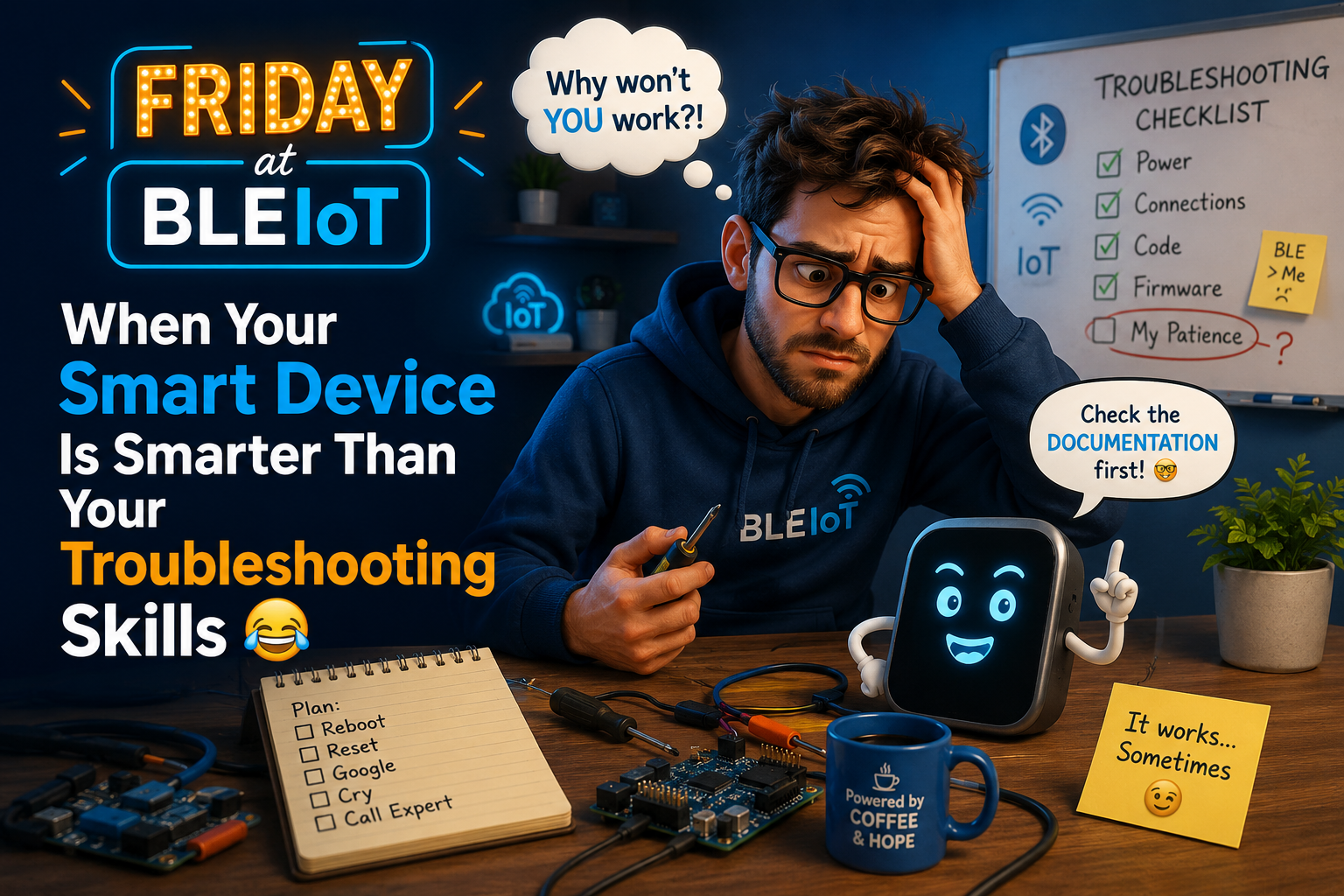
It’s Friday.
The coffee is ready.
The laptop fan sounds like a jet engine.
The developer has exactly one goal:
“Please don’t break anything today.”
Then someone says:
“The BLE device isn’t connecting.”
And just like that…
Friday is cancelled. 😂
Welcome to the wonderfully unpredictable world of BLE and IoT development, where devices are smart, sensors are connected, cloud platforms are powerful, and somehow the first troubleshooting question is still:
“Did you turn Bluetooth off and on again?”
1. The Device Was Working Five Minutes Ago
Every BLE developer has heard this sentence:
“It was working perfectly yesterday.”
Yesterday:
✅ Device discovered
✅ BLE connected
✅ Data transferred
✅ App worked
✅ Everything was beautiful
Today:
❌ Device not found
The developer checks everything.
Bluetooth?
On.
Permissions?
Granted.
Firmware?
Correct.
GATT services?
Correct.
Connection parameters?
Correct.
Then someone asks:
“Did you restart the phone?”
And somehow…
It works.
This is why production BLE applications need proper device discovery, connection handling, reconnection logic, diagnostics, and testing across real devices.
BLEIoT’s development services include BLE peripheral and central implementations, custom GATT services, device provisioning, OTA firmware updates, and native iOS and Android Bluetooth APIs.
2. Bluetooth Says “Connected”
The phone:
Connected.
The BLE device:
Connected.
The application:
Connected.
The user:
“Then why isn’t anything happening?”
Welcome to BLE.
A successful connection is only the beginning.
The application still needs to:
- Discover services
- Discover characteristics
- Subscribe to notifications
- Read and write data
- Handle packets
- Manage connection state
- Recover from disconnections
So yes…
Connected doesn’t always mean useful.
3. The GATT Characteristic Nobody Wants to Touch
Every BLE developer eventually encounters that one GATT characteristic.
Nobody fully understands it.
Nobody wants to modify it.
But somehow:
Everything depends on it.
Touch the wrong byte?
Something breaks.
Change the packet format?
Something breaks.
Update firmware?
Something breaks.
Document it?
Everyone suddenly becomes busy.
Custom GATT services and characteristics are an important part of designing BLE communication around a device’s specific data model and use case.
And yes…
Documentation is cheaper than archaeology.
4. The Battery Has Trust Issues
IoT devices often need to run for long periods on limited battery power.
Unfortunately, the device developer wants:
More data.
The product manager wants:
More connectivity.
The customer wants:
Longer battery life.
The device wants:
Please leave me alone.
Every BLE transmission consumes energy.
So developers need to balance:
Performance + Connectivity + Data Frequency + Battery Life
Sometimes the smartest IoT feature is simply:
Sleep mode.
Even developers understand the importance of sleeping on Friday.
5. “Can We Just Add Wi-Fi?”
Someone:
“Why don’t we just use Wi-Fi?”
BLE developer:
“Because…”
Then begins a 25-minute explanation involving:
- Power consumption
- Range
- Device architecture
- Mobile connectivity
- Pairing
- Network availability
- Hardware limitations
BLE is particularly useful when devices need efficient short-range wireless communication.
Wi-Fi may be better for other use cases.
The correct technology depends on the product.
Because the answer isn’t always:
“More Wi-Fi = Better IoT.”
6. The Cloud Has Entered the Conversation
At first, the product is simple.
Device → Mobile App
Then somebody says:
“Can we store the data in the cloud?”
Now we have:
Device → BLE → Mobile → API → Cloud → Database → Dashboard
Then another person asks:
“Can we add analytics?”
Now:
Device → BLE → Mobile → API → Cloud → Database → Analytics → Dashboard
Then:
“Can we add AI?”
Developer:
“Of course.”
Architecture diagram:
📈📡☁️📱🔐🧠📊
At this point, the original Bluetooth device has accidentally become an enterprise platform.
BLEIoT supports IoT system integration, real-time data monitoring, automation, control systems, and gateway/cloud connectivity as part of its connected-device approach.
7. The IoT Device That Sends EVERYTHING
Temperature?
Send it.
Battery level?
Send it.
Signal strength?
Send it.
Device status?
Send it.
Random sensor fluctuation?
SEND IT.
Soon the cloud database has millions of records.
Then the business asks:
“What are we actually doing with this data?”
Silence.
This is why successful IoT development starts with a data strategy.
Ask:
What data do we need?
How frequently should we collect it?
Where should it go?
Who needs it?
What decision will it support?
Because collecting data is easy.
Collecting useful data is the real challenge.
8. OTA Updates: Because Nobody Wants to Visit 10,000 Devices
Imagine deploying thousands of connected devices.
Then discovering a firmware bug.
Option A:
Send a technician to every device.
Developer:
“Absolutely not.”
Option B:
Use Over-the-Air firmware updates.
Developer:
“Now we’re talking.”
OTA updates allow connected devices to receive firmware improvements without requiring physical access to every unit.
But OTA systems need careful planning around:
- Secure updates
- Authentication
- Version management
- Interrupted downloads
- Recovery
- Rollback
- Device compatibility
Because updating 10 devices manually is annoying.
Updating 10,000 is a career change.
BLEIoT highlights OTA firmware update pipelines as part of its BLE development capabilities.
9. Android Works. iPhone Works. Why Are They Different?
Developer:
“The BLE app works perfectly on Android.”
Five minutes later:
“Why isn’t iOS behaving the same way?”
Because mobile BLE development isn’t simply copying the same code onto two operating systems.
Developers need to account for differences in:
- Bluetooth APIs
- Background execution
- Permissions
- Connection behavior
- OS restrictions
- Device manufacturers
- Application lifecycle
BLEIoT specifically works with Apple’s CoreBluetooth framework and Android Bluetooth APIs, reflecting the platform-specific considerations involved in BLE application development.
10. The Friday Deployment
And now…
The ultimate IoT horror story.
“Let’s deploy it today. It’s Friday.”
The developer:
😐
The QA team:
😐
The infrastructure team:
😐
The device:
“Connection Lost.”
The cloud:
“Error 500.”
The mobile app:
“Something went wrong.”
The product manager:
“Can we fix this before Monday?”
Everyone:
“…”
For connected products, production deployments should include proper testing, monitoring, rollback procedures, firmware management, and staged releases.
Friday is a great day for deployment.
If you’re extremely confident.
Otherwise…
Monday is looking pretty attractive.
The Funny Problems Are Actually Serious
Behind the jokes are genuine BLE and IoT engineering challenges.
A reliable connected product needs to consider:
BLE Connectivity
Devices need stable discovery, pairing, communication, and reconnection.
Firmware
Hardware and software need to remain compatible as the product evolves.
Mobile Applications
iOS and Android applications must handle platform-specific Bluetooth behavior.
Cloud Connectivity
Device data needs secure and scalable pathways into cloud infrastructure.
Security
Authentication, encryption, device authorization, and secure updates matter throughout the ecosystem.
Scalability
A prototype supporting 10 devices may behave very differently when deployed to 100,000 devices.
Monitoring
Businesses need visibility into device health, connectivity, battery status, and system performance.
What a Smart BLE IoT Architecture Looks Like
A modern connected product can follow an architecture such as:
BLE Device
↓
Mobile App / Gateway
↓
Secure API
↓
Cloud Platform
↓
Data Processing
↓
Analytics / AI
↓
Business Dashboard
↓
Automated Action
The technology behind the scenes can be extremely complex.
But the user experience should remain simple.
Connect.
Use.
Monitor.
Done.
That’s what smart technology should feel like.
Where BLE and IoT Can Be Used
BLE and IoT technologies can support connected products across many industries, including:
- Healthcare
- Fitness
- Smart homes
- Industrial monitoring
- Asset tracking
- Retail
- Automotive
- Logistics
- Smart buildings
- Consumer electronics
- Wearables
The exact architecture changes according to the product, but the objective remains the same:
Connect physical products with useful digital intelligence.
The BLEIoT Friday Rule
Here’s our favorite rule:
If the user needs to restart Bluetooth five times before using the product, the product isn’t smart enough yet. 😂
Great BLE and IoT products should hide the complexity.
Users don’t want to know about:
- GATT
- Characteristics
- Packets
- APIs
- Firmware
- Cloud infrastructure
- Connection parameters
They simply want to see:
CONNECTED ✅
And preferably…
Actually connected.
Final Thoughts
BLE and IoT are making everyday products increasingly connected and intelligent.
But building a successful connected product requires much more than getting two devices to communicate.
It requires a complete ecosystem involving:
Hardware + BLE + Firmware + Mobile + Cloud + APIs + Security + Data + Automation
The best connected products are the ones where all of that complexity disappears behind a simple user experience.
So if your BLE device refuses to connect this Friday…
Don’t panic.
Check the permissions.
Check the firmware.
Check the GATT services.
Check the logs.
Check the battery.
Restart Bluetooth.
Restart the phone.
And if absolutely nothing works…
Blame the Wi-Fi. 😂
Happy Friday from the world of BLE and IoT!