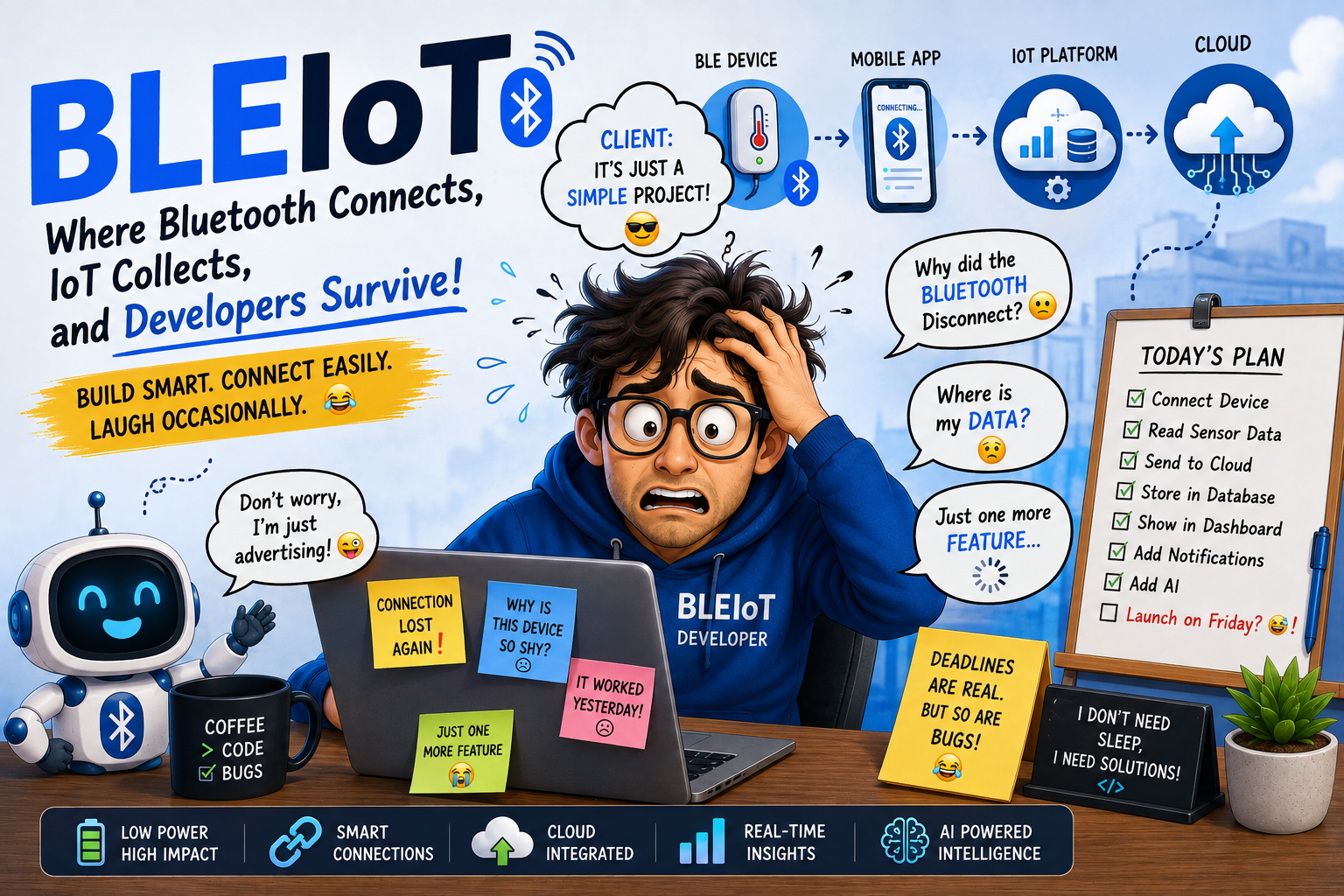
Every BLE IoT development project starts with confidence.
The client says:
“We only need to connect a device to an app.”
Developer:
“No problem.”
Then the requirements arrive.
BLE communication.
Mobile app.
Cloud integration.
Real-time dashboard.
Device management.
Notifications.
AI analytics.
Remote firmware updates.
And finally:
“Can we launch by Friday?”
Developer:
☕ “Of course.”
Welcome to the wonderful world of BLE IoT. 😂
What Is BLE IoT?
BLE IoT combines Bluetooth Low Energy with connected devices, sensors, mobile applications, gateways, cloud platforms, and analytics.
A typical BLE IoT architecture looks like:
BLE Device 📡 → Mobile App 📱 → Cloud ☁️ → Database 🗄️ → Analytics 📊 → Business Action 🚀
Sounds simple.
Until the BLE device decides it doesn’t want to connect.
😂
The BLE Connection That Has Commitment Issues
Every BLE developer knows this conversation.
Developer: “Scan for devices.”
App: “Found the device.”
Developer: “Connect.”
Device: “No.”
Developer: “Try again.”
Device: “Maybe.”
Developer: “Connect!”
Device: “Fine.”
Developer: “Great!”
Device: “Disconnected.”
😂
Bluetooth Low Energy is incredibly useful, but connection management can involve:
- Device discovery
- Pairing
- GATT services
- Characteristics
- Notifications
- Connection intervals
- Signal strength
- Background restrictions
- OS-specific behavior
And sometimes…
The device simply needs emotional support.
“But It Works on My Phone!”
This sentence creates instant fear in a development team.
Developer:
“Which phone did you test?”
Client:
“Mine.”
Developer:
“Which model?”
Client:
“Samsung something.”
Developer:
“Android version?”
Client:
“I don’t know.”
😂
BLE IoT applications often need testing across different:
- Android devices
- iPhones
- Operating-system versions
- Bluetooth chipsets
- Firmware versions
- Network conditions
Because “works on my phone” is not a testing strategy.
The “Small IoT Project” Trap
Client:
“We have one sensor.”
Easy.
Then:
“Actually, there are five.”
Okay.
“Maybe 100.”
Fine.
“Eventually around 20,000.”
Developer:
😐
Now you’re no longer building a small BLE application.
You’re building a scalable IoT platform.
Suddenly you need:
- Device provisioning
- Device authentication
- Cloud infrastructure
- Data ingestion
- Databases
- Monitoring
- APIs
- Analytics
- Security
- Device management
And someone still says:
“But it’s just a sensor.”
😂
BLE + Mobile App: The Dynamic Duo
One of the most common BLE IoT architectures is:
BLE Device
↓
iOS / Android App
↓
Internet
↓
Cloud
The smartphone acts as the bridge between the physical device and the internet.
This architecture can be extremely useful for:
- Wearables
- Healthcare devices
- Fitness products
- Smart accessories
- Industrial sensors
- Consumer electronics
- Connected products
But then someone asks:
“What happens when the app is in the background?”
Developer:
“Here we go again.” 😂
GATT: The Secret Language of BLE
If you’re working on BLE application development, you’ll quickly encounter GATT.
GATT stands for Generic Attribute Profile.
It organizes BLE data through:
- Services
- Characteristics
- Descriptors
For example:
Temperature Service
→ Temperature Characteristic
→ Sensor Value
The application can read values or subscribe to notifications.
It sounds complicated at first.
After enough BLE development, it becomes normal.
Just like drinking coffee at 11 PM.
☕😂
The BLE Device With Zero Documentation
This is where things get interesting.
Client:
“Can you connect our existing BLE device?”
Developer:
“Do you have the BLE documentation?”
Client:
“No.”
“SDK?”
“No.”
“GATT specification?”
“No.”
“Firmware documentation?”
“No.”
“Who developed the device?”
Client:
“Someone we used to work with.”
Developer:
“Excellent.” 😂
Now the team has to reverse-engineer the communication behavior.
This is why proper device documentation and BLE protocol definitions are extremely valuable during product development.
IoT Data: One Tiny Sensor, Millions of Messages
A single sensor may send:
Temperature = 28°C
No big deal.
Now imagine:
10,000 devices
sending data every few seconds.
Suddenly the backend has a serious job.
A scalable IoT platform may need:
- Data ingestion
- Message processing
- APIs
- Databases
- Device management
- Data retention
- Monitoring
- Analytics
The sensor might fit in your hand.
The infrastructure behind it definitely won’t.
😂
“Can We Add AI?”
The IoT system is finally working.
BLE works.
Devices connect.
Data reaches the cloud.
Dashboard works.
Everyone celebrates.
Then:
“Can we add AI?”
Developer:
“What should the AI do?”
Client:
“You know… AI stuff.”
😂
AI becomes genuinely useful when it has a clear purpose.
For example, IoT data can potentially be used for:
- Anomaly detection
- Predictive maintenance
- Forecasting
- Pattern recognition
- Intelligent alerts
- Automated decisions
The goal shouldn’t be:
“Add AI.”
The goal should be:
“Use AI to solve this specific business problem.”
The IoT Dashboard That Ate the Project
It starts innocently:
“Just show the sensor readings.”
Then:
“Can we add a graph?”
Sure.
“Add filters.”
Okay.
“Can we export CSV?”
Yep.
“Real-time data?”
Sure.
“User roles?”
Fine.
“Can we add dark mode?”
😂
Three weeks later:
Dashboard has 26 charts.
Nobody knows which chart matters.
The best IoT dashboard isn’t the one with the most charts.
It’s the one that helps users quickly answer:
“What is happening, and what should I do?”
BLE IoT and the Internet Problem
Everything is connected.
Everything is working.
Then…
Internet disappears.
Sensor:
“I have data.”
Gateway:
“I can’t send it.”
Cloud:
“I don’t see anything.”
Developer:
“Please save it locally.”
This is why reliable IoT systems should consider:
- Local caching
- Retry mechanisms
- Data queues
- Synchronization
- Connection recovery
- Offline operation
Because unfortunately:
The internet does not care about your product demo. 😂
BLE vs Wi-Fi: The Never-Ending Debate
BLE:
“I’m low power.”
Wi-Fi:
“I have more bandwidth.”
BLE:
“I work beautifully with smartphones.”
Wi-Fi:
“I can connect directly to the network.”
BLE:
“I don’t need as much battery.”
Wi-Fi:
“I can transfer much more data.”
😂
The answer isn’t “BLE always wins.”
The correct technology depends on:
- Range
- Power consumption
- Data requirements
- Connectivity
- Hardware
- Cost
- Deployment environment
Sometimes the best solution uses BLE and Wi-Fi together.
For example:
BLE Sensor → Gateway → Wi-Fi → Cloud
BLE vs LoRaWAN: Another Technology Conversation
BLE is generally excellent for:
- Short-range communication
- Wearables
- Smartphones
- Sensors
- Accessories
LoRaWAN can be better suited to:
- Long-range sensor networks
- Remote monitoring
- Agriculture
- Smart-city deployments
There isn’t one wireless technology that wins every IoT project.
The right choice depends on:
Range + Power + Data + Cost + Environment
The Battery Problem 🔋
IoT devices often need to operate for long periods.
That means battery consumption matters.
Every BLE operation can potentially affect power usage:
- Scanning
- Advertising
- Connections
- Data transmission
- Sensor sampling
Developers therefore have to think about:
How much data?
How often?
How quickly?
How long should the device sleep?
Because nobody wants a smart sensor that becomes a very expensive paperweight after two days.
😂
BLE Firmware Updates: “Can We Do It Remotely?”
Client:
“Can we update the device software remotely?”
Developer:
“Yes, using OTA firmware updates.”
Client:
“Like updating an app?”
Developer:
“Not exactly.”
😂
Firmware updates can involve:
- BLE file transfer
- Version management
- Validation
- Error handling
- Battery considerations
- Connection reliability
- Rollback mechanisms
A good OTA architecture is important when thousands of connected devices are deployed in the field.
BLE IoT Security: The Part We Should Actually Take Seriously
Okay, jokes aside.
IoT security is not funny.
Connected devices can communicate with mobile applications, cloud platforms, APIs, and business systems.
A BLE IoT solution should consider:
Device Security
Protect hardware and firmware.
BLE Security
Use appropriate authentication and encryption.
Mobile Security
Protect credentials and local information.
API Security
Secure communication between applications and backend systems.
Cloud Security
Protect devices, users, data, and infrastructure.
Access Control
Ensure users can only access authorized devices and information.
The security chain is:
Device → BLE → Mobile/Gateway → API → Cloud → Database
Every layer matters.
Where BLE IoT Is Being Used
BLE IoT technology can support applications across many industries.
🏭 Manufacturing
- Equipment monitoring
- Asset tracking
- Predictive maintenance
- Environmental sensing
🏥 Healthcare
- Connected medical devices
- Wearables
- Patient monitoring
- Health sensors
🚚 Logistics
- Asset tracking
- Cold-chain monitoring
- Warehouse monitoring
🛒 Retail
- BLE beacons
- Smart shelves
- Proximity experiences
- Asset tracking
🏢 Smart Buildings
- Occupancy monitoring
- Access systems
- Environmental monitoring
- Indoor navigation
⌚ Wearables
- Fitness devices
- Smart accessories
- Connected health products
The BLEIoT Developer Survival Checklist 😂
☑ Bluetooth ON?
☑ Device advertising?
☑ Correct UUID?
☑ GATT service found?
☑ Characteristic responding?
☑ Notification enabled?
☑ Phone nearby?
☑ Firmware compatible?
☑ Internet working?
☑ API responding?
☑ Cloud receiving data?
☑ Dashboard updated?
☑ Client hasn’t added another feature?
☑ Coffee ready? ☕
What Makes a Good BLE IoT Solution?
A successful BLE IoT product needs more than a working Bluetooth connection.
It should be:
Reliable
Devices should communicate consistently.
Secure
Data and devices should be properly protected.
Scalable
The architecture should support future device growth.
Power Efficient
Battery-powered devices need optimized communication.
User-Friendly
The technology should feel simple to the end user.
Maintainable
Developers should be able to monitor and update the system after launch.
Business-Focused
The connected technology should solve an actual business problem.
The Future of BLEIoT
The future of BLE IoT isn’t simply about connecting more devices.
It’s about making connected devices smarter.
The evolution looks like:
BLE Devices
↓
IoT Connectivity
↓
Cloud Platforms
↓
Real-Time Analytics
↓
AI
↓
Automation
Imagine a system that doesn’t just tell you:
“The machine temperature is high.”
but can potentially identify:
“This machine is behaving differently from its normal operating pattern.”
That’s where AI-powered BLE IoT becomes especially interesting.
Why BLEIoT?
Modern connected products often require expertise across several technology layers:
Hardware
Firmware
BLE
Mobile Apps
IoT
Cloud
AI
Analytics
BLEIoT focuses on creating connected technology solutions across these areas.
Possible applications include:
- BLE IoT applications
- BLE mobile apps
- IoT applications
- BLE device integration
- Sensor solutions
- Wearable applications
- Asset tracking
- Smart-device solutions
- IoT gateways
- Cloud-connected products
- AI-powered IoT systems
The objective is simple:
Connect the device. Collect the data. Understand the data. Make something useful happen.
Final Thoughts 😂
BLE IoT looks easy from the outside.
Device → Bluetooth → App → Cloud.
Done.
Right?
Not quite. 😂
Behind that simple experience can be:
Firmware + BLE + Mobile + APIs + Cloud + Databases + Security + Analytics + AI
And occasionally:
One developer + 17 cups of coffee. ☕
But that’s also what makes BLE IoT development exciting.
The goal isn’t simply to connect devices.
It’s to build a reliable digital ecosystem where hardware, software, connectivity, data, and intelligence work together.