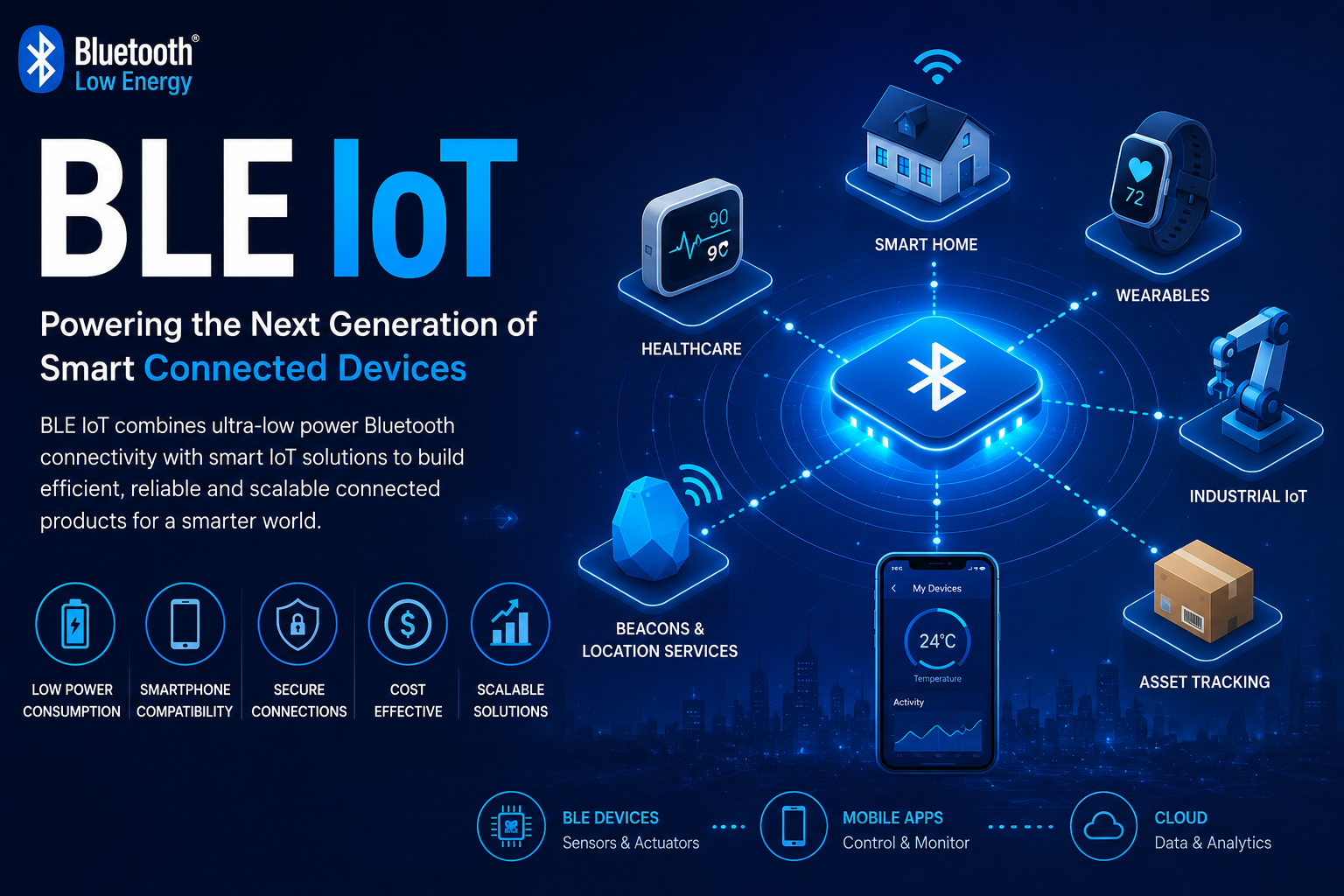
The rapid growth of the Internet of Things (IoT) has changed the way businesses and consumers interact with technology. From smart homes and wearable devices to industrial automation and healthcare monitoring, connected devices are becoming an essential part of everyday life.
One technology playing a major role in this transformation is Bluetooth Low Energy (BLE).
BLE IoT combines the power of Bluetooth Low Energy communication with IoT ecosystems to create smart, energy-efficient, and reliable connected solutions. Its low power consumption, affordability, and smartphone compatibility make BLE one of the most preferred technologies for modern IoT applications.
What Is BLE IoT?
BLE IoT refers to IoT solutions that use Bluetooth Low Energy technology for communication between smart devices, sensors, mobile applications, and cloud platforms.
Unlike traditional Bluetooth, BLE is designed for devices that need to exchange small amounts of data while consuming very little power.
A typical BLE IoT ecosystem includes:
- BLE-enabled sensors
- Smart devices
- Mobile applications
- IoT gateways
- Cloud platforms
- Data analytics systems
This architecture allows businesses to monitor, control, and manage connected devices efficiently.
Why BLE Is Becoming Essential for IoT Development
IoT devices require communication technologies that offer:
- Low energy usage
- Long battery life
- Affordable hardware
- Secure connections
- Easy deployment
BLE addresses these requirements, making it a preferred choice for startups and enterprises developing connected products.
1. Extremely Low Power Consumption
The biggest advantage of BLE is its energy efficiency.
BLE devices can operate for months or years on small batteries because they remain in sleep mode when communication is not required.
This makes BLE ideal for:
- Smart sensors
- Fitness trackers
- Wearable devices
- Medical monitoring systems
- Smart locks
2. Seamless Smartphone Connectivity
Almost every modern smartphone supports BLE technology.
This eliminates the need for additional communication hardware and allows users to directly interact with IoT devices through mobile applications.
Examples:
- Smart device configuration
- Real-time monitoring
- Remote control applications
- Firmware updates
- Data synchronization
3. Cost-Effective IoT Solutions
BLE hardware components are affordable and easy to integrate into products.
Businesses can reduce:
- Manufacturing costs
- Power requirements
- Maintenance expenses
- Product complexity
This makes BLE IoT an excellent solution for large-scale deployments.
Major Applications of BLE IoT Technology
Smart Home Automation
BLE is transforming traditional homes into intelligent environments.
BLE-powered smart home solutions include:
- Smart lighting systems
- Smart door locks
- Security sensors
- Smart thermostats
- Home automation controllers
Users can control devices directly from their smartphones with reliable wireless connectivity.
Healthcare and Medical IoT
Healthcare is one of the fastest-growing sectors adopting BLE technology.
BLE IoT enables:
- Remote patient monitoring
- Smart medical devices
- Health tracking systems
- Fitness monitoring
- Wireless medical sensors
Doctors and healthcare providers can collect real-time health information and improve patient care.
Wearable Technology
Wearable devices depend heavily on BLE because they require:
- Small hardware size
- Low power consumption
- Continuous connectivity
Popular BLE wearable applications include:
- Smart watches
- Fitness bands
- Smart rings
- Sports monitoring devices
Industrial IoT (IIoT)
Industries are using BLE IoT solutions to improve automation and efficiency.
Applications include:
- Equipment monitoring
- Predictive maintenance
- Asset tracking
- Factory sensors
- Environmental monitoring
BLE sensors help companies collect valuable operational data in real time.
Retail and Location-Based Services
BLE beacon technology enables businesses to create personalized customer experiences.
Retail applications include:
- Indoor navigation
- Customer engagement
- Product tracking
- Smart inventory systems
- Proximity marketing
BLE IoT Architecture: How It Works
A typical BLE IoT system works through multiple layers:
1. BLE Device Layer
Sensors collect information such as:
- Temperature
- Motion
- Location
- Heart rate
- Environmental conditions
2. Communication Layer
BLE transfers collected data securely between devices and applications.
3. Application Layer
Mobile or web applications allow users to monitor and control connected devices.
4. Cloud Layer
Cloud platforms store and analyze IoT data to generate insights.
BLE IoT vs Wi-Fi IoT: Which Is Better?
| Feature | BLE IoT | Wi-Fi IoT |
|---|---|---|
| Power Consumption | Very Low | High |
| Battery Life | Longer | Shorter |
| Cost | Low | Medium |
| Range | Short to Medium | Medium to Long |
| Best Use Case | Sensors & Wearables | Data Heavy Applications |
BLE is ideal for battery-powered devices where energy efficiency is more important than high-speed data transfer.
Future Trends in BLE IoT Development
The future of BLE IoT is evolving with new innovations.
AI-Powered IoT Devices
Combining AI with BLE IoT allows devices to analyze data locally and make smarter decisions.
Advanced Asset Tracking
BLE-based tracking solutions are improving logistics, healthcare, and industrial operations.
Smart City Applications
BLE IoT will support:
- Smart parking
- Environmental monitoring
- Public infrastructure management
- Smart transportation
Enhanced Security
Future BLE solutions will focus on stronger encryption and secure device communication.
Benefits of Developing BLE IoT Solutions
Businesses investing in BLE IoT development can achieve:
✅ Longer battery life
✅ Reduced operational costs
✅ Better user experiences
✅ Real-time monitoring
✅ Scalable IoT infrastructure
✅ Faster product development
BLE provides businesses with a reliable foundation for building innovative connected products.
Conclusion
BLE IoT is becoming a critical technology for the future of connected devices. Its combination of low energy consumption, affordability, security, and smartphone compatibility makes it suitable for a wide range of industries.
From healthcare and smart homes to industrial automation and wearable technology, BLE IoT is helping businesses create smarter and more efficient solutions.
Companies looking to build next-generation connected products can leverage BLE IoT development to create scalable, reliable, and future-ready applications.