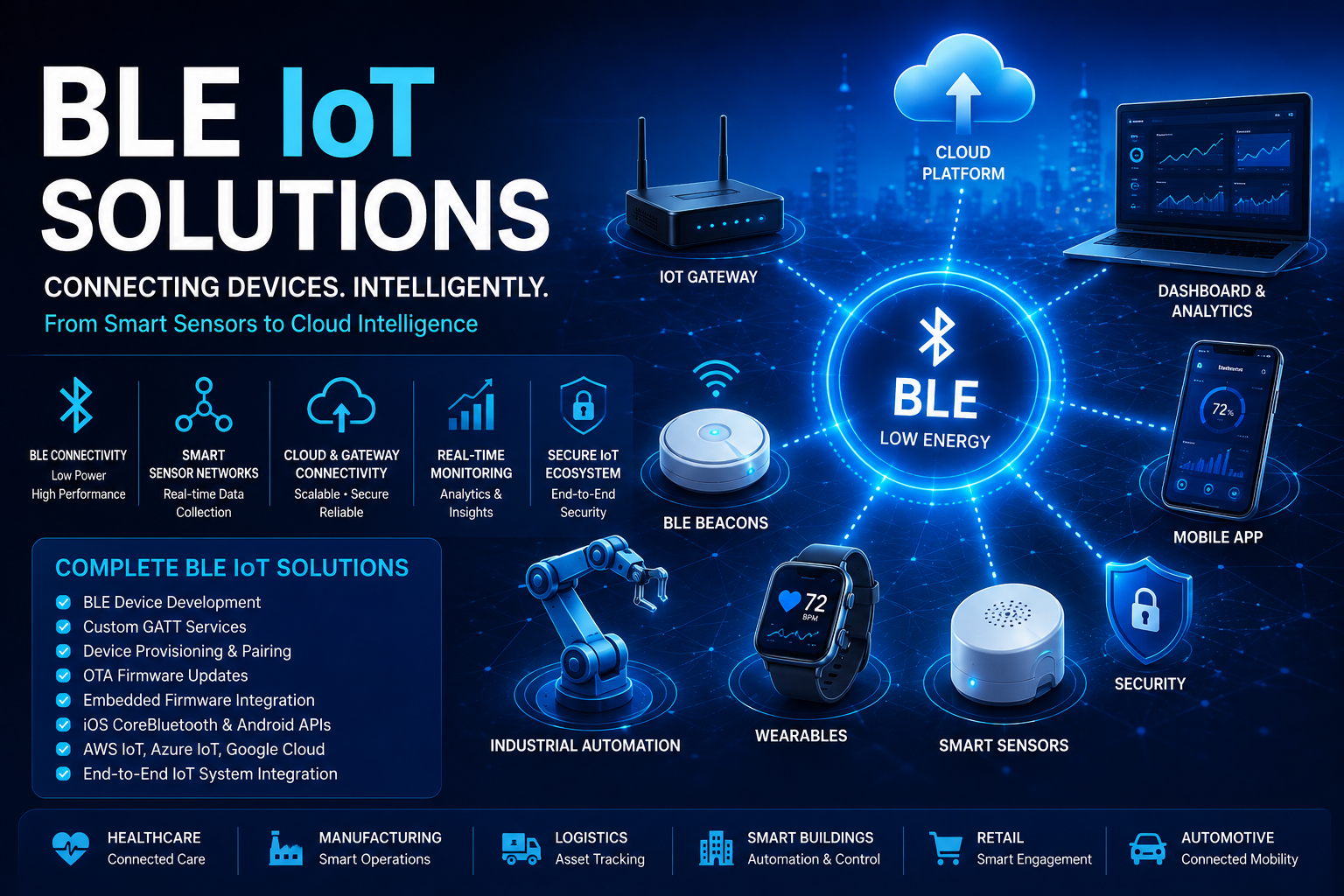
Bluetooth Low Energy is no longer limited to fitness trackers and simple wireless accessories. In 2026, BLE IoT solutions are becoming an important part of connected products across healthcare, manufacturing, logistics, retail, smart buildings, automotive, fitness, and industrial automation.
Businesses are combining BLE Bluetooth IoT, smart sensors, mobile applications, IoT gateways, cloud platforms, embedded firmware, and AI-powered analytics to create connected systems that can collect data, monitor devices, automate workflows, and deliver real-time insights.
The result is a new generation of intelligent connected products.
What Are BLE IoT Solutions?
BLE IoT solutions combine Bluetooth Low Energy connectivity with Internet of Things technologies to connect devices, sensors, applications, gateways, and cloud platforms.
A typical BLE IoT architecture can look like:
BLE Device → Mobile App/Gateway → Cloud → Data Processing → Analytics → Automated Action
BLE provides an energy-efficient communication layer between nearby devices, while the IoT infrastructure enables data collection, remote monitoring, device management, analytics, and automation.
This combination is especially useful for battery-powered connected devices that need reliable wireless communication without consuming excessive power.
Why BLE Is Important for IoT
Many IoT devices operate on batteries and may need to work for months or even years without frequent maintenance.
BLE is designed for low-power wireless communication, making it suitable for devices such as:
- Smart sensors
- Wearables
- Fitness trackers
- Medical devices
- Asset trackers
- Smart locks
- Industrial sensors
- Environmental monitors
- BLE beacons
- Connected equipment
- EV charging systems
Instead of requiring every sensor to have direct internet connectivity, BLE devices can communicate with a smartphone, tablet, or IoT gateway that forwards information to the cloud.
This can simplify device architecture and improve power efficiency.
How a BLE IoT System Works
A complete BLE IoT system generally contains several layers.
1. BLE Device Development
The first layer is the physical connected device.
A BLE device may contain:
- Sensors
- BLE chipset
- Microcontroller
- Battery
- Embedded firmware
- Custom GATT services
- Security components
The device collects information and communicates wirelessly with a central device or gateway.
2. BLE Communication
BLE communication allows devices to discover, connect, exchange data, and maintain wireless connections.
Depending on the product architecture, BLE can support:
- Advertising
- Scanning
- Device discovery
- Connections
- Data exchange
- Notifications
- Read/write operations
- Secure pairing
A carefully designed BLE protocol is essential for reliable IoT products.
Custom GATT Services for Connected Products
The Generic Attribute Profile, commonly called GATT, defines how BLE devices organize and exchange data.
Custom GATT services allow developers to create data structures specifically for an IoT product.
For example, an industrial sensor could expose characteristics for:
- Temperature
- Pressure
- Battery level
- Device status
- Error conditions
- Configuration
- Sensor readings
A mobile application or gateway can interact with these characteristics according to the product’s requirements.
A well-designed GATT architecture can make the communication layer easier to maintain and expand as the product evolves.
BLE Device Provisioning and Pairing
Connecting a new device for the first time is an important part of the user experience.
A typical provisioning process can involve:
Device Discovery → Authentication → Pairing → Configuration → Cloud Registration → Activation
Secure device provisioning helps associate a physical BLE device with:
- A user
- A mobile application
- A customer account
- A location
- An IoT platform
- A specific business environment
For enterprise and commercial deployments, provisioning should be designed with security and scalability in mind.
Mobile Applications as BLE Gateways
Smartphones are often an important component of BLE IoT systems.
A mobile application can communicate directly with BLE devices and then send data to a cloud platform.
The architecture can be:
BLE Sensor → iOS/Android App → API → Cloud Platform
On Apple devices, BLE applications commonly use CoreBluetooth.
Android applications can use Android’s Bluetooth APIs to discover, connect, and communicate with BLE peripherals.
However, BLE development is not simply about making a connection.
Developers must also consider:
- Background operation
- Connection reliability
- OS limitations
- Battery consumption
- Device compatibility
- Reconnection logic
- Permissions
- Data synchronization
- Security
IoT Gateway and Cloud Connectivity
For larger deployments, a dedicated IoT gateway can communicate with multiple BLE devices.
The gateway collects BLE data and sends it to a cloud platform using internet connectivity.
For example:
Multiple BLE Sensors
↓
BLE IoT Gateway
↓
Internet
↓
Cloud Platform
↓
Database
↓
Dashboard & Analytics
This architecture can be useful in manufacturing facilities, warehouses, hospitals, smart buildings, and other environments containing many connected devices.
AWS IoT, Azure IoT, and Google Cloud
Cloud connectivity is an important part of scalable IoT systems.
BLE IoT platforms can integrate with major cloud ecosystems such as:
- AWS IoT
- Microsoft Azure IoT
- Google Cloud
Cloud infrastructure can support:
- Device authentication
- Data ingestion
- Data storage
- Device management
- APIs
- Analytics
- Monitoring
- Alerts
- Automation
The right cloud architecture depends on the number of devices, data volume, security requirements, application architecture, and business objectives.
Real-Time Data Monitoring
Connecting a device is only the beginning.
The real value of IoT comes from turning device data into useful information.
A real-time monitoring platform can display:
- Sensor readings
- Device status
- Battery level
- Connectivity
- Location
- Equipment performance
- Alerts
- Historical trends
For example, an industrial organization could monitor equipment sensors and receive an alert when a measurement crosses a predefined threshold.
This allows businesses to move from manual monitoring toward proactive operations.
Smart Sensor Networks
Smart sensor networks are one of the strongest applications of BLE IoT technology.
A network of BLE-enabled sensors can continuously monitor physical environments.
Examples include:
Industrial Monitoring
Sensors can monitor machinery, temperature, vibration, pressure, and equipment conditions.
Smart Buildings
BLE sensors can help monitor occupancy, temperature, environmental conditions, and building systems.
Warehouses
Connected sensors can monitor storage conditions, assets, equipment, and environmental parameters.
Healthcare
BLE-enabled devices can support connected monitoring and data collection applications.
Retail
BLE beacons and connected sensors can support proximity experiences, asset tracking, and location-aware applications.
OTA Firmware Updates
IoT products may remain deployed in the field for years.
Manually updating thousands of devices can be expensive and impractical.
OTA firmware updates allow manufacturers to update device firmware remotely.
A reliable OTA system should consider:
- Secure firmware packages
- Device authentication
- Version control
- Update validation
- Interrupted connections
- Recovery mechanisms
- Rollback strategies
- Battery limitations
OTA capability can significantly reduce maintenance costs for large-scale IoT deployments.
BLE Beacon Technologies
BLE beacons can add location and proximity capabilities to IoT systems.
Beacon-based applications can support:
- Indoor positioning
- Asset tracking
- Proximity notifications
- Retail engagement
- Location-aware applications
- Visitor management
- Smart buildings
Technologies such as iBeacon and Eddystone can be integrated into broader BLE and IoT ecosystems depending on the application requirements.
Embedded Firmware Integration
The mobile application and BLE hardware cannot be developed independently.
Reliable BLE products require coordination between:
Hardware + Embedded Firmware + BLE Protocol + Mobile Application + Cloud
Embedded firmware controls how the device:
- Advertises
- Connects
- Reads sensors
- Processes data
- Manages power
- Handles commands
- Performs OTA updates
- Responds to errors
Strong coordination between embedded firmware and application development is therefore critical for production-ready BLE IoT products.
BLE IoT and AI: The Next Step
The next generation of IoT is moving beyond data collection.
Businesses are increasingly interested in combining BLE IoT with artificial intelligence.
A future-ready architecture could look like:
BLE Sensors
↓
IoT Gateway
↓
Cloud Platform
↓
Real-Time Data
↓
AI/ML Processing
↓
Prediction
↓
Automated Action
For example, sensors installed on industrial equipment could continuously collect operational information.
AI models could analyze historical and real-time data to identify unusual patterns.
The system could then generate an alert or trigger an automated workflow.
This transforms IoT from simple monitoring into intelligent automation.
BLE IoT Applications Across Industries
Healthcare and Medical Devices
BLE can provide an energy-efficient communication layer for connected healthcare devices and monitoring applications.
Manufacturing
Industrial BLE IoT solutions can support equipment monitoring, sensor networks, predictive maintenance, and operational visibility.
Logistics and Asset Tracking
BLE devices can help organizations track assets and monitor conditions across warehouses and logistics environments.
Fitness and Wearables
BLE remains highly useful for connected fitness devices, wearable sensors, health trackers, and mobile applications.
Smart Homes
BLE IoT can connect locks, sensors, controllers, appliances, and mobile applications.
Smart Buildings
Connected BLE sensors can support monitoring, occupancy systems, environmental management, and location-aware applications.
Automotive
BLE can support connected vehicle experiences, sensors, access systems, diagnostics, and mobile connectivity.
What Makes a BLE IoT Solution Scalable?
A prototype may work with five devices.
An enterprise IoT platform may need to support thousands or millions.
Scalability therefore needs to be considered from the beginning.
Low-Power Architecture
Battery-powered devices require efficient advertising, connection management, and data transmission.
Reliable Connectivity
The system should handle disconnections, reconnections, interference, and changing network conditions.
Security
Authentication, encryption, secure pairing, authorization, and secure cloud communication should be part of the architecture.
Device Management
Businesses need the ability to monitor, configure, update, and troubleshoot devices throughout their lifecycle.
Cloud Architecture
The cloud infrastructure should be capable of handling increasing numbers of devices and growing volumes of data.
Data Architecture
IoT generates continuous streams of information. Storage, processing, retention, and analytics should therefore be planned carefully.
Custom BLE IoT Solutions vs. Off-the-Shelf Platforms
Off-the-shelf IoT platforms can be useful for prototypes and simple deployments.
However, complex connected products often require customization.
A custom BLE IoT solution can combine:
- BLE hardware
- Embedded firmware
- Custom GATT services
- iOS applications
- Android applications
- IoT gateways
- Cloud infrastructure
- APIs
- Databases
- Analytics
- AI/ML
- Device management
This allows the technology architecture to be designed around the actual business requirement.
Why Businesses Need an Experienced BLE IoT Development Partner
BLE IoT development involves multiple technologies.
A connected product may require expertise in:
- Bluetooth Low Energy
- BLE protocol design
- Embedded firmware
- GATT
- iOS CoreBluetooth
- Android Bluetooth APIs
- IoT gateways
- Cloud platforms
- APIs
- Databases
- Security
- OTA updates
- Hardware testing
Choosing a development team with experience across these layers can reduce integration problems and help move a product from prototype to production.
How BLEIoT Helps Build Connected Products
BLEIoT provides specialized BLE Bluetooth IoT and connected application development services for businesses building smart products and connected systems.
Its capabilities cover areas such as:
- BLE device development
- IoT system integration
- Smart sensor networks
- Gateway and cloud connectivity
- Custom GATT services
- BLE peripheral and central implementations
- Device provisioning and pairing
- OTA firmware updates
- BLE beacon technologies
- Embedded firmware integration
- iOS CoreBluetooth
- Android Bluetooth APIs
- AWS IoT
- Azure IoT
- Google Cloud
This enables businesses to develop connected products across multiple layers instead of treating hardware, mobile, and cloud systems as separate projects.
Frequently Asked Questions
What is BLE IoT?
BLE IoT combines Bluetooth Low Energy technology with IoT systems to connect sensors, devices, applications, gateways, cloud platforms, and analytics systems.
What is BLE used for in IoT?
BLE is commonly used for low-power wireless communication between sensors, wearables, trackers, smart devices, mobile applications, and IoT gateways.
Is BLE good for battery-powered IoT devices?
Yes. BLE is designed for low-power wireless communication, making it suitable for many battery-powered connected products.
What is a BLE IoT gateway?
A BLE IoT gateway collects data from BLE devices and forwards that information to an IoT platform or cloud service using an internet connection.
What are custom GATT services?
Custom GATT services allow BLE developers to define application-specific services and characteristics for exchanging data between connected devices.
What are OTA firmware updates?
OTA firmware updates allow manufacturers to remotely update firmware on deployed connected devices without physically accessing each device.
Can BLE connect to AWS IoT?
Yes. BLE devices can communicate with mobile applications or IoT gateways that then transfer device data to AWS IoT or another cloud platform.
What is the difference between BLE and IoT?
BLE is a wireless communication technology, while IoT describes the broader ecosystem of connected devices, networks, cloud platforms, software, data, and automation. BLE can serve as the connectivity layer within an IoT system.
The Future of BLE IoT
The future of connected technology is not simply about connecting more devices.
It is about making those devices smarter, more efficient, secure, and useful.
The combination of:
BLE + IoT + Cloud + Mobile + Embedded Firmware + AI
can enable businesses to build systems capable of continuous monitoring, intelligent decision-making, automation, and real-time control.
As connected products become more sophisticated, BLE will continue to play an important role in creating energy-efficient communication between physical devices and digital ecosystems.
Build Your Next BLE IoT Solution
From a single BLE-enabled sensor to a large enterprise IoT platform, successful connected products require the right combination of hardware, firmware, connectivity, applications, cloud infrastructure, and data.
BLEIoT helps businesses turn connected-device ideas into scalable BLE IoT solutions through specialized BLE development, IoT integration, mobile development, cloud connectivity, firmware integration, and device management.
Ready to build your connected product?
Start with the right BLE IoT architecture and build a smarter connected future.