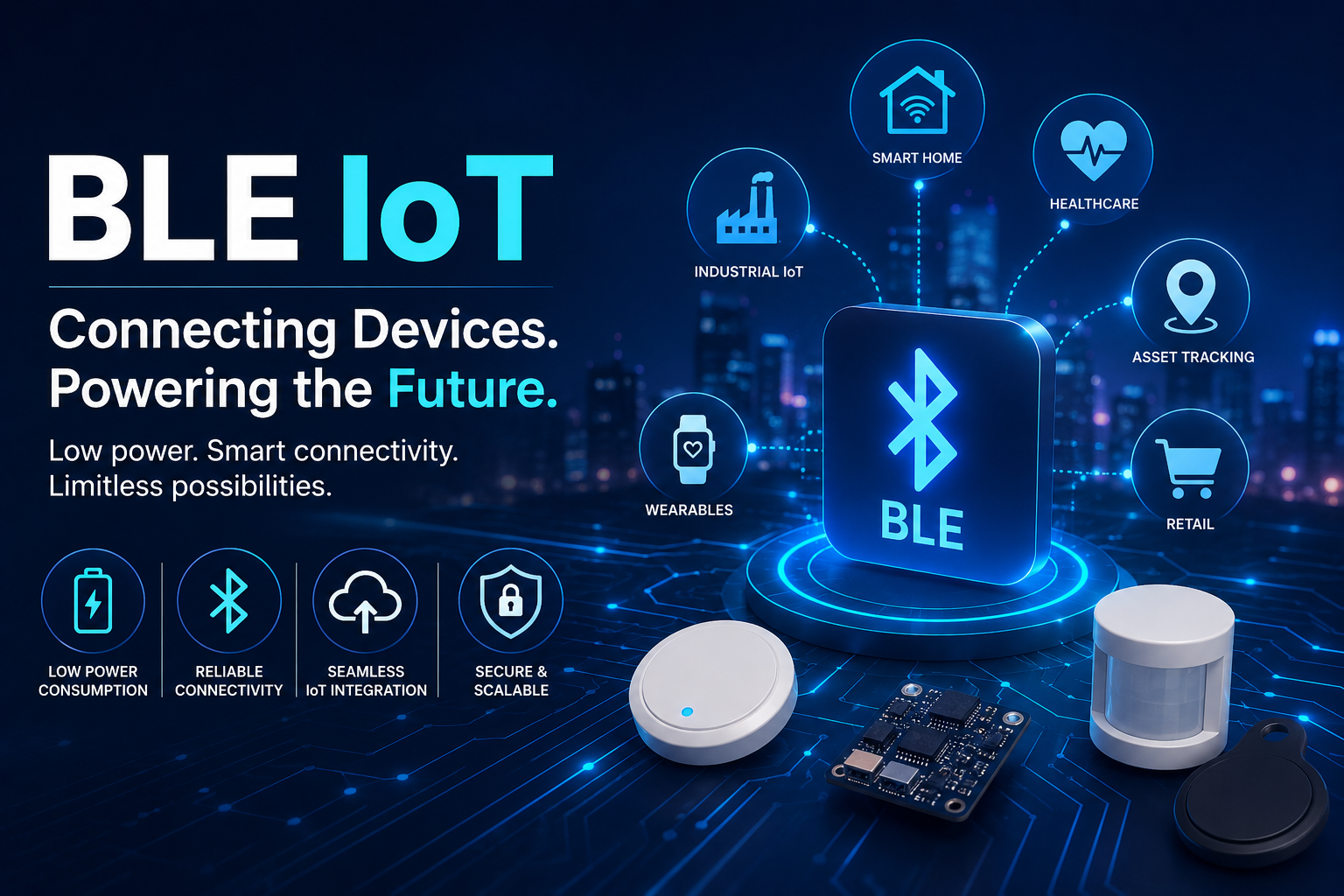
Bluetooth Low Energy (BLE) has become one of the most important wireless technologies for modern connected devices. As businesses increasingly adopt the Internet of Things (IoT), BLE is helping organizations connect sensors, devices, machines, and mobile applications while keeping power consumption low.
In 2026, BLE IoT solutions are moving beyond basic device connectivity. With cloud platforms, edge computing, artificial intelligence, mobile applications, and advanced sensors, BLE is becoming a powerful foundation for intelligent connected ecosystems.
What Is BLE IoT?
BLE IoT refers to the use of Bluetooth Low Energy technology within Internet of Things solutions.
BLE-enabled devices can collect information from their environment and communicate that data to smartphones, tablets, gateways, or embedded systems. The information can then be transferred to cloud platforms for monitoring, analytics, automation, and decision-making.
A typical BLE IoT solution may include:
- BLE-enabled sensors
- Smart devices and wearables
- BLE gateways
- Mobile applications
- Cloud platforms
- IoT dashboards
- APIs and backend systems
- AI and data analytics
This architecture allows businesses to build connected products that are efficient, scalable, and easier to manage.
Why BLE IoT Matters in 2026
IoT environments are becoming larger and more intelligent. Businesses need technologies that can connect thousands of devices without creating excessive power and maintenance requirements.
BLE provides several advantages for these deployments.
Low Energy Consumption
Many IoT devices operate using batteries. BLE is designed for low-power wireless communication, making it suitable for sensors and devices that need to operate for extended periods.
Lower energy consumption can also reduce maintenance requirements in large deployments.
Easy Mobile Integration
BLE is supported by modern smartphones and tablets, allowing mobile applications to communicate directly with compatible IoT devices.
This is particularly useful for consumer products, healthcare devices, smart accessories, and field-service applications.
Cost-Effective Hardware
BLE chipsets and modules are widely available, making BLE a practical option for connected products ranging from small sensors to sophisticated industrial equipment.
Flexible Connectivity
BLE devices can communicate with mobile devices, gateways, embedded systems, and other compatible platforms.
Businesses can therefore design architectures based on their specific application requirements.
How a BLE IoT Ecosystem Works
A BLE IoT solution generally follows a simple data flow.
1. Sensors Collect Information
BLE-enabled sensors collect information from physical environments.
Examples include:
- Temperature
- Humidity
- Motion
- Pressure
- Proximity
- Equipment status
- Location
- Battery level
2. BLE Transmits the Data
The collected information is transmitted using Bluetooth Low Energy.
Depending on the application, the receiving device may be a smartphone, tablet, gateway, or embedded controller.
3. Gateway or Application Handles Communication
A gateway can aggregate information from multiple BLE devices and transfer it to an IoT backend through Wi-Fi, Ethernet, cellular networks, or other connectivity technologies.
For mobile-based solutions, an application can act as the communication bridge between the BLE device and the cloud.
4. Cloud Platform Processes the Information
The backend can store and analyze sensor data and provide dashboards, alerts, reports, and automation features.
5. IoT Applications Turn Data into Action
Businesses can use the information to monitor operations, detect problems, optimize processes, and automate workflows.
Key BLE IoT Applications
BLE IoT technology is being adopted across many industries.
Smart Healthcare
Healthcare organizations can use BLE-enabled devices to collect and transmit information from connected equipment and wearable devices.
Potential applications include:
- Patient monitoring
- Fitness and wellness tracking
- Medical equipment connectivity
- Hospital asset monitoring
- Temperature monitoring
- Remote data collection
BLE can provide a convenient communication layer between devices and mobile or gateway-based systems.
Industrial IoT
Industrial environments contain large numbers of machines, tools, sensors, and assets.
BLE IoT solutions can help organizations monitor:
- Equipment conditions
- Temperature
- Vibration
- Asset movement
- Machine status
- Environmental conditions
When combined with analytics, sensor data can help identify potential equipment problems before they become major failures.
Smart Buildings
BLE sensors can contribute to intelligent building-management systems.
Applications may include:
- Occupancy monitoring
- Temperature monitoring
- Lighting automation
- Access control
- Indoor positioning
- Energy management
Connected building systems can use sensor data to improve operational efficiency and occupant experiences.
Retail and Customer Experiences
Retail businesses can use BLE beacons and sensors to create location-aware experiences.
Examples include:
- Indoor navigation
- Proximity notifications
- Customer engagement
- Asset tracking
- Store analytics
- Smart inventory solutions
BLE can help physical retail environments become more connected and data-driven.
Asset Tracking and Logistics
BLE tags can be attached to equipment, packages, tools, containers, and other assets.
BLE gateways placed throughout a facility can detect nearby devices and transfer information to centralized IoT systems.
This can help businesses understand where assets are located and improve inventory visibility.
Smart Homes
BLE IoT can also contribute to connected-home applications.
Sensors can monitor doors, windows, temperature, motion, lighting, and other environmental conditions.
BLE devices can communicate with smartphones or smart-home hubs, creating a foundation for automated home experiences.
BLE Beacons in IoT
BLE beacons are small devices that periodically transmit Bluetooth signals.
When integrated with IoT systems, beacons can support location-aware applications such as:
- Indoor navigation
- Proximity detection
- Asset monitoring
- Location-based automation
- Retail engagement
- Facility management
Beacon-based solutions can be particularly useful when businesses need to understand the location or proximity of people and assets.
BLE Mesh for Connected Environments
For larger deployments, Bluetooth Mesh can provide an additional networking approach.
Mesh networking allows compatible devices to communicate through a network of nodes rather than relying exclusively on a single direct connection.
This can make BLE Mesh useful for environments such as:
- Commercial buildings
- Smart lighting systems
- Industrial facilities
- Large sensor deployments
- Building automation
The right architecture depends on the number of devices, physical environment, communication requirements, and application design.
BLE IoT and Edge Computing
As IoT deployments become more sophisticated, edge computing is becoming increasingly important.
Instead of sending every sensor reading to the cloud, an edge gateway can process some information locally.
For example, a gateway monitoring industrial equipment could identify an abnormal temperature or vibration pattern and immediately generate an alert.
This can help improve:
- Response time
- Network efficiency
- Data processing
- Reliability
- Operational automation
Cloud computing and edge computing can therefore work together in a modern BLE IoT architecture.
BLE IoT and Artificial Intelligence
AI can add another layer of intelligence to BLE IoT systems.
BLE sensors can generate large volumes of real-world data. AI and machine-learning systems can analyze that information to identify patterns and anomalies.
Potential applications include:
- Predictive maintenance
- Anomaly detection
- Equipment monitoring
- Energy optimization
- Demand forecasting
- Automated alerts
For example, an industrial system could analyze historical sensor readings to identify patterns that often occur before equipment failure.
Security in BLE IoT
Security should be considered throughout the entire IoT ecosystem.
Important areas include:
- Device authentication
- Secure pairing
- Encryption
- Secure firmware updates
- API protection
- User authentication
- Access control
- Cloud security
- Device lifecycle management
A secure BLE IoT solution should protect not only wireless communication but also the connected application, gateway, APIs, databases, and cloud infrastructure.
Challenges of BLE IoT Development
While BLE offers significant benefits, developing a production-ready IoT solution can present several challenges.
Device Compatibility
Different BLE devices can use different services, characteristics, profiles, and communication approaches. Developers need to understand the hardware specifications before designing the integration.
Connection Reliability
Applications need to handle scanning, connections, disconnections, reconnection, background behavior, and device availability correctly.
Scalability
An architecture designed for a small prototype may not work efficiently when thousands of devices are deployed.
Scalability should therefore be considered from the beginning.
Data Management
Large IoT deployments can generate substantial volumes of sensor data. Efficient storage, processing, monitoring, and analytics become essential.
Security
Security vulnerabilities at the device, communication, application, or cloud level can affect the complete IoT ecosystem.
What Businesses Should Consider Before Building a BLE IoT Solution
Organizations planning a BLE IoT project should define their requirements before development begins.
Important considerations include:
- What devices need to communicate?
- How many devices will be deployed?
- What type of data will be collected?
- How frequently will devices transmit information?
- How long should the device battery last?
- Is a smartphone, gateway, or both required?
- Will the solution require cloud connectivity?
- What security requirements apply?
- How will devices be updated and maintained?
- How will the system scale in the future?
Answering these questions can help businesses select the right BLE hardware, communication architecture, mobile platform, gateway, and cloud infrastructure.
The Future of BLE IoT
The future of BLE IoT is closely connected with the growth of intelligent connected environments.
Emerging opportunities include:
- AI-powered IoT monitoring
- Smart healthcare systems
- Industrial predictive maintenance
- Connected retail
- Smart buildings
- Advanced asset tracking
- Indoor positioning
- Energy optimization
- Automated device management
As BLE hardware becomes more capable and IoT platforms become more intelligent, businesses can build increasingly sophisticated solutions while maintaining efficient wireless communication.
Conclusion
BLE IoT is becoming a key technology for connecting the physical world with intelligent digital systems.
Its low-power capabilities, broad device compatibility, mobile integration, and flexible architecture make it suitable for applications across healthcare, industrial IoT, retail, logistics, smart buildings, and consumer technology.
In 2026, the greatest opportunity is not simply connecting BLE devices. It is combining BLE + IoT + cloud + edge computing + mobile applications + AI to create intelligent systems that can monitor, analyze, and respond to real-world events.
Businesses investing in BLE IoT today can build a strong foundation for scalable connected products and smarter digital experiences in the years ahead.