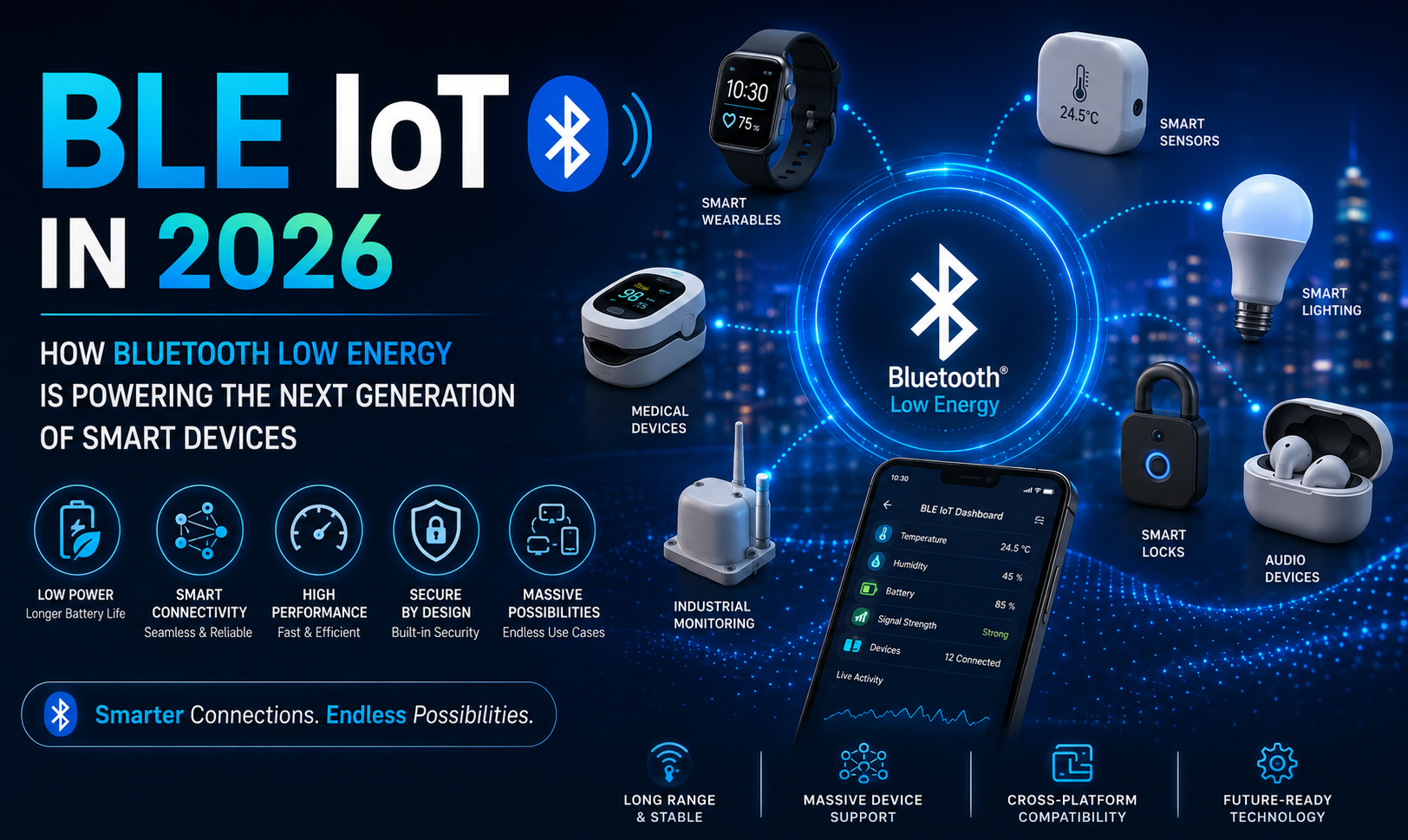
Bluetooth Low Energy (BLE) has become one of the most important technologies for building connected products. From smart wearables and healthcare devices to asset tracking, retail, industrial monitoring, and smart homes, BLE IoT solutions are helping businesses connect physical devices with mobile apps, cloud platforms, and intelligent software.
In 2026, the combination of BLE, IoT, edge computing, AI, and real-time data is creating new opportunities for companies developing connected products.
What Is BLE IoT?
BLE IoT combines Bluetooth Low Energy technology with Internet of Things architecture.
A BLE device can collect information from sensors and communicate with smartphones, gateways, computers, or other connected devices. The data can then be processed locally or transferred to cloud platforms for analytics, monitoring, and automation.
A typical BLE IoT ecosystem can include:
- BLE sensors
- Bluetooth-enabled devices
- Mobile applications
- BLE gateways
- Cloud platforms
- IoT dashboards
- APIs
- AI and analytics systems
The result is a connected environment where physical devices can communicate with digital applications efficiently.
Why BLE Is Important for IoT
One of BLE’s biggest advantages is its low power consumption.
Many IoT devices need to operate for months or even years using small batteries. BLE is designed for short-range wireless communication while consuming significantly less power than many traditional wireless technologies.
This makes BLE particularly useful for:
- Wearable devices
- Health and fitness trackers
- Smart locks
- Asset tracking
- Industrial sensors
- Retail beacons
- Smart home devices
- Environmental sensors
For businesses, BLE can provide an effective way to add wireless connectivity without dramatically increasing device power requirements.
BLE + IoT + AI: A Smarter Connected Ecosystem
The future of BLE IoT isn’t only about connecting devices.
It is about making those devices intelligent.
Consider an industrial sensor monitoring a machine.
A basic BLE solution might send temperature and vibration data to a mobile app.
A modern BLE IoT solution can take the same data and combine it with AI and analytics to identify unusual patterns and predict potential equipment problems.
This creates a powerful workflow:
BLE Sensor → Gateway → IoT Platform → AI Analysis → Automated Action
Businesses can use this architecture for predictive maintenance, anomaly detection, asset monitoring, and operational optimization.
BLE Gateways Are Connecting Devices to the Cloud
BLE devices often communicate within a relatively short range. That’s where BLE gateways become important.
A gateway can collect information from multiple BLE devices and forward it to an IoT platform through Wi-Fi, Ethernet, cellular connectivity, or another network.
For example:
Multiple BLE Sensors → BLE Gateway → Cloud → Dashboard
This architecture can support large deployments across factories, warehouses, hospitals, retail stores, and commercial buildings.
BLE IoT Applications in 2026
1. Smart Healthcare
BLE is widely suited to connected healthcare and wellness devices.
Potential applications include:
- Patient monitoring
- Wearable health devices
- Medical equipment tracking
- Fitness monitoring
- Medication-related reminders
- Hospital asset tracking
BLE connectivity allows devices to communicate with smartphones, tablets, gateways, and healthcare platforms.
2. Asset Tracking
Businesses often need to know where equipment, tools, inventory, or other assets are located.
BLE tags can communicate with strategically placed gateways or receivers to provide location and proximity information.
This can help businesses:
- Reduce lost equipment
- Monitor asset movement
- Improve inventory visibility
- Automate asset identification
- Reduce manual tracking
3. Smart Retail
Retail businesses can use BLE beacons and connected devices to create more interactive customer experiences.
BLE can support:
- Indoor positioning
- Proximity-based interactions
- Product information
- Customer engagement
- Inventory monitoring
- Smart checkout concepts
When integrated with mobile applications and backend systems, BLE can become part of a broader retail IoT ecosystem.
4. Industrial IoT
BLE is increasingly useful for industrial environments where wireless sensors can collect operational information.
Examples include:
- Machine monitoring
- Temperature sensing
- Equipment tracking
- Environmental monitoring
- Worker safety systems
- Predictive maintenance
BLE can be particularly valuable where installing wired sensors across large facilities would be expensive or difficult.
5. Smart Homes
Smart locks, sensors, lighting controllers, security devices, and other connected products can use BLE for local communication and device setup.
BLE can also complement Wi-Fi and other wireless technologies instead of replacing them.
BLE IoT and Edge Computing
Sending every piece of sensor data directly to the cloud isn’t always necessary.
With edge computing, some processing can happen closer to the BLE devices.
For example:
BLE Sensor → Edge Gateway → Local Analysis → Cloud
A gateway could identify an abnormal reading locally and immediately trigger an alert.
This can provide:
- Lower latency
- Reduced cloud traffic
- Faster responses
- Better reliability
- More efficient data processing
For time-sensitive IoT applications, edge processing can make a significant difference.
Security Should Be Part of BLE IoT Development
Connecting a device to the internet also introduces security considerations.
A secure BLE IoT architecture should consider:
- Device authentication
- Secure pairing
- Data encryption
- Access control
- Secure firmware updates
- API security
- Cloud security
- Device lifecycle management
Security shouldn’t be treated as something to add after development. It should be considered from the architecture and hardware stages through deployment and maintenance.
Challenges in BLE IoT Development
Building a reliable BLE IoT product involves more than simply connecting a Bluetooth device to an application.
Developers need to consider:
Device Compatibility
Different smartphones, operating systems, chipsets, and BLE implementations can behave differently.
Connection Reliability
BLE applications need to handle connection drops, reconnection, interference, and changing device conditions.
Battery Optimization
Poorly designed communication patterns can drain battery quickly.
Scalability
A prototype working with five devices may behave very differently when deployed with thousands of devices.
Data Management
Large IoT deployments can generate enormous quantities of sensor data that need efficient processing and storage.
Security
Devices, applications, gateways, APIs, and cloud infrastructure all need appropriate protection.
The Future of BLE IoT
BLE IoT is moving toward increasingly intelligent and automated systems.
Future solutions will combine:
BLE + Sensors + Edge Computing + AI + Cloud + Mobile Apps
Instead of simply collecting sensor information, connected products will increasingly be able to interpret data, identify patterns, and initiate actions automatically.
This opens opportunities across healthcare, manufacturing, logistics, retail, fitness, smart homes, agriculture, and enterprise technology.
Conclusion
BLE IoT is becoming a powerful foundation for modern connected products.
Its low-power wireless communication, broad device ecosystem, and ability to work alongside gateways, mobile applications, cloud platforms, and AI make BLE a practical technology for many IoT applications.
For businesses building connected products in 2026, the goal shouldn’t simply be to create a device that communicates.
The goal should be to build a complete ecosystem where:
Devices collect data.
BLE connects them.
IoT platforms understand them.
AI finds intelligence in the data.
And software turns that intelligence into action.
That is where the next generation of BLE IoT solutions is heading.
SEO Keywords
Primary Keywords: BLE IoT, BLE IoT solutions, BLE IoT development, Bluetooth Low Energy IoT
Secondary Keywords: BLE development, Bluetooth IoT, BLE application development, BLE gateway, BLE sensors, IoT development, Bluetooth Low Energy development, smart connected devices, industrial IoT, BLE wearable development
Long-Tail Keywords: BLE IoT development company, Bluetooth Low Energy IoT solutions, custom BLE IoT development, BLE gateway development, BLE IoT application development, BLE solutions for smart devices, Bluetooth Low Energy IoT applications