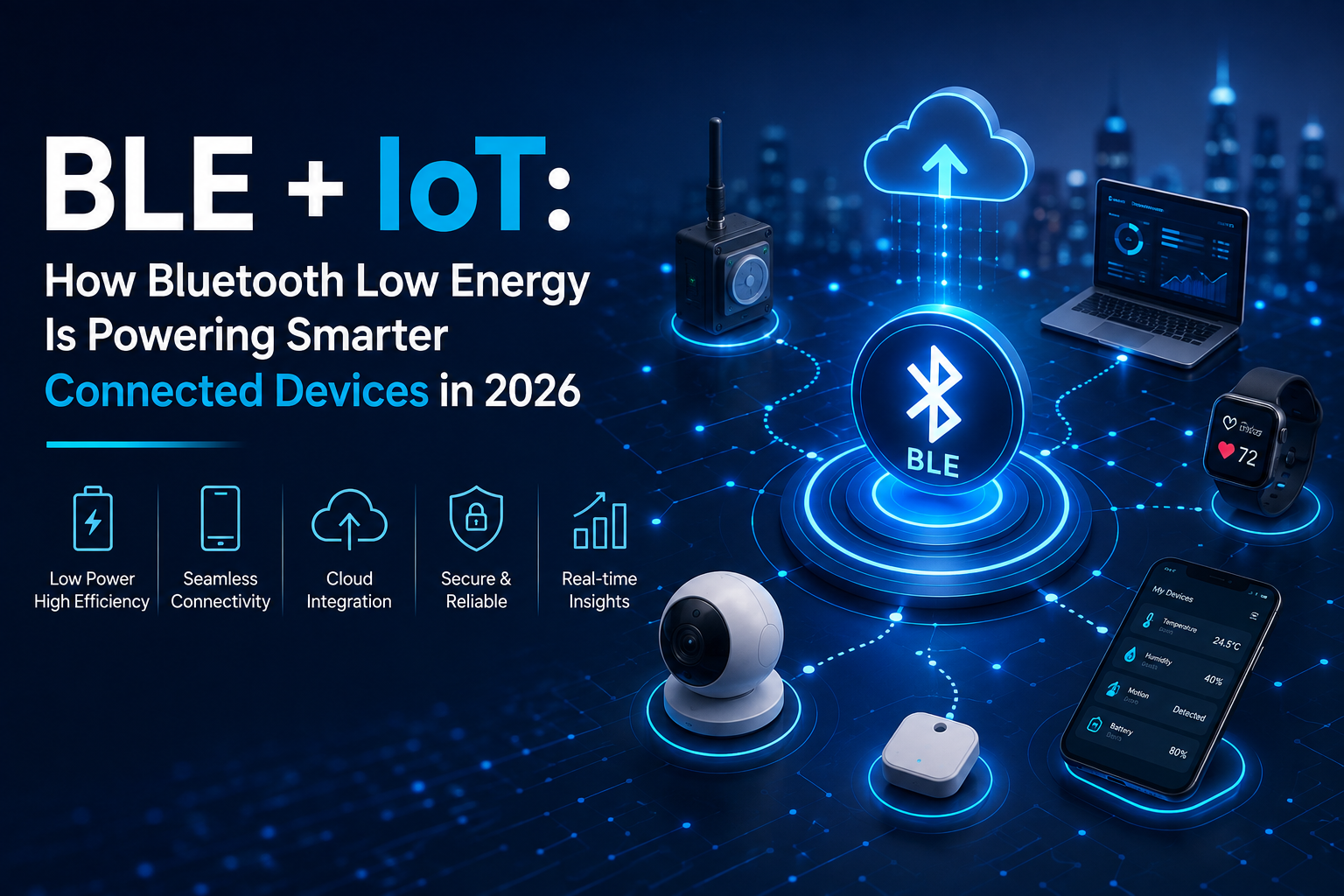
The Internet of Things is changing how devices communicate, collect information, and support everyday activities. From smart watches and fitness trackers to industrial sensors, connected healthcare devices, smart retail systems, and intelligent buildings, IoT technology is creating a more connected world.
But connected devices need a communication technology that is reliable, energy-efficient, affordable, and suitable for small hardware.
That is where Bluetooth Low Energy (BLE) plays an important role.
BLE allows devices to exchange information while using significantly less power than many traditional wireless communication methods. This makes it especially useful for battery-powered devices that need to operate for months—or sometimes years—without frequent charging or battery replacement.
In 2026, BLE is no longer limited to simple wireless accessories. When combined with IoT, cloud platforms, mobile applications, artificial intelligence, and real-time analytics, BLE can support intelligent connected ecosystems across multiple industries.
At BLEIoT, we help businesses turn connected-device ideas into practical, scalable, and user-friendly digital solutions.
What Is Bluetooth Low Energy?
Bluetooth Low Energy, commonly known as BLE, is a wireless communication technology designed for low-power data exchange.
BLE is commonly used when a device needs to:
- Send small amounts of data
- Consume minimal battery power
- Communicate with nearby smartphones, tablets, gateways, or other connected devices
- Operate efficiently for long periods
- Support fast device discovery and connection
BLE is different from traditional Bluetooth because it is optimized for energy-efficient communication rather than continuous, high-bandwidth data transfer.
For example, a BLE temperature sensor may wake up, send a temperature reading, and return to a low-power state. Because the device is not continuously transmitting large amounts of information, it can conserve battery power.
Why BLE Is Important for IoT
IoT devices are often small, battery-powered, and deployed in locations where frequent maintenance is difficult.
A wireless technology used in these devices must balance:
- Power consumption
- Communication speed
- Device size
- Hardware cost
- Reliability
- Security
- Scalability
BLE provides a strong combination of these capabilities.
A typical BLE IoT ecosystem may include:
BLE Sensor → Mobile App or IoT Gateway → Cloud Platform → Analytics Dashboard
For example:
- A BLE sensor collects temperature data.
- The sensor sends the information to a nearby gateway.
- The gateway transfers the data to a cloud platform.
- The cloud platform stores and analyzes the information.
- A dashboard displays real-time data.
- The system sends an alert if the temperature crosses a defined limit.
This simple communication flow can support applications in healthcare, logistics, manufacturing, retail, smart buildings, and many other industries.
Key Benefits of BLE IoT Solutions
1. Low Power Consumption
Energy efficiency is one of BLE’s biggest advantages.
BLE devices can remain in low-power modes and activate only when they need to send or receive information. This helps extend battery life and reduces maintenance requirements.
2. Smartphone Compatibility
Most modern smartphones support Bluetooth Low Energy.
This allows businesses to build connected products without requiring users to purchase a separate communication device in every situation.
A mobile app can connect with a BLE device to:
- Read sensor data
- Send commands
- Display device status
- Update settings
- Receive notifications
- Support device onboarding
3. Cost-Effective Hardware
BLE can be integrated into compact and cost-effective hardware designs.
This makes it suitable for products ranging from consumer wearables to enterprise IoT sensors.
4. Fast Device Discovery
BLE devices can broadcast information that allows nearby applications or gateways to discover them quickly.
This is useful for:
- Asset tracking
- Proximity detection
- Smart retail
- Indoor navigation
- Location-aware experiences
5. Flexible Connectivity
BLE can support different communication approaches depending on the application.
Devices may communicate with:
- Smartphones
- Tablets
- Dedicated gateways
- Industrial systems
- Other BLE-enabled devices
6. Scalable Connected Ecosystems
BLE can be part of a larger IoT architecture that includes cloud services, APIs, dashboards, analytics platforms, and enterprise software.
Real-World Applications of BLE IoT
Smart Healthcare
BLE-enabled healthcare devices can help collect and transmit health-related information.
Potential applications include:
- Connected medical devices
- Patient monitoring systems
- Wearable health devices
- Medication reminders
- Hospital asset tracking
- Smart healthcare alerts
Healthcare solutions must be designed with strong privacy, security, regulatory, and clinical requirements.
Wearables and Fitness Devices
Many wearable products use BLE to communicate with mobile applications.
Examples include:
- Fitness trackers
- Smart watches
- Sleep-monitoring devices
- Smart clothing
- Sports performance sensors
BLE allows these devices to share information while helping preserve battery life.
Smart Homes
BLE can support connected home experiences such as:
- Smart locks
- Lighting controls
- Environmental sensors
- Smart appliances
- Home automation systems
- Proximity-based actions
A smartphone can act as a control interface for multiple connected devices.
Industrial IoT
Industrial environments use connected sensors to improve visibility and operational efficiency.
BLE IoT applications may include:
- Equipment monitoring
- Predictive maintenance
- Worker safety systems
- Asset tracking
- Environmental monitoring
- Inventory visibility
When sensor data is connected to analytics platforms, businesses can identify patterns and respond to operational issues more quickly.
Smart Retail
Retail businesses can use BLE technology to create more connected customer and operational experiences.
Examples include:
- BLE beacons
- Proximity-based promotions
- Smart inventory systems
- In-store navigation
- Customer engagement
- Connected POS environments
BLE can help connect physical spaces with mobile applications and digital business systems.
Logistics and Asset Tracking
BLE tags and sensors can help businesses monitor assets and improve operational visibility.
Potential use cases include:
- Warehouse asset tracking
- Equipment monitoring
- Package identification
- Inventory management
- Cold-chain monitoring
- Proximity alerts
BLE Beacons: Connecting Physical Spaces with Digital Experiences
A BLE beacon is a small wireless device that broadcasts a signal to nearby smartphones or compatible receivers.
The beacon can help an application understand that a user or device is near a specific location.
For example, a retail application may detect a beacon near a product section and display relevant information inside the mobile app.
BLE beacons can support:
- Indoor navigation
- Location-based notifications
- Museum guides
- Event experiences
- Retail engagement
- Smart building systems
- Workplace automation
BLE beacons usually provide proximity information rather than precise GPS-style location data.
BLE IoT Architecture
A successful BLE IoT solution requires more than a Bluetooth connection.
A complete architecture may include:
BLE Hardware
The physical device may include sensors, processors, batteries, BLE chips, and other electronic components.
Firmware
Firmware controls how the device collects information, manages power, communicates, and responds to commands.
Mobile Application
A mobile application can help users connect with the device, view information, update settings, and receive notifications.
IoT Gateway
A gateway can receive BLE information and transfer it to cloud systems when direct internet connectivity is not available.
Cloud Platform
Cloud services can store device information, manage users, process data, and support remote access.
Web Dashboard
Businesses may use dashboards to monitor devices, analyze trends, manage users, and view operational insights.
AI and Analytics
AI can help identify patterns, detect unusual activity, predict future conditions, and generate useful recommendations.
BLE IoT and Artificial Intelligence
BLE devices can generate valuable real-world information.
AI can help transform this information into actionable insights.
For example, an industrial BLE sensor may collect:
- Temperature
- Vibration
- Equipment usage
- Operating time
An AI system can analyze the data and identify patterns that may indicate a future equipment issue.
The system could then notify a maintenance team before a major failure occurs.
This combination supports:
- Predictive maintenance
- Anomaly detection
- Intelligent alerts
- Demand forecasting
- Automated recommendations
- Operational optimization
BLE collects information from the physical world, while AI helps businesses understand what the information means.
Security Considerations for BLE IoT
Connected devices should be designed with security from the beginning.
Important security practices may include:
- Secure device pairing
- Authentication
- Data encryption
- Secure firmware updates
- Access control
- Device identity management
- API security
- Regular security testing
Security requirements depend on the device, industry, data type, and business use case.
A consumer fitness device and a connected healthcare system may require very different security and compliance approaches.
Challenges in BLE IoT Development
BLE IoT development involves both software and hardware considerations.
Common challenges include:
Device Compatibility
Different smartphones, operating systems, BLE chipsets, and hardware configurations may behave differently.
Connection Stability
Applications must handle connection interruptions, device movement, signal interference, and reconnection workflows.
Battery Optimization
Developers need to balance communication frequency, data requirements, and power consumption.
Data Synchronization
The system should manage situations where a device temporarily loses connectivity and later reconnects.
Scalability
A solution that works with ten devices may require a different architecture when supporting thousands of devices.
Security
Connected devices can create additional security risks if authentication, encryption, updates, and access controls are not properly designed.
How BLEIoT Builds Connected Solutions
At BLEIoT, we help businesses develop connected products from concept to deployment.
Our services can include:
- BLE Application Development
- Custom BLE Software Development
- BLE Mobile App Development
- BLE Device Integration
- BLE Beacon Applications
- IoT Application Development
- IoT Dashboard Development
- Cloud Integration
- Embedded Software and Firmware Support
- AI-Powered IoT Solutions
- Custom Web Application Development
- Device Testing and Optimization
Our development process focuses on understanding the complete product ecosystem—not only the Bluetooth connection.
We consider:
- Business requirements
- Device functionality
- Hardware capabilities
- Mobile application requirements
- Cloud architecture
- Data management
- Security
- Scalability
- User experience
- Long-term maintenance
The Future of BLE IoT
The future of connected technology will involve more intelligent, energy-efficient, and interoperable devices.
BLE is expected to continue supporting innovations in:
- Smart healthcare
- Wearable technology
- Industrial automation
- Smart buildings
- Connected retail
- Asset tracking
- Intelligent transportation
- AI-powered IoT systems
As connected devices become more capable, businesses will need technology partners who understand the relationship between hardware, Bluetooth communication, mobile applications, cloud platforms, and intelligent analytics.
Conclusion
Bluetooth Low Energy is helping businesses build connected products that are efficient, scalable, and practical.
Its low-power communication capabilities make it suitable for wearables, sensors, smart devices, industrial systems, healthcare applications, retail solutions, and many other IoT use cases.
When BLE is combined with mobile applications, cloud technology, IoT platforms, and artificial intelligence, it can create intelligent systems that connect the physical and digital worlds.
BLEIoT helps businesses design and develop connected solutions that are built around real operational needs and long-term growth.
Have a BLE or IoT product idea? Connect with BLEIoT to build a secure, scalable, and intelligent connected-device solution.