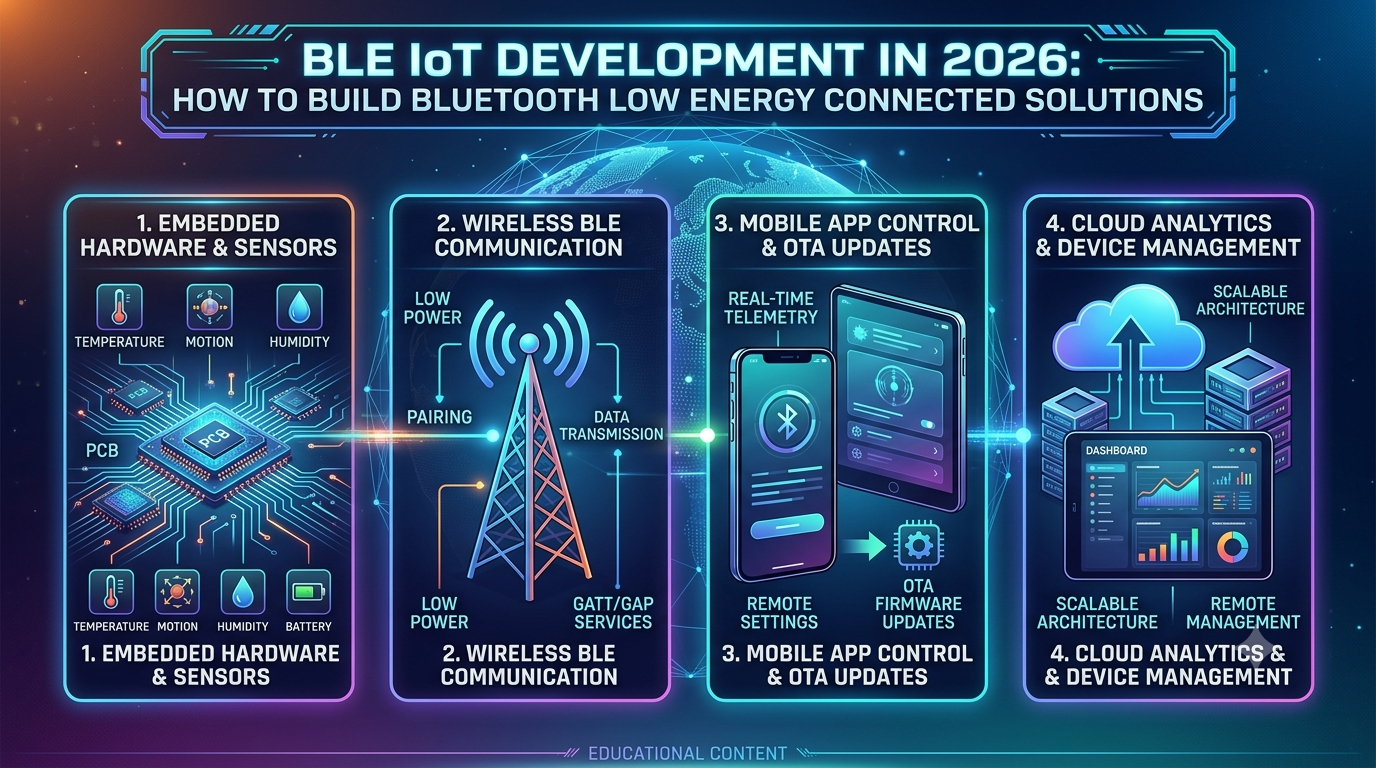
Bluetooth Low Energy (BLE) has become an important connectivity technology for modern Internet of Things (IoT) products. Its combination of low power consumption, wireless communication, smartphone compatibility, and flexible device connectivity makes BLE useful across healthcare, industrial automation, retail, logistics, fitness, smart home, and consumer electronics applications.
Businesses developing connected products often combine BLE IoT development with mobile applications, cloud platforms, gateways, sensors, and real-time analytics.
A typical BLE IoT ecosystem can connect physical devices with software systems through a communication path such as:
BLE Device → Smartphone or Gateway → Cloud Platform → IoT Application → Business Dashboard
This article explains how BLE IoT development works in 2026, its architecture, use cases, development process, security considerations, costs, and the technologies businesses should consider when building connected products.
What Is BLE IoT Development?
BLE IoT development is the process of building connected devices and software solutions that use Bluetooth Low Energy to communicate between sensors, embedded devices, smartphones, gateways, and other systems.
A BLE IoT solution can include:
- BLE sensors
- Embedded devices
- BLE beacons
- Wearables
- Mobile applications
- IoT gateways
- Cloud platforms
- APIs
- Web dashboards
- Databases
- Analytics systems
The exact architecture depends on the product and how the device needs to communicate.
What Is Bluetooth Low Energy?
Bluetooth Low Energy is a wireless technology designed for applications where power efficiency is important.
Compared with traditional Bluetooth use cases, BLE is particularly suited to devices that need to operate for long periods using small batteries.
BLE can be used for communication between:
- Sensors
- Smartphones
- Tablets
- Wearables
- Industrial equipment
- Medical devices
- Tracking tags
- Smart appliances
- IoT gateways
For many IoT products, BLE provides the local wireless connection while another device or gateway provides internet connectivity.
How Does a BLE IoT System Work?
A basic BLE IoT system can operate as follows:
Step 1: Device Collects Data
Sensors collect information from the physical environment.
For example:
- Temperature
- Humidity
- Pressure
- Motion
- Light
- Battery level
- Equipment status
Step 2: BLE Transfers the Data
The device uses BLE to communicate the information to a compatible smartphone, gateway, or other BLE central device.
Step 3: Mobile App or Gateway Processes the Data
A mobile application or IoT gateway can receive the information and perform local processing.
Step 4: Data Goes to the Cloud
The application or gateway sends relevant information to the cloud using an internet connection.
Step 5: Users Access the Data
Users can access device information through a mobile application or web dashboard.
The architecture can therefore look like:
Sensor → BLE Device → Mobile App/Gateway → API → Cloud → Dashboard
Key Components of BLE IoT Development
Building a complete BLE IoT solution requires more than Bluetooth programming.
1. BLE Hardware
The physical device may contain:
- Microcontroller
- BLE chipset
- Sensors
- Battery
- Power-management components
- Antenna
- Memory
- Other electronic components
Hardware selection should consider power consumption, communication range, processing requirements, physical size, and operating environment.
2. Embedded Firmware
Firmware controls the device and manages communication between the hardware components and BLE stack.
Firmware may handle:
- Sensor readings
- BLE advertising
- BLE connections
- Data processing
- Power management
- Device configuration
- Error handling
- Firmware updates
Efficient firmware can be particularly important for battery-powered products.
3. BLE Services and Characteristics
BLE communication commonly uses the Generic Attribute Profile (GATT).
A device can expose:
- Services
- Characteristics
- Descriptors
Characteristics can support operations such as:
- Read
- Write
- Notify
- Indicate
Developers can create custom BLE services and characteristics based on the product requirements.
BLE IoT Mobile App Development
A mobile application can serve as the interface between the user and BLE device.
A BLE-enabled application may provide:
- Device discovery
- Pairing
- Device configuration
- Sensor readings
- Real-time monitoring
- Device control
- Notifications
- User accounts
- Data synchronization
- Firmware update functionality
For example, a connected health device could use a smartphone application to receive measurements from a BLE sensor and securely transmit selected information to a cloud platform.
BLE IoT Gateway Development
An IoT gateway can connect local BLE devices with cloud infrastructure.
A typical architecture is:
Multiple BLE Devices → BLE Gateway → Internet → Cloud Platform
A gateway can provide:
- BLE device discovery
- Data aggregation
- Local processing
- Protocol conversion
- Cloud communication
- Device management
- Security controls
Gateways can be particularly useful when many BLE devices are deployed in a location such as a warehouse, factory, hospital, or retail environment.
BLE Beacon Development
BLE beacons are small wireless devices that broadcast signals that compatible devices can detect.
Beacon-based solutions can support applications such as:
- Indoor positioning
- Proximity detection
- Asset tracking
- Retail engagement
- Equipment monitoring
- Location-aware applications
A business can deploy multiple beacons and combine them with mobile applications or gateways to create a larger IoT solution.
BLE IoT Use Cases
BLE can support a wide range of IoT applications.
Healthcare IoT
BLE can connect:
- Wearable health devices
- Medical sensors
- Patient-monitoring devices
- Fitness equipment
- Healthcare accessories
Healthcare applications require careful attention to privacy, security, and applicable regulatory requirements.
Industrial IoT
Industrial BLE solutions can help monitor:
- Machines
- Equipment
- Sensors
- Temperature
- Vibration
- Maintenance conditions