Connected products are becoming smarter, smaller, and more power-efficient. From wearable devices and smart sensors to industrial monitoring systems, asset trackers, healthcare devices, and smart-building solutions, businesses are looking for reliable wireless technologies that can connect physical products with mobile applications and cloud platforms.
Bluetooth Low Energy (BLE) has become an important technology for these applications because it is designed for low-power wireless communication and works across a broad ecosystem of smartphones, embedded devices, gateways, and sensors.
In 2026, BLE IoT development is moving beyond simple device-to-phone communication. Modern solutions increasingly combine BLE connectivity, embedded firmware, mobile apps, gateways, cloud platforms, edge computing, analytics, and intelligent automation.
What Is BLE IoT?
BLE IoT refers to connected products and systems that use Bluetooth Low Energy as part of their communication architecture.
A typical BLE IoT ecosystem can include:
BLE Device → Sensor → Smartphone/Gateway → Cloud → Analytics → Business Application
For example, a smart sensor can collect temperature data, transmit it through BLE to a gateway, send the information to a cloud platform, and display the results through a web dashboard.
This architecture can be adapted for many industries and use cases.
Why Businesses Are Using BLE for IoT
IoT devices are often expected to operate for long periods while using limited battery power.
BLE is well suited to many of these scenarios because it supports low-power wireless communication and can connect devices with smartphones, tablets, computers, and dedicated gateways.
Important benefits include:
- Low-power communication
- Wireless connectivity
- Smartphone compatibility
- Compact device designs
- Sensor integration
- Flexible communication architecture
- Support for proximity-based applications
- Scalable connected-device ecosystems
For battery-powered products, power consumption is often one of the most important design considerations.
BLE IoT Architecture
A reliable BLE IoT product usually involves multiple technology layers.
1. Connected Hardware
The hardware may contain:
- BLE chipset
- Microcontroller
- Sensors
- Battery
- Memory
- Antenna
- Actuators
- Display
- Power-management components
Hardware selection affects the device’s battery life, connectivity, processing capabilities, physical size, and cost.
2. Embedded Firmware
Firmware controls how the device operates and communicates.
BLE firmware can manage:
- Advertising
- Scanning
- BLE connections
- GATT services
- Sensor readings
- Device configuration
- Power management
- Security
- Firmware updates
Efficient firmware is essential when the product needs to operate for months or years on battery power.
3. Mobile Application
Smartphones can act as a convenient interface between BLE devices and users.
A BLE-enabled mobile application can provide:
- Device discovery
- Pairing
- Configuration
- Sensor monitoring
- Device control
- User authentication
- Data visualization
- Cloud synchronization
Both iOS and Android applications can be developed around the requirements of the connected product.
4. IoT Gateway
For larger deployments, a dedicated gateway can collect data from multiple BLE devices.
The gateway can then transmit information to a cloud or enterprise system using technologies such as Wi-Fi, Ethernet, cellular connectivity, or other network protocols.
This approach is useful for industrial environments, warehouses, smart buildings, healthcare facilities, and large sensor deployments.
5. Cloud Platform
Cloud infrastructure can provide centralized:
- Data storage
- Device management
- Analytics
- Alerts
- Dashboards
- User management
- API access
- Remote monitoring
The result is a complete connected-device ecosystem rather than an isolated Bluetooth product.
BLE GATT and Custom Services
The Generic Attribute Profile (GATT) is an important part of BLE application development.
GATT organizes the information exchanged between BLE devices through services and characteristics.
A smart environmental sensor, for example, might have custom characteristics for:
- Temperature
- Humidity
- Battery level
- Device status
- Sensor configuration
- Alert conditions
Custom GATT services allow developers to design BLE communication around the specific requirements of a product.
BLE IoT and Battery Optimization
Battery life can determine whether an IoT product is commercially practical.
A BLE IoT development team needs to consider communication frequency, sensor sampling, processing requirements, and sleep modes.
Important optimization techniques can include:
Efficient Advertising
The advertising interval can be configured according to the application’s discovery requirements.
Connection Optimization
Connection parameters can be adjusted to balance responsiveness and power consumption.
Sensor Management
Sensors do not necessarily need to operate continuously. Sampling strategies can be designed around the actual business requirement.
Sleep Modes
Devices can enter low-power states when active communication or processing is not required.
Local Processing
Processing selected information locally can sometimes reduce the amount of data transmitted wirelessly.
BLE IoT Security
Security should be designed into the product from the beginning.
A connected device may communicate with smartphones, gateways, cloud systems, and enterprise applications. Weak security at any point can create risks across the entire ecosystem.
A BLE IoT solution can incorporate:
- Secure pairing
- Authentication
- Encryption
- Device identity
- Access control
- Secure provisioning
- Protected APIs
- Secure firmware updates
- Key management
Security requirements should be evaluated across the entire architecture rather than treating BLE security as an isolated feature.
OTA Firmware Updates for BLE Devices
Connected products may remain in the field for several years.
If a firmware problem is discovered after deployment, physically collecting every device for an update may be expensive.
Over-the-air (OTA) updates can allow manufacturers to distribute firmware updates remotely.
OTA functionality can support:
- Bug fixes
- Security patches
- Performance improvements
- New features
- Device optimization
A production-ready OTA system should also consider firmware integrity, authentication, interrupted transfers, version compatibility, and recovery procedures.
BLE IoT Use Cases
Smart Wearables
Fitness trackers, smartwatches, smart rings, and other wearable products can use BLE to communicate with smartphones and other connected devices.
Healthcare Devices
BLE can connect sensors and monitoring devices with mobile applications and backend systems.
Depending on the product, healthcare applications may also require additional regulatory, privacy, and security considerations.
Industrial Sensors
Industrial BLE sensors can monitor:
- Temperature
- Pressure
- Vibration
- Humidity
- Equipment status
- Environmental conditions
Data can then be transferred to gateways and enterprise platforms.
Asset Tracking
BLE tags can help organizations monitor equipment, inventory, tools, and other physical assets.
Combined with suitable gateway or positioning technologies, BLE can become part of a larger asset-tracking architecture.
Smart Buildings
BLE IoT technology can support:
- Occupancy sensing
- Smart access
- Environmental monitoring
- Energy management
- Facility automation
- Location-aware services
Retail
BLE-enabled devices can support connected retail applications such as smart shelves, asset monitoring, customer experiences, and inventory-related solutions.
Smart Home Devices
BLE can be used for device configuration, local control, provisioning, and communication within smart-home ecosystems.
BLE IoT and Edge Computing
Not every piece of IoT data needs to travel directly to the cloud.
An edge gateway can process information closer to the physical device.
A typical architecture can look like:
BLE Sensor → Edge Gateway → Local Processing → Cloud → Dashboard
This can help applications that require faster responses or need to reduce unnecessary cloud communication.
Edge processing can also support local alerts and automation when continuous cloud connectivity is unavailable.
BLE IoT and AI
Artificial intelligence is increasingly being incorporated into connected-device systems.
BLE devices can collect data from sensors while edge or cloud platforms analyze that information.
For example:
BLE Sensor → Data Collection → Edge/Cloud AI → Analysis → Alert or Automated Action
Potential applications include:
- Predictive maintenance
- Anomaly detection
- Equipment monitoring
- Health and fitness insights
- Energy optimization
- Smart-building automation
The BLE layer provides connectivity, while AI can add intelligence to the collected data.
Challenges in BLE IoT Development
Building a BLE IoT product involves more than implementing Bluetooth communication.
Hardware Compatibility
The selected BLE chipset, sensors, antenna, battery, and enclosure need to work together effectively.
Mobile Compatibility
BLE behavior can vary across mobile operating systems and devices, making real-device testing important.
Battery Life
Frequent communication, sensor activity, and processing can significantly affect battery performance.
Connectivity
Physical obstacles, radio interference, device density, and distance can influence BLE performance.
Security
Security must cover the device, firmware, mobile application, gateway, APIs, and cloud platform.
Scalability
A prototype that works with ten devices may require a different architecture when deployed across thousands of devices.
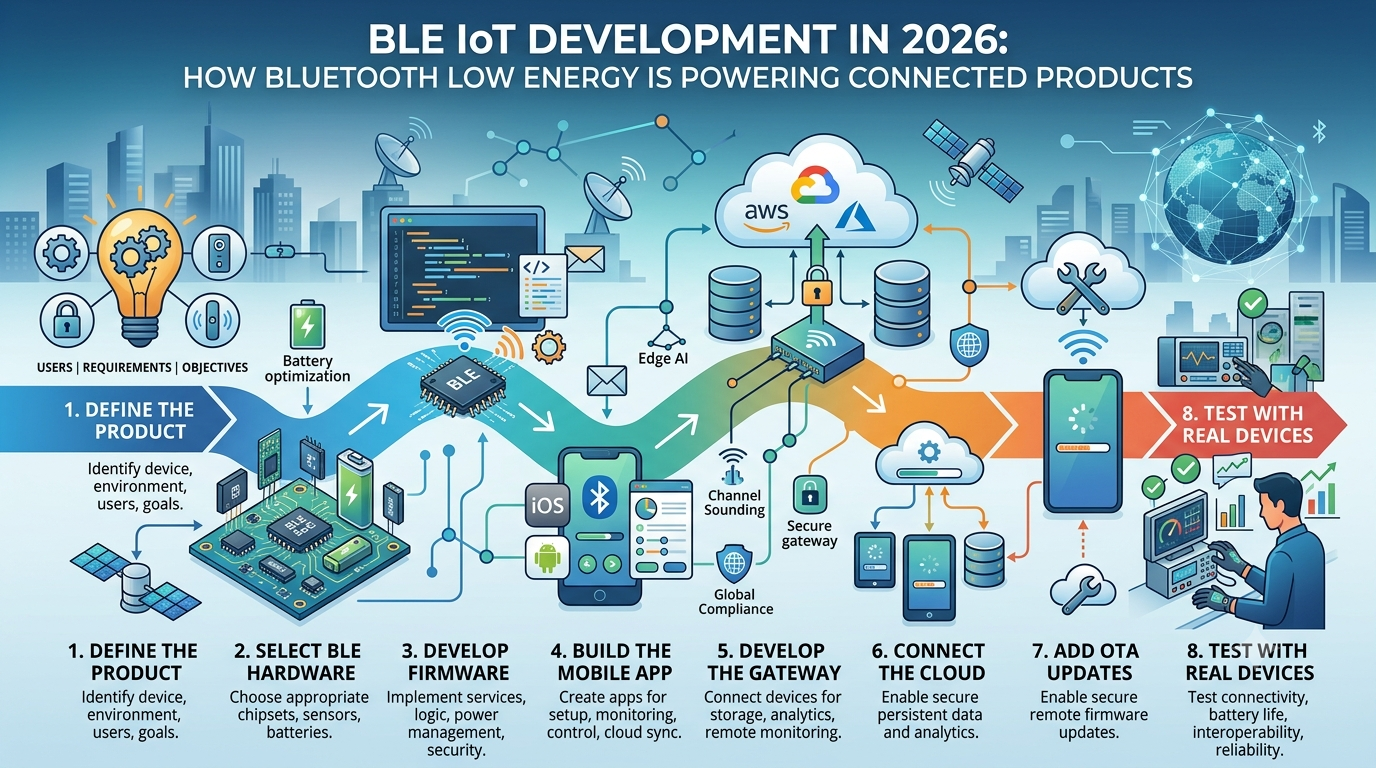
How to Build a BLE IoT Product
A structured development process can reduce technical problems during deployment.
Step 1: Define the Product
Identify the target users, sensors, environment, connectivity requirements, battery expectations, and business objectives.
Step 2: Select BLE Hardware
Choose the appropriate chipset, microcontroller, sensors, antenna, battery, and supporting components.
Step 3: Develop Firmware
Implement BLE communication, GATT services, sensor functionality, power management, security, and device logic.
Step 4: Build the Mobile App
Develop iOS and Android applications for device discovery, configuration, monitoring, and control when a mobile interface is required.
Step 5: Develop the Gateway
For larger deployments, build or integrate a gateway capable of receiving BLE data and forwarding it to the appropriate backend.
Step 6: Connect the Cloud
Implement APIs, databases, dashboards, device management, analytics, and notifications.
Step 7: Add OTA Updates
Create a secure mechanism for maintaining devices after deployment.
Step 8: Test With Real Devices
Testing should cover:
- Battery consumption
- BLE range
- Connection reliability
- Mobile compatibility
- Firmware stability
- Security
- Gateway performance
- Cloud communication
Why Choose BLE IoT Development Services?
BLE IoT products require expertise across multiple technical areas.
A development team may need experience with:
- Bluetooth Low Energy
- Embedded systems
- Firmware development
- Custom GATT
- BLE hardware integration
- iOS BLE development
- Android BLE development
- IoT gateways
- Cloud platforms
- APIs
- OTA firmware updates
- Security
- Device testing
Working with a team that understands the complete architecture can help businesses move from a BLE prototype to a production-ready IoT product.
The Future of BLE IoT
BLE is continuing to evolve as connected-device requirements become more advanced.
Future BLE IoT systems will increasingly combine:
BLE + Sensors + Edge Computing + AI + Cloud + Automation
This combination can support connected products that do more than transmit information. They can collect data, understand conditions, trigger actions, and provide real-time insights.
Applications such as smart buildings, industrial monitoring, wearables, asset tracking, healthcare technology, and connected consumer products can all benefit from this evolution.
Conclusion
BLE IoT development in 2026 is about creating complete connected ecosystems rather than simply adding Bluetooth connectivity to a device.
A successful product can require coordinated development across hardware, BLE firmware, GATT services, mobile applications, gateways, cloud platforms, security, OTA updates, and analytics.
Whether you’re developing a wearable, industrial sensor, asset tracker, smart-building product, healthcare device, or connected consumer product, BLE can provide an efficient foundation for wireless IoT connectivity.
Build Your BLE IoT Solution
Looking to develop a connected BLE product from concept to production?
A specialized BLE IoT development team can help with hardware integration, embedded firmware, custom BLE services, mobile applications, IoT gateways, cloud connectivity, security, OTA updates, and device management.