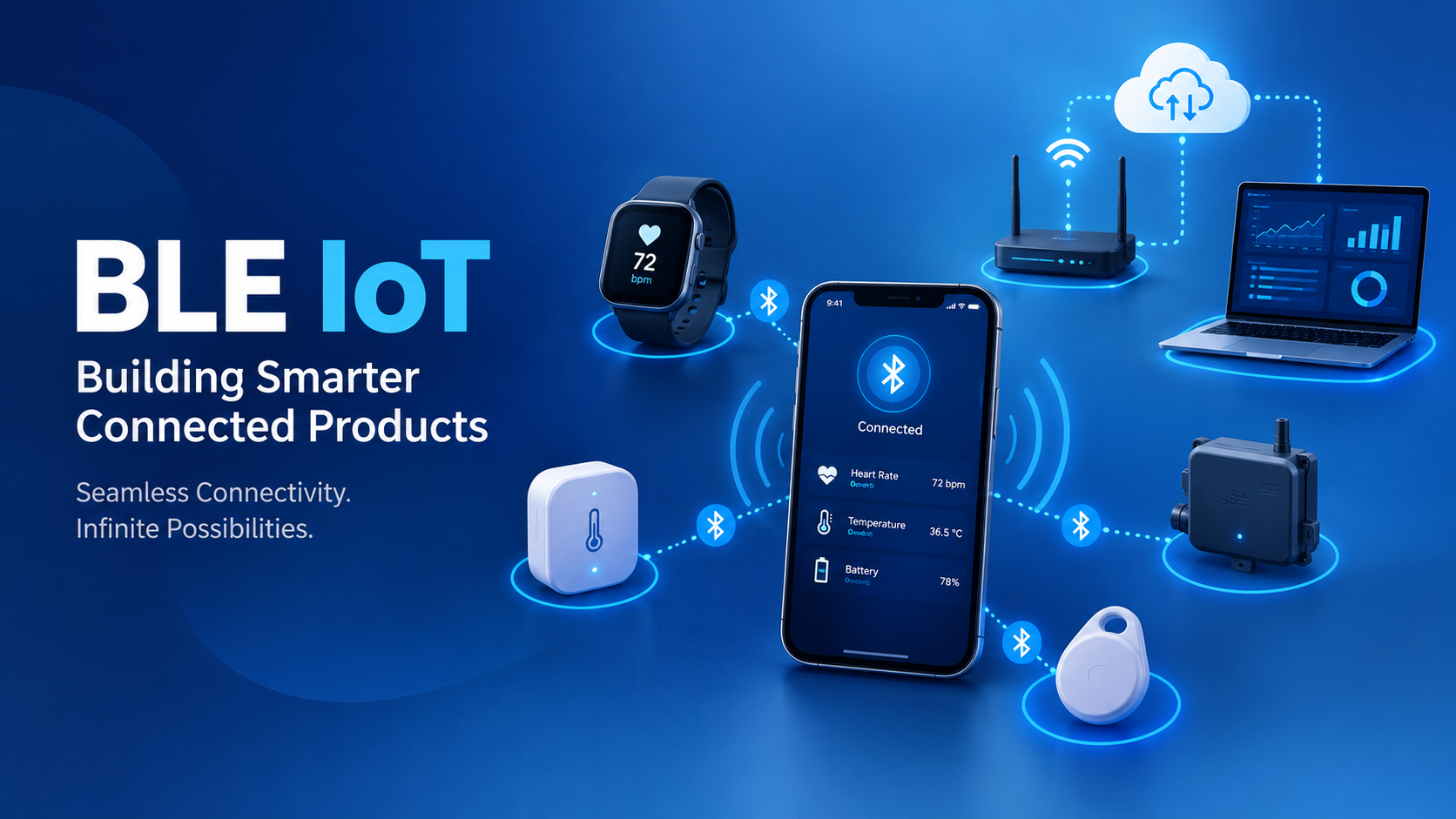
Bluetooth Low Energy (BLE) and the Internet of Things (IoT) are playing an increasingly important role in the development of connected products. In 2026, businesses are using BLE IoT technology to connect sensors, mobile applications, smart devices, gateways, and cloud platforms.
From healthcare and asset tracking to smart buildings and industrial automation, BLE IoT enables businesses to collect real-time data while maintaining low power consumption and flexible connectivity.
What Is BLE IoT?
BLE IoT combines Bluetooth Low Energy technology with IoT systems to enable wireless communication between connected devices and digital platforms.
A typical BLE IoT ecosystem can include:
- BLE sensors and devices
- Mobile applications
- IoT gateways
- Cloud platforms
- APIs
- Web dashboards
- Data analytics systems
BLE devices can collect information from sensors and transmit it to a smartphone or gateway. The data can then be processed, stored, analyzed, and displayed through an IoT platform.
Why BLE Is Important for IoT in 2026
Battery efficiency is one of the biggest requirements for many IoT devices. BLE is designed for low-power wireless communication, making it suitable for devices that need to operate for long periods on batteries.
Businesses can use BLE IoT to create products that offer:
- Low-power connectivity
- Wireless device communication
- Smartphone compatibility
- Flexible data exchange
- Cost-effective device integration
- Scalable IoT architectures
Key BLE IoT Applications
1. Healthcare and Wearable Devices
BLE is widely suitable for connected healthcare and wearable applications where small devices need to communicate with smartphones or gateways.
Potential applications include:
- Fitness trackers
- Wearable health devices
- Patient monitoring
- Medical sensors
- Temperature monitoring
- Healthcare asset tracking
Data collected by BLE devices can be transmitted to mobile or cloud applications for monitoring and analysis.
2. Asset Tracking
BLE beacons and tags can help businesses monitor the location and status of assets.
Organizations can track:
- Equipment
- Inventory
- Tools
- Vehicles
- Medical equipment
- Warehouse assets
When integrated with gateways and cloud platforms, BLE tracking can provide centralized visibility across business operations.
3. Smart Buildings
BLE IoT technology can support connected building environments.
Applications include:
- Smart access control
- Indoor positioning
- Occupancy monitoring
- Smart lighting
- Environmental sensors
- Room management
These technologies can help organizations create more efficient and connected workplaces.
4. Industrial IoT
Manufacturing and industrial organizations can use BLE sensors to collect data from equipment and production environments.
Sensors can monitor parameters such as:
- Temperature
- Vibration
- Pressure
- Humidity
- Equipment status
This information can support predictive maintenance and operational monitoring.
5. Retail and Customer Engagement
Retail businesses can use BLE technology to create proximity-based experiences and improve store operations.
Possible applications include:
- Indoor navigation
- Product information
- Customer engagement
- Inventory monitoring
- Location-based experiences
- Smart retail systems
BLE IoT and Mobile Applications
Mobile applications are an important component of many BLE IoT products.
A BLE-enabled mobile application can:
- Discover nearby devices
- Establish a BLE connection
- Exchange data
- Configure connected devices
- Display sensor information
- Send information to cloud platforms
Developers need to carefully handle permissions, connection stability, background operation, device compatibility, and battery usage.
BLE IoT Cloud Integration
For larger IoT deployments, BLE devices often need to communicate with cloud platforms.
A common architecture is:
BLE Device → Smartphone/Gateway → API → Cloud → Dashboard
This architecture allows businesses to collect data from connected devices and make it available for monitoring, analytics, alerts, and automation.
APIs can also connect BLE IoT platforms with existing enterprise applications and business systems.
BLE IoT Security
Security is a critical part of connected-device development.
A BLE IoT solution should consider:
- Secure device pairing
- Authentication
- Encryption
- Secure APIs
- Access control
- Device authorization
- Secure firmware updates
- Cloud security
Security requirements should be planned during the architecture and development stages.
Challenges in BLE IoT Development
Although BLE offers many advantages, developing a reliable BLE IoT product can involve several challenges.
Device Compatibility
Different BLE devices and chipsets can behave differently, requiring extensive testing.
Connection Stability
Applications need to handle connection drops, reconnection, device discovery, and communication failures.
Battery Optimization
BLE communication must be designed carefully to maximize battery life.
Mobile OS Restrictions
iOS and Android have different Bluetooth permissions, background behavior, and operating-system restrictions.
Scalability
An IoT system designed for a few devices may require a different architecture when scaled to thousands or millions of devices.
BLE IoT and AI
The combination of BLE IoT and artificial intelligence can create more intelligent connected systems.
BLE sensors can collect real-world data, while AI systems can analyze that information to identify patterns and support automated decisions.
For example, sensor data from industrial equipment can be analyzed to detect unusual behavior and help predict maintenance requirements.
This creates a powerful ecosystem:
BLE Sensors + IoT Platform + AI Analytics = Intelligent Connected Products
Benefits of BLE IoT for Businesses
Organizations can use BLE IoT to achieve several business benefits:
- Reduced manual monitoring
- Lower device power consumption
- Real-time data collection
- Better asset visibility
- Improved operational efficiency
- Remote monitoring
- Automated alerts
- Better customer experiences
- Scalable connected-product solutions
Why Choose BLEIoT for BLE IoT Development?
Building a production-ready BLE IoT solution requires expertise across wireless communication, mobile applications, device integration, APIs, cloud infrastructure, and security.
BLEIoT focuses on helping businesses develop customized BLE and IoT solutions for connected products and applications.
Whether you are building a wearable device, industrial sensor system, asset-tracking solution, smart building application, or connected consumer product, a customized BLE IoT architecture can help turn your concept into a scalable solution.
Future of BLE IoT
BLE IoT is expected to continue expanding as businesses demand smaller, smarter, and more energy-efficient connected devices.
Future solutions will increasingly combine BLE with:
- Artificial intelligence
- Edge computing
- Cloud platforms
- Advanced analytics
- Smart sensors
- Real-time monitoring
- Automated decision-making
The focus will move beyond simple connectivity toward intelligent ecosystems where connected devices can collect information, analyze conditions, and trigger automated actions.
Conclusion
BLE IoT provides businesses with a practical way to build low-power, connected products and applications. Its compatibility with smartphones, flexible wireless communication, and integration with cloud and IoT platforms make it suitable for a wide range of industries.
In 2026, companies looking to develop connected products should consider the complete ecosystem—from BLE hardware and mobile applications to APIs, cloud infrastructure, security, analytics, and scalability.
With the right technology architecture and development expertise, BLE IoT can help businesses create smarter products, improve operational efficiency, and deliver innovative connected experiences.