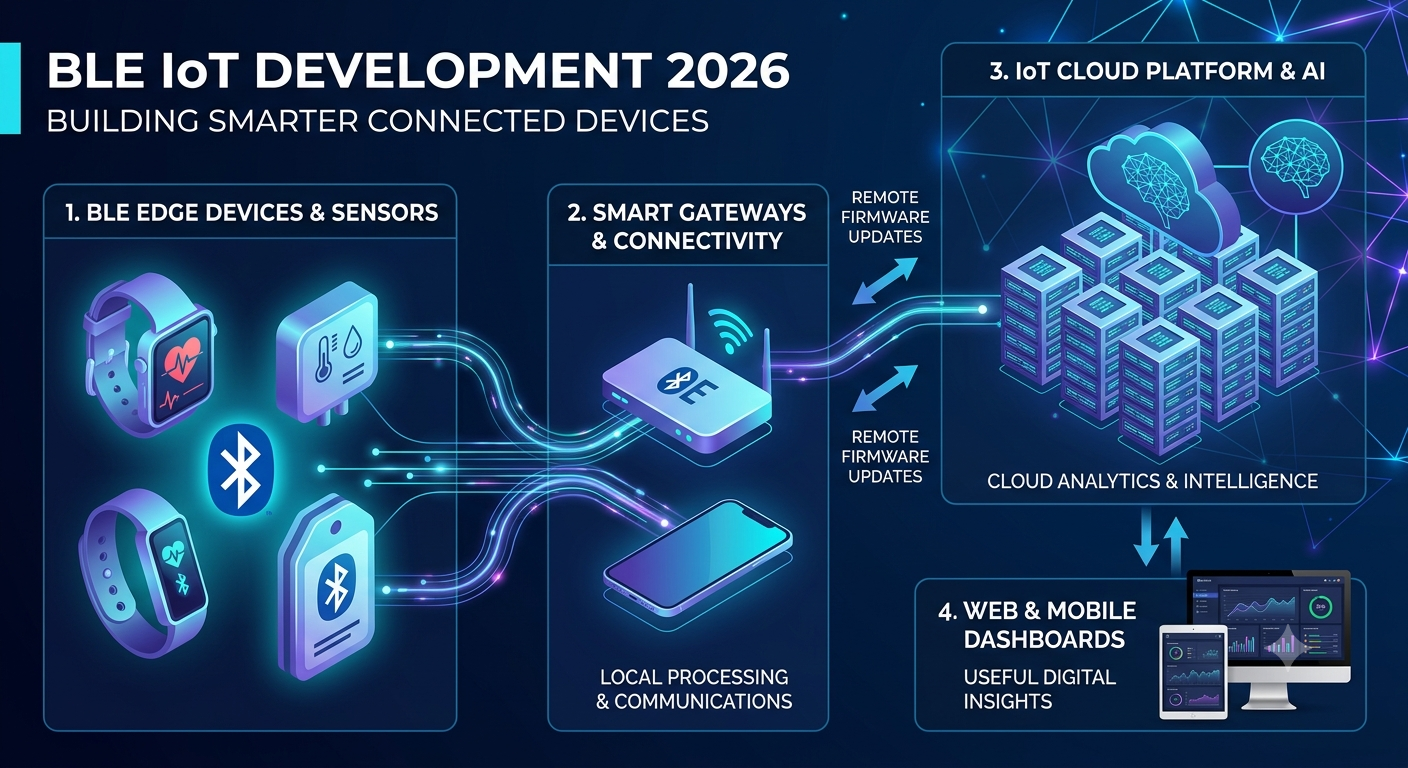
Bluetooth Low Energy (BLE) has become an important connectivity technology for modern Internet of Things (IoT) solutions. From wearable devices and healthcare sensors to smart buildings, retail systems, industrial equipment, and asset tracking, BLE enables connected products to communicate efficiently while consuming very little power.
As businesses invest in connected products, BLE IoT development is increasingly being used to build scalable solutions that combine Bluetooth devices, mobile applications, gateways, cloud platforms, and real-time analytics.
For companies developing connected products in 2026, choosing the right BLE architecture can help improve device performance, battery life, security, and user experience.
What Is BLE IoT Development?
BLE IoT development involves creating IoT solutions that use Bluetooth Low Energy to connect sensors, devices, smartphones, gateways, and cloud platforms.
Unlike traditional Bluetooth applications that are often designed for continuous data communication, BLE is optimized for low-power communication and short data exchanges.
A typical BLE IoT ecosystem can include:
- BLE sensors
- Bluetooth-enabled devices
- Mobile applications
- BLE gateways
- IoT cloud platforms
- APIs
- Databases
- Web dashboards
- Analytics systems
- AI-powered monitoring tools
This architecture allows businesses to collect data from physical devices and convert it into useful digital insights.
Why Bluetooth Low Energy Is Important for IoT
Battery consumption is one of the biggest challenges in IoT product development. Many connected devices need to operate for months or even years without frequent battery replacement.
BLE addresses this requirement through low-power wireless communication.
Key benefits include:
Low Power Consumption
BLE devices can communicate while consuming significantly less power than many traditional wireless technologies, making BLE suitable for battery-powered IoT products.
Easy Smartphone Connectivity
Modern smartphones support BLE, allowing businesses to develop mobile applications that communicate directly with connected devices.
Cost-Effective Hardware
BLE modules and chipsets are widely available, making them practical for many consumer and commercial IoT products.
Flexible Device Communication
BLE can support sensors, beacons, trackers, wearables, medical devices, industrial equipment, and other connected products.
Scalable IoT Architecture
BLE devices can communicate with mobile applications or gateways that transfer data to cloud platforms for centralized monitoring and analytics.
How a BLE IoT System Works
A BLE IoT solution generally follows a connected data flow:
BLE Device → Mobile App/Gateway → Internet → Cloud Platform → Dashboard/Analytics
For example, a temperature sensor can collect environmental information and transmit it using BLE.
A nearby gateway receives the information and sends it to a cloud platform. The cloud application can then process the data and display real-time information on a web or mobile dashboard.
This architecture can be customized depending on the product requirements.
Key Components of BLE IoT Solutions
1. BLE Devices and Sensors
The physical device is the foundation of a BLE IoT ecosystem.
Examples include:
- Temperature sensors
- Fitness trackers
- Smart locks
- Asset trackers
- Medical sensors
- Industrial sensors
- Smart meters
- Beacons
- Wearable devices
2. BLE Mobile Applications
A mobile application can act as a communication interface between BLE devices and users.
A BLE mobile app can provide features such as:
- Device discovery
- Device pairing
- Configuration
- Sensor data visualization
- Device control
- Firmware updates
- Notifications
- User authentication
3. BLE Gateways
BLE gateways are useful when IoT devices need to communicate with cloud systems without relying directly on a smartphone.
A gateway can collect data from multiple BLE devices and transmit it to a remote server through Wi-Fi, Ethernet, cellular connectivity, or another network.
4. IoT Cloud Platform
The cloud layer stores and processes information generated by connected devices.
It may include:
- Device management
- Data storage
- APIs
- User management
- Analytics
- Alerts
- Remote monitoring
- Reporting
5. Web and Mobile Dashboards
Dashboards convert raw sensor information into useful business insights.
For example, an industrial dashboard could display equipment status, temperature, battery levels, alerts, and historical sensor data.
BLE IoT Development Process
Developing a connected BLE IoT product requires coordination between hardware, firmware, mobile applications, backend systems, and cloud infrastructure.
Step 1: Define the Product Requirements
The first step is understanding what the device needs to measure, monitor, control, or communicate.
Important considerations include:
- Device type
- Sensors
- Communication range
- Battery requirements
- Data frequency
- User experience
- Security requirements
- Cloud requirements
Step 2: Select BLE Hardware
The appropriate BLE chipset, module, sensors, and microcontroller must be selected based on the product’s requirements.
Hardware selection can affect:
- Battery life
- Communication range
- Processing performance
- Manufacturing cost
- Device size
Step 3: Develop BLE Firmware
Firmware controls how the device communicates and operates.
BLE firmware development can include:
- GATT services
- Characteristics
- Data transmission
- Device configuration
- Power management
- Security
- Firmware updates
Step 4: Build the Mobile Application
The mobile application can connect to the BLE device and provide users with an interface for configuration, monitoring, and control.
Applications can be developed for both iOS and Android depending on the target audience.
Step 5: Develop the IoT Backend
The backend manages communication between devices, applications, databases, and cloud services.
A scalable backend can support thousands or millions of device interactions depending on the architecture.
Step 6: Integrate Cloud Services
Cloud integration allows businesses to store device data, monitor connected products, generate reports, and create automated workflows.
Step 7: Testing and Deployment
BLE IoT products should