Introduction
Connected devices are rapidly changing how businesses operate. From wearable technology and healthcare devices to smart retail systems, industrial sensors, and asset-tracking solutions, businesses are investing in technologies that connect physical devices with digital applications.
Bluetooth Low Energy (BLE) has become one of the most useful technologies for building these connected ecosystems. When combined with Internet of Things (IoT) platforms, mobile applications, cloud services, and AI, BLE can help businesses create efficient, scalable, and intelligent connected solutions.
In 2026, BLE IoT development is moving beyond basic device connectivity. Businesses are increasingly looking for complete solutions that can collect real-time data, analyze information, automate processes, and provide better user experiences.
What Is BLE IoT?
BLE IoT refers to the integration of Bluetooth Low Energy technology with Internet of Things systems.
BLE enables nearby devices and sensors to communicate using low-power wireless connectivity. IoT platforms then provide the infrastructure required to collect, transmit, store, monitor, and analyze that data.
A typical BLE IoT ecosystem may include:
- BLE sensors
- Smart devices
- Mobile applications
- BLE gateways
- Cloud platforms
- APIs
- Databases
- Analytics dashboards
- AI-powered services
Together, these components create a connected environment where devices can communicate with applications and cloud platforms.
Why BLE Is Important for IoT Applications
One of the biggest advantages of BLE is its low power consumption.
Many IoT devices operate using batteries and may need to function for months or even years without frequent maintenance. BLE can provide efficient short-range communication for these devices.
Other advantages include:
- Low energy consumption
- Wireless connectivity
- Smartphone compatibility
- Flexible device communication
- Low hardware cost
- Fast device discovery
- Support for sensors and wearables
- Easy integration with mobile applications
These characteristics make BLE suitable for a wide range of IoT applications.
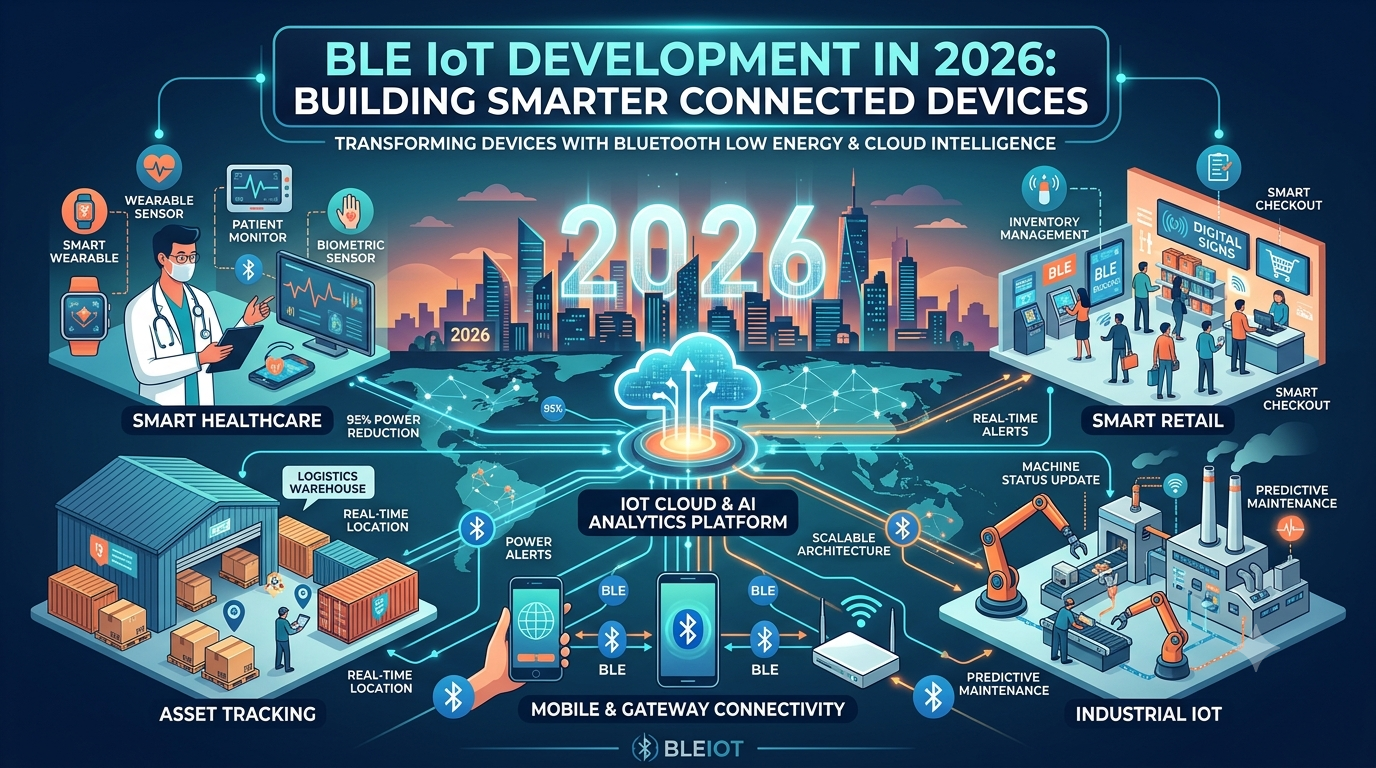
How BLE IoT Architecture Works
A BLE IoT solution generally consists of several layers.
1. BLE Device Layer
Sensors and connected devices collect information from the physical environment.
Examples include:
- Temperature sensors
- Motion sensors
- Heart-rate devices
- Asset tags
- Smart locks
- Wearables
2. Gateway or Mobile Layer
A smartphone, tablet, BLE gateway, or edge device receives information from BLE devices.
The gateway can then forward the data to the cloud.
3. IoT Cloud Layer
The cloud platform stores and processes device data.
It can provide:
- Device management
- Data storage
- APIs
- User management
- Monitoring
- Analytics
4. Application Layer
Mobile and web applications allow users to monitor devices, view information, and control connected equipment.
5. Intelligence Layer
AI and analytics can be added to identify patterns, detect anomalies, generate predictions, and automate business processes.
The complete ecosystem can therefore look like:
BLE Device → Mobile/Gateway → IoT Cloud → Analytics/AI → Business Application
Major BLE IoT Applications in 2026
Healthcare and Medical Devices
BLE IoT is increasingly useful for connected healthcare products.
Potential applications include:
- Patient monitoring
- Wearable health devices
- Fitness tracking
- Medical sensors
- Remote monitoring
- Connected diagnostic equipment
BLE can allow healthcare devices to communicate with smartphones or dedicated gateways while consuming relatively little power.
Smart Wearables
Smartwatches, fitness trackers, and other wearable products commonly rely on Bluetooth connectivity.
BLE IoT applications can collect information such as:
- Activity
- Movement
- Heart rate
- Sleep patterns
- Device status
- Environmental information
This data can then be synchronized with mobile applications and cloud platforms.
Asset Tracking
BLE tags can help businesses monitor the location and status of valuable assets.
Industries that can benefit include:
- Logistics
- Warehousing
- Healthcare
- Manufacturing
- Retail
- Construction
BLE-based asset tracking can improve visibility and reduce the risk of misplaced equipment.
Smart Retail
Retailers can use BLE beacons, sensors, and connected applications to create smarter stores.
Possible applications include:
- Indoor navigation
- Proximity-based notifications
- Customer engagement
- Inventory monitoring
- Product tracking
- Smart checkout
- Store analytics
BLE data can also be combined with other IoT information to provide a more complete view of store operations.
Industrial IoT
Manufacturing companies can use BLE sensors to collect information from machines and equipment.
Applications may monitor:
- Temperature
- Vibration
- Equipment status
- Machine utilization
- Environmental conditions
IoT platforms can analyze this information and help businesses identify operational problems.
Smart Buildings
BLE IoT technology can also support smart building applications.
Examples include:
- Smart access control
- Occupancy monitoring
- Energy management
- Indoor positioning
- Smart lighting
- Environmental monitoring
Connected systems can help organizations improve both operational efficiency and user experiences.
BLE IoT and Mobile App Development
Mobile applications are an important part of many BLE IoT ecosystems.
A mobile application can discover nearby BLE devices, connect to them, read and write BLE characteristics, process sensor data, and synchronize information with cloud services.
A well-designed BLE application should handle:
- Device discovery
- Pairing and connection
- Reconnection
- Background communication
- Data synchronization
- Bluetooth permissions
- Error handling
- Battery optimization
- Secure communication
This is why BLE IoT development requires knowledge of both wireless communication and application development.
BLE IoT and AI
The combination of BLE, IoT, and AI can create more intelligent connected systems.
For example, sensors can continuously collect equipment data through BLE. The IoT platform can store the information, while AI algorithms analyze it to identify unusual patterns.
This can support:
- Predictive maintenance
- Anomaly detection
- Automated alerts
- Predictive analytics
- Smart recommendations
- Process optimization
Instead of simply collecting data, businesses can use connected systems to turn data into actionable insights.
Security in BLE IoT Development
Security should be included throughout the development lifecycle.
Important areas include:
Device Authentication
Only authorized devices should be able to communicate with the system.
Encryption
Sensitive information should be protected while being transferred and stored.
API Security
Cloud APIs should use appropriate authentication and authorization mechanisms.
Access Control
Users should only have access to the devices and information they are authorized to manage.
Secure Firmware Updates
Connected devices should support secure update mechanisms to address vulnerabilities.
Data Privacy
Businesses should carefully manage personal and sensitive information collected by connected devices.
Challenges of BLE IoT Development
Despite its benefits, BLE IoT development can involve several technical challenges.
Device Compatibility
Different BLE devices can use different profiles, services, and characteristics.
Connection Reliability
Applications must handle signal loss, interference, device disconnections, and reconnection scenarios.
Battery Optimization
Frequent communication can consume additional power, so communication patterns need to be optimized.
Cross-Platform Development
BLE behavior can vary between Android and iOS devices, requiring careful testing.
Scalability
An IoT platform needs to support increasing numbers of devices, users, and data points.
Security
Connected devices create additional entry points that need to be secured.
How to Build a Successful BLE IoT Solution
A structured development process can help businesses reduce technical risks.
Step 1: Define the Business Requirement
Start by identifying the exact problem the solution needs to solve.
Step 2: Select BLE Hardware
Choose appropriate sensors, modules, tags, gateways, or connected devices.
Step 3: Design the Connectivity Architecture
Determine how BLE devices will communicate with smartphones, gateways, and cloud platforms.
Step 4: Develop the Mobile or Web Application
Create an interface for monitoring, managing, and controlling connected devices.
Step 5: Build the IoT Backend
Develop APIs, databases, cloud infrastructure, and device-management services.
Step 6: Add Analytics or AI
Introduce analytics and AI capabilities where they provide measurable business value.
Step 7: Test the Complete Ecosystem
Test devices, applications, connectivity, security, performance, battery usage, and scalability before deployment.
Why Businesses Need Experienced BLE IoT Developers
A successful BLE IoT product involves much more than Bluetooth connectivity.
The complete solution may require expertise in:
- BLE development
- IoT architecture
- Mobile app development
- Cloud development
- API integration
- Embedded systems
- Data analytics
- Cybersecurity
- Device management
Working with an experienced development team can help businesses build a more reliable and scalable connected ecosystem.
Why Choose BLEIoT for Connected Solutions?
BLEIoT focuses on helping businesses develop connected technology solutions using BLE, Bluetooth, IoT, mobile applications, cloud platforms, and smart devices.
From BLE-enabled mobile applications to complete IoT ecosystems, the right development approach can help businesses turn connected-device concepts into commercially viable products.
Solutions can be designed for:
- Healthcare
- Wearables
- Retail
- Logistics
- Manufacturing
- Asset tracking
- Smart buildings
- Consumer electronics
- Industrial applications
The Future of BLE IoT
The future of BLE IoT will be driven by the growing demand for connected, automated, and data-driven systems.
BLE will continue to provide efficient short-range connectivity, while IoT platforms will manage devices and data at scale.
The integration of BLE + IoT + AI + Cloud will enable businesses to build applications that can monitor real-world environments, understand data, and automate decisions.
As connected devices become more common, businesses that invest in scalable and secure IoT architecture will be better positioned to develop future-ready products.
Conclusion
BLE IoT development is becoming an important part of the connected technology landscape in 2026.
BLE provides efficient low-power communication, while IoT platforms provide connectivity, data management, monitoring, and scalability. Mobile applications make these systems accessible to users, and AI can transform collected data into actionable insights.
Whether you are developing a wearable, healthcare device, asset-tracking system, smart retail platform, or industrial IoT solution, the right BLE IoT architecture can help create a reliable and scalable product.
BLEIoT can help businesses transform connected-device ideas into modern BLE and IoT solutions designed for real-world applications.
Suggested SEO Keywords
Primary Keywords:
BLE IoT development, BLE IoT solutions, BLE development, IoT development
Secondary Keywords:
BLE IoT application development, Bluetooth Low Energy IoT, BLE app development, IoT app development, BLE integration, Bluetooth IoT solutions, connected device development, BLE IoT developers
Suggested Meta Title:
BLE IoT Development in 2026: Smarter Connected Devices
Suggested Meta Description:
Explore BLE IoT development in 2026, including applications, architecture, benefits, security, AI integration, and how businesses can build scalable connected-device solutions.