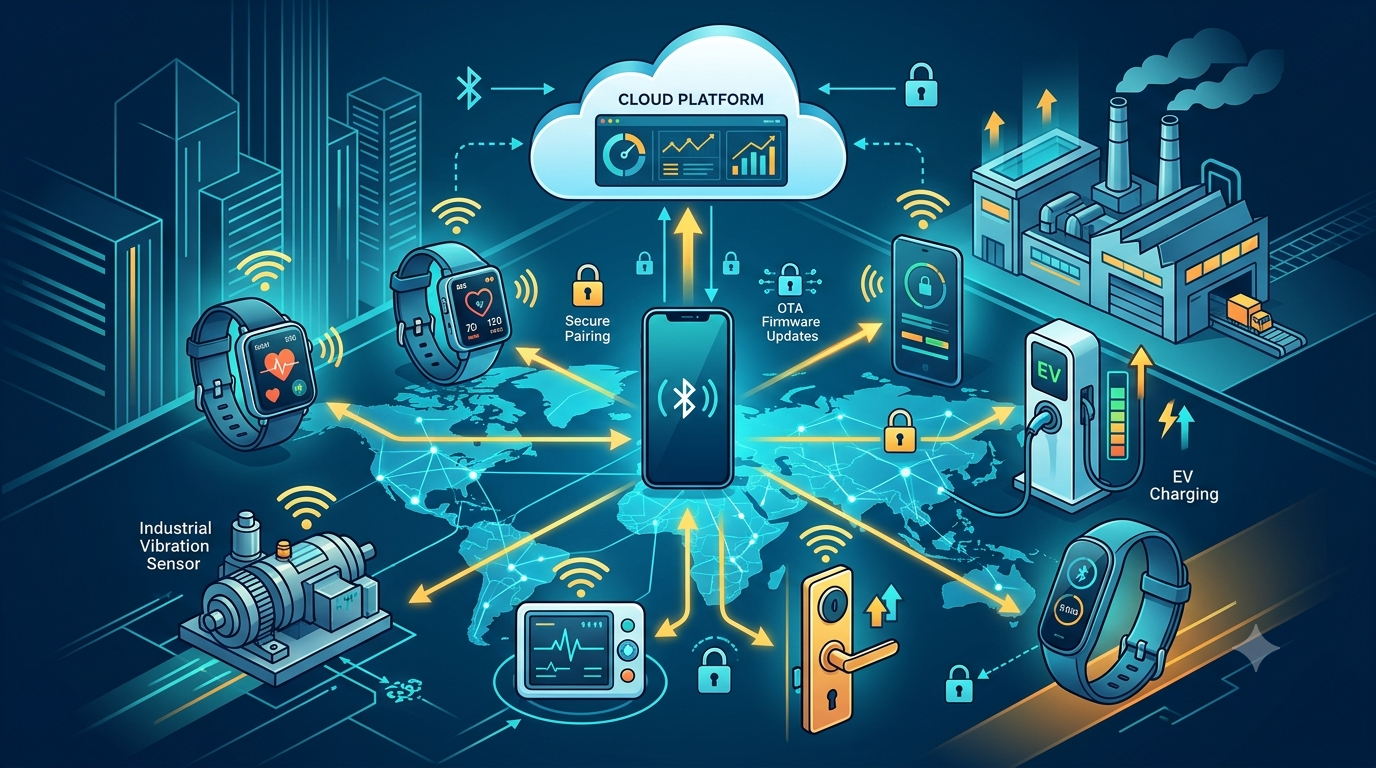
The Internet of Things (IoT) is transforming how businesses design, operate, and manage connected products. From wearable technology and medical devices to industrial sensors, smart locks, fitness trackers, and EV chargers, connected hardware is becoming an important part of modern digital ecosystems.
At the center of many of these products is Bluetooth Low Energy (BLE).
BLE enables devices to communicate wirelessly while keeping power consumption low, making it a practical connectivity technology for battery-powered products and smart sensor networks.
In 2026, businesses are increasingly looking beyond basic Bluetooth connectivity. They need complete BLE IoT solutions that combine device development, embedded firmware, mobile applications, cloud connectivity, real-time monitoring, automation, and security.
What Is BLE IoT?
BLE IoT combines Bluetooth Low Energy technology with Internet of Things platforms to connect physical devices, sensors, smartphones, gateways, and cloud systems.
A typical BLE IoT ecosystem may look like:
BLE Device → Mobile App/Gateway → Cloud Platform → Dashboard → Business Action
This architecture allows connected devices to collect information, communicate with applications, transmit data to cloud platforms, and support real-time monitoring.
For businesses developing connected products, BLE IoT development can provide the foundation for efficient and scalable device communication.
For businesses looking for complete BLE IoT services, [BLE IoT Services] is a relevant resource covering BLE device development, IoT system integration, smart sensor networks, and gateway and cloud connectivity.
Why Bluetooth Low Energy Is Important for IoT
Many IoT products operate on batteries and need to remain active for extended periods.
BLE is designed for low-energy wireless communication, making it suitable for products that periodically transmit sensor data or interact with smartphones and gateways.
Common BLE IoT applications include:
- Wearable devices
- Medical devices
- Fitness trackers
- Smart locks
- EV chargers
- Industrial sensors
- Smart home products
- Asset tracking devices
- Beacon systems
- Connected consumer electronics
The right BLE architecture depends on factors such as power consumption, communication range, data requirements, hardware, application platforms, and scalability.
BLE Device Development
BLE device development is one of the core components of a connected product.
A BLE-enabled device may contain sensors, microcontrollers, wireless modules, and embedded firmware responsible for collecting and transmitting data.
A production-ready BLE device needs more than wireless connectivity. Developers may need to address:
- BLE protocol implementation
- Power optimization
- Device discovery
- Advertising
- Connection management
- GATT services
- Security
- Firmware updates
- Hardware compatibility
- Real-world connectivity testing
A strong device architecture can help create reliable communication between hardware, applications, and IoT platforms.
BLE Peripheral and Central Implementations
BLE devices can operate in different roles depending on the application.
BLE peripheral and central implementations allow devices to scan, advertise, connect, and communicate with other BLE devices.
For example, a smartphone can act as a central device while a sensor operates as a peripheral.
More advanced products may require dual-role BLE architecture where devices can both scan and communicate with other devices.
This approach can be useful in complex connected-device ecosystems.
Custom GATT Services
Custom GATT services are another important component of BLE product development.
GATT, or the Generic Attribute Profile, defines how BLE devices organize and exchange data.
Custom GATT profiles and characteristics can be designed around a product’s specific data model.
For example, a connected sensor could expose characteristics for:
- Temperature
- Battery level
- Device status
- Sensor readings
- Configuration
- Alerts
- Commands
A carefully designed GATT structure can make communication between embedded devices and applications more predictable and maintainable.
Device Provisioning and Pairing
A connected product needs a reliable onboarding experience.
Device provisioning and pairing allow a new BLE device to be securely connected to a smartphone, application, user account, or IoT ecosystem.
A typical onboarding process can include:
- Discovering the BLE device
- Establishing a secure connection
- Authenticating the device
- Associating the device with a user
- Configuring device parameters
- Connecting the device to the appropriate backend
Secure provisioning becomes particularly important for products deployed at scale.
BLE Mobile App Development
BLE IoT products frequently require mobile applications to communicate with connected hardware.
Businesses developing these applications can also explore [BLE App Development] for additional information about Bluetooth Low Energy mobile applications, BLE integration, and connected-device applications.
Native mobile development can use:
iOS CoreBluetooth
iOS CoreBluetooth provides the framework required for iPhone and iPad applications to communicate with BLE peripherals.
BLE applications may need to handle:
- Device discovery
- Connections
- GATT services
- Characteristics
- Background operation
- State restoration
- Reconnection
- Data synchronization
Android Bluetooth APIs
On Android, developers work with Android Bluetooth APIs to discover and communicate with BLE devices.
Android BLE development can require additional consideration for:
- Different Android versions
- OEM variations
- Permission requirements
- Background restrictions
- Connection reliability
- Device compatibility
Cross-platform BLE applications should therefore be tested on real devices rather than relying only on simulators.
OTA Firmware Updates for BLE Devices
Connected products often need to receive software improvements after deployment.
OTA firmware updates, or over-the-air firmware updates, allow developers to update field devices without physically accessing the hardware.
OTA functionality can help with:
- Bug fixes
- Performance improvements
- New features
- Security updates
- Device compatibility
- Firmware maintenance
For production IoT deployments, OTA systems should be designed with security, reliability, recovery, and interrupted-update scenarios in mind.
Beacon Technologies: iBeacon and Eddystone
BLE also supports proximity and location-aware applications through beacon technologies.
iBeacon and Eddystone can be used for:
- Proximity detection
- Indoor positioning
- Location-aware experiences
- Retail engagement
- Navigation
- Asset awareness
Beacon technology can complement broader IoT systems by providing location or proximity information to applications and connected platforms.
Embedded Firmware Integration
The connection between a mobile application and a physical device depends heavily on reliable firmware.
Embedded firmware integration coordinates the device’s hardware behavior, BLE communication, sensors, power management, and application requirements.
A complete BLE IoT project may therefore involve:
- Embedded firmware
- BLE protocol implementation
- Mobile application development
- Backend APIs
- Cloud infrastructure
- Hardware testing
- Quality assurance
This end-to-end approach is particularly useful for businesses developing production-ready connected hardware.
Gateway and Cloud Connectivity
BLE devices are often connected to smartphones or gateways before data reaches the cloud.
Gateway and cloud connectivity enables connected devices to communicate with larger IoT ecosystems.
A gateway can collect information from multiple BLE devices and transmit it to cloud platforms.
Common cloud environments include:
- AWS IoT
- Azure IoT
- Google Cloud
For another perspective on end-to-end IoT BLE services, [IoT BLE Services] covers BLE device development, IoT system integration, smart sensor networks, gateway connectivity, automation, and real-time monitoring.
Real-Time Data Monitoring
Modern IoT systems are not only about collecting data. Businesses need to understand that data and respond to it.
Real-time data monitoring can provide dashboards showing:
- Device status
- Sensor values
- Connectivity
- Battery levels
- Alerts
- Usage patterns
- Operational information
Businesses can use these insights to monitor connected products and identify issues more quickly.
Smart Sensor Networks
A smart sensor network can contain multiple connected devices collecting information from physical environments.
Examples include:
- Industrial temperature sensors
- Environmental monitoring devices
- Healthcare sensors
- Equipment monitoring systems
- Smart building sensors
- Asset tracking devices
BLE can provide the wireless connectivity layer while gateways and cloud platforms handle larger-scale data processing.
BLE IoT Security
Security needs to be considered throughout the BLE IoT development lifecycle.
Important areas include:
- Secure pairing
- Encryption
- Authentication
- Device identity
- Key management
- Access control
- Secure firmware
- OTA update security
- Cloud security
Secure pairing and encryption are particularly important when connected devices handle sensitive information or control physical systems.
For regulated applications such as medical devices, development may also need to account for applicable regulatory and compliance requirements.
Bluetooth 5.x and BLE Protocol Design
Modern connected products may require careful Bluetooth 5.x and BLE protocol design.
The architecture should consider:
- Range
- Throughput
- Reliability
- Power consumption
- Connection behavior
- Device density
- Data requirements
Choosing the appropriate BLE architecture early can help reduce development problems later.
BLE Hardware and Chipset Development
BLE IoT development can involve different hardware platforms and chipsets.
Common ecosystems include:
- Nordic nRF52/nRF53
- Silicon Labs
- Texas Instruments CC26xx
- ESP32
- Other BLE-capable chipsets
The appropriate chipset depends on the product’s processing requirements, connectivity needs, power constraints, hardware design, cost targets, and production requirements.
BLE IoT Applications Across Industries
Wearable Technology
BLE can connect wearable devices to smartphones and cloud platforms for monitoring and data synchronization.
Medical Devices
BLE can support communication between connected medical or healthcare devices and applications, subject to the security and regulatory requirements of the specific product.
Fitness Trackers
Fitness devices can use BLE to synchronize activity, health, and performance information with mobile applications.
Smart Locks
BLE enables smartphones and other authorized devices to communicate with smart locking systems.
EV Chargers
Connected EV charging products can use wireless communication and IoT platforms for monitoring, configuration, and management.
Industrial Sensors
Industrial IoT systems can use connected sensors to monitor equipment and operational conditions.
How to Build a BLE IoT Product
A typical BLE IoT development process can include:
- Define product requirements
- Select BLE hardware and chipset
- Design the BLE communication architecture
- Develop embedded firmware
- Create custom GATT services
- Implement device provisioning and pairing
- Develop native iOS and Android applications
- Integrate gateway connectivity
- Connect the system with AWS IoT, Azure IoT, or Google Cloud
- Implement security and encryption
- Add OTA firmware updates
- Test with real hardware
- Deploy and monitor the connected product
- Provide production support
This full-stack approach connects hardware, firmware, mobile applications, backend systems, and cloud infrastructure into a single IoT ecosystem.
Why Choose a BLE IoT Development Partner?
A capable BLE development firm should understand more than Bluetooth connectivity.
Important technical capabilities can include:
- Bluetooth 5.x and BLE protocol design
- iOS CoreBluetooth
- Android Bluetooth APIs
- Nordic nRF52/nRF53 SDKs
- Silicon Labs chipsets
- TI CC26xx
- ESP32
- Custom GATT services
- OTA firmware updates
- Secure pairing and encryption
- Embedded firmware integration
- AWS IoT
- Azure IoT
- Google Cloud
- Hardware QA and testing
For a product involving a wearable, medical device, fitness tracker, smart lock, EV charger, industrial sensor, or other connected hardware, an end-to-end development team can help coordinate embedded firmware, BLE protocol implementation, mobile applications, backend infrastructure, QA, and production support.
For broader software engineering and IoT integration capabilities, [Quartus Technology] is the parent technology resource associated with these BLE and IoT development services.
The Future of BLE and IoT
The future of connected products will increasingly involve communication between devices, applications, cloud platforms, and intelligent software.
BLE can provide an efficient connectivity layer while IoT platforms provide data processing, monitoring, automation, and analytics.
The combination of:
BLE + Embedded Firmware + Mobile Apps + Cloud + IoT + AI
can create connected products that are more intelligent, manageable, and scalable.
Frequently Asked Questions
What is BLE IoT development?
BLE IoT development involves building connected products that use Bluetooth Low Energy to communicate between devices, smartphones, gateways, and IoT cloud platforms.
What services are included in BLE development?
BLE development can include BLE device development, custom GATT services, embedded firmware integration, device provisioning, pairing, OTA firmware updates, mobile BLE applications, and cloud connectivity.
Can BLE devices connect to AWS IoT?
Yes. BLE devices can communicate with an IoT gateway or intermediary system that connects the device ecosystem with platforms such as AWS IoT.
What is the difference between BLE central and peripheral?
A BLE peripheral generally advertises its presence and provides services, while a central scans for and establishes connections with peripherals. Some products can support dual-role implementations.
Can BLE work with both iOS and Android?
Yes. BLE applications can be developed using iOS CoreBluetooth and Android Bluetooth APIs, although platform-specific behavior and testing requirements need to be considered.
What products can use BLE IoT technology?
BLE IoT can be used in wearables, medical devices, fitness trackers, smart locks, EV chargers, industrial sensors, smart buildings, asset tracking systems, and other connected products.
Conclusion
BLE IoT development is becoming an important part of modern connected-product development.
From BLE device development and custom GATT services to embedded firmware integration, iOS CoreBluetooth, Android Bluetooth APIs, OTA firmware updates, smart sensor networks, and cloud connectivity, successful IoT products require a complete technology ecosystem.
Businesses planning a connected product can benefit from designing the BLE architecture, firmware, mobile applications, security, gateway, and cloud infrastructure together from the beginning.
BLEIoT focuses on building smart, secure, and scalable connected solutions that bridge devices, data, and people—from initial product requirements through development, testing, deployment, and production support.