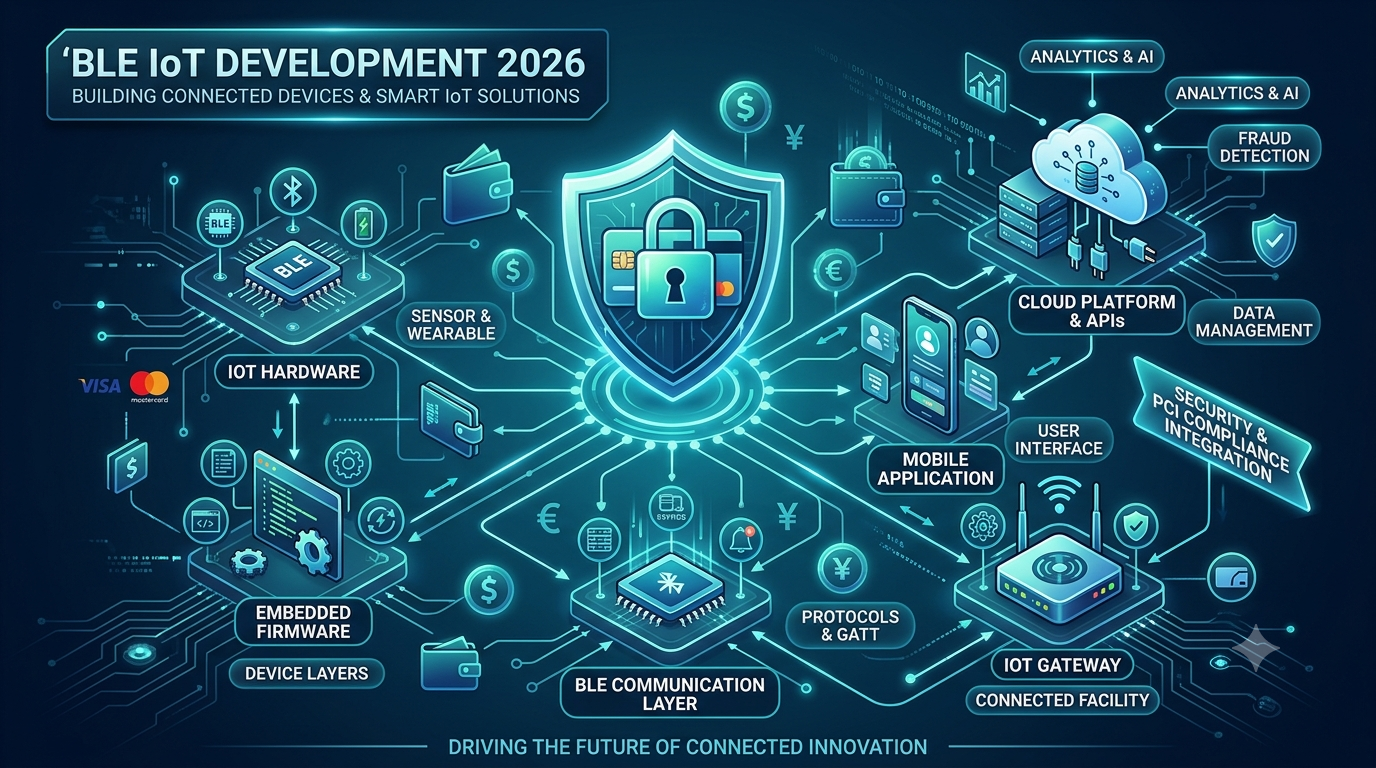
Bluetooth Low Energy (BLE) has become an important connectivity technology for modern Internet of Things (IoT) products. From smart sensors and wearables to industrial equipment, healthcare devices, asset trackers, and smart buildings, BLE enables devices to exchange data while keeping power consumption relatively low.
In 2026, businesses are moving beyond simple Bluetooth connectivity. Modern BLE IoT development combines hardware, firmware, sensors, mobile applications, gateways, cloud platforms, APIs, analytics, and security into complete connected ecosystems.
For companies developing a new IoT product, choosing the right BLE architecture can directly affect battery life, connectivity, scalability, security, and the overall user experience.
What Is BLE IoT?
BLE IoT refers to using Bluetooth Low Energy technology as part of an IoT ecosystem.
A BLE-enabled device can collect information from sensors and communicate that information to a nearby smartphone, gateway, computer, or other compatible device.
A typical BLE IoT architecture can look like:
BLE Sensor → Gateway/Mobile Device → Cloud Platform → Database → Analytics Dashboard
Depending on the product, the gateway may be a smartphone, tablet, dedicated IoT gateway, embedded computer, or another connected device.
BLE can be particularly useful when an IoT product requires short-range wireless communication and efficient power consumption.
Why BLE Is Important for IoT Development
BLE has several characteristics that make it useful for connected-device development.
Low Power Communication
Many IoT products operate using batteries. Sensors and other devices may need to remain operational for long periods without frequent battery replacement.
BLE’s low-power design makes it suitable for applications such as:
- Wearable devices
- Asset trackers
- Smart sensors
- Environmental monitoring
- Healthcare and wellness devices
- Smart locks
- Industrial monitoring equipment
Smartphone Connectivity
Smartphones can communicate with compatible BLE devices, making them useful as configuration tools, local gateways, and user interfaces.
A mobile application can:
- Discover BLE devices
- Connect to devices
- Read sensor information
- Send commands
- Configure device settings
- Display real-time information
- Synchronize information with the cloud
Flexible IoT Architecture
BLE does not have to provide the complete connectivity path to the internet.
Instead, a BLE device can communicate with a gateway that handles internet connectivity.
For example:
Sensor → BLE → Gateway → Wi-Fi/Cellular → Cloud
This architecture can allow businesses to keep the connected device relatively simple while moving data processing and management into the cloud.
Key Components of a BLE IoT Solution
A complete BLE IoT product normally includes several technical layers.
1. IoT Hardware
The hardware layer contains the physical components of the product.
Depending on the use case, this can include:
- BLE chipset
- Microcontroller
- Sensors
- Antenna
- Battery
- Memory
- Display
- Actuators
- Power-management components
Hardware selection can affect communication range, power consumption, processing capability, and product cost.
2. Embedded Firmware
Firmware controls how the IoT device operates.
BLE firmware may manage:
- Advertising
- Device discovery
- Connections
- Sensor readings
- GATT services
- Data transmission
- Power management
- Device authentication
- Firmware updates
Efficient firmware design is particularly important for battery-powered products.
3. BLE Communication Layer
The BLE communication layer defines how the device exchanges information.
Developers may design:
- BLE services
- Characteristics
- Read operations
- Write operations
- Notifications
- Indications
- Device commands
- Data formats
A well-designed communication protocol can make future integration and product expansion easier.
4. Mobile Application
Many BLE products use an Android or iOS application.
The application can act as the user interface between the customer and the physical device.
Typical functionality includes:
- Device discovery
- Pairing
- Device configuration
- Real-time monitoring
- Data synchronization
- Notifications
- User accounts
- Firmware updates
5. IoT Gateway
A gateway can collect data from multiple BLE devices and forward it to the cloud.
This can be useful in:
- Warehouses
- Manufacturing facilities
- Hospitals
- Retail stores
- Smart buildings
- Commercial facilities
For example:
100 BLE Sensors → IoT Gateway → Cloud Platform
The gateway can reduce the need for every sensor to have its own internet connection.
6. Cloud Platform
The cloud layer provides centralized management of IoT devices and collected data.
It can support:
- Device management
- User management
- Data storage
- APIs
- Analytics
- Alerts
- Reporting
- Remote monitoring
- Device configuration
BLE IoT Use Cases
BLE IoT development can support a wide variety of connected products.
1. Industrial IoT
Industrial organizations can use BLE sensors to monitor equipment and environmental conditions.
Potential applications include:
- Temperature monitoring
- Machine monitoring
- Vibration sensing
- Asset tracking
- Equipment status
- Maintenance monitoring
- Warehouse monitoring
A BLE sensor can periodically collect information and transmit it to a nearby gateway.
The gateway can then send the information to an IoT platform for analysis.
2. Healthcare and Wellness
BLE can support connected healthcare and wellness products where low-power wireless communication is useful.
Examples include:
- Wearable health devices
- Fitness equipment
- Patient monitoring systems
- Temperature sensors
- Blood-pressure-related devices
- Connected wellness products
Healthcare applications require careful attention to privacy, security, reliability, and applicable regulatory requirements.
3. Asset Tracking
BLE tags and beacons can be used to improve visibility of physical assets.
Businesses can track or monitor:
- Equipment
- Tools
- Inventory
- Hospital equipment
- Warehouse assets
- Retail products
A gateway can collect BLE signals and send relevant information to an asset-management platform.
4. Smart Buildings
BLE IoT can support connected-building applications such as:
- Smart access
- Environmental monitoring
- Occupancy-related sensing
- Lighting control
- Temperature monitoring
- Equipment monitoring
Multiple BLE sensors can communicate with gateways positioned throughout a building.
5. Smart Home Products
BLE is also useful for consumer IoT products.
Examples include:
- Smart locks
- Sensors
- Connected appliances
- Lighting devices
- Home security products
- Temperature monitors
A smartphone can provide local configuration and control while cloud services provide additional remote functionality when appropriate.
6. Retail IoT
Retail businesses can use BLE technology for:
- Asset tracking
- Inventory monitoring
- Beacons
- Proximity experiences
- Equipment monitoring
- Store analytics
BLE can act as one connectivity layer within a broader retail IoT platform.
BLE Beacons in IoT
BLE beacons are small wireless devices that transmit information that compatible devices can detect.
They can be used for:
- Proximity detection
- Indoor location applications
- Asset identification
- Retail experiences
- Facility management
- Navigation-related applications
Beacon deployments can become more useful when their data is