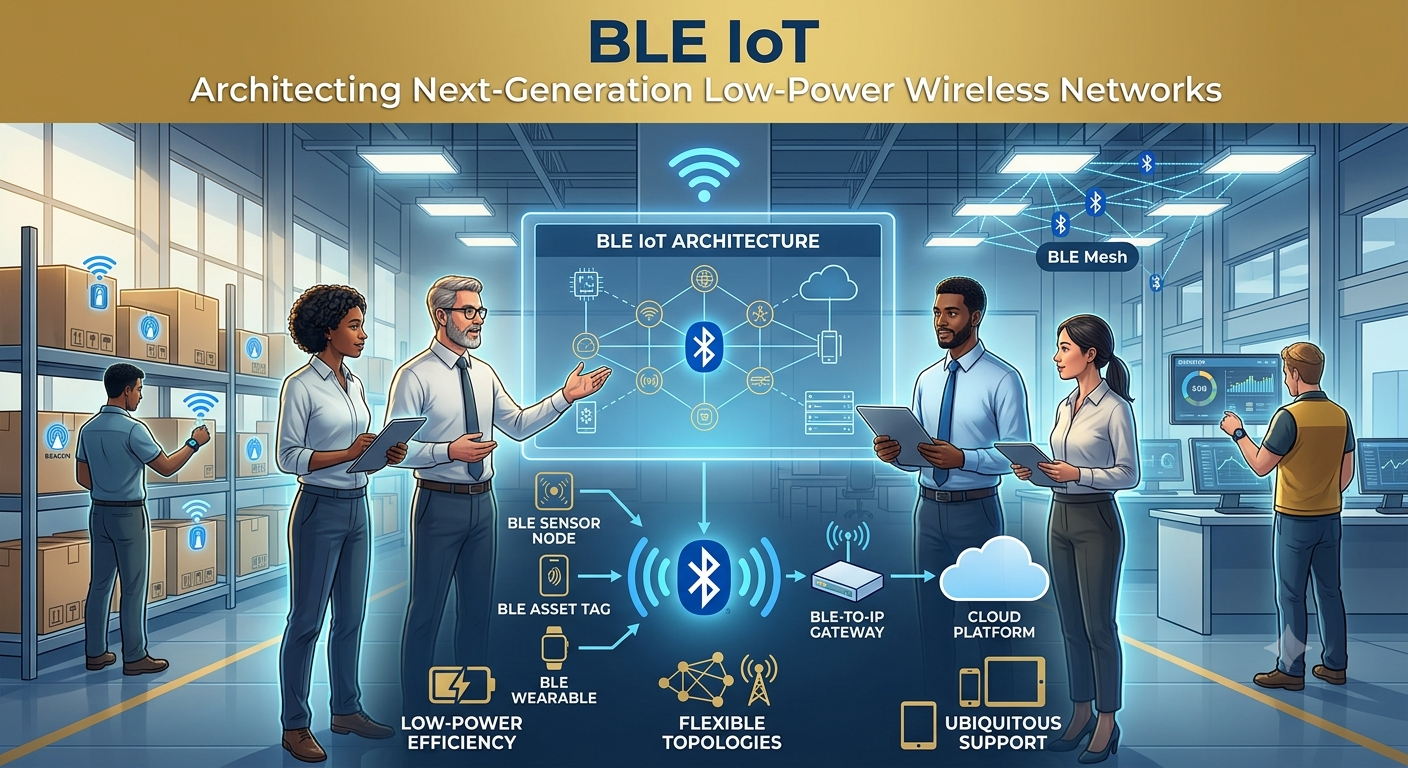
Bluetooth Low Energy (BLE) has evolved from a simple smartphone peripheral protocol into one of the most critical communication backbones of the Internet of Things (IoT). From real-time asset tracking in industrial warehouses to continuous remote patient monitoring in modern healthcare, BLE enables intelligent, battery-efficient, and scalable edge connectivity.
Understanding the architectural foundations of BLE within the IoT ecosystem is essential for building robust, secure, and long-lasting connected systems.
Why BLE Dominates the Edge of IoT
While Wi-Fi delivers high bandwidth and Cellular offers long-range coverage, BLE occupies a vital sweet spot for low-data-rate, power-constrained applications. Operating in the 2.4 GHz ISM band, BLE is optimized for low duty cycles—transmitting short bursts of data while remaining in deep sleep modes to preserve energy.
┌──────────────────────────────────────────────────────────┐
│                   BLE IoT Network Architecture           │
└──────────────────────────────────────────────────────────┘
  [ BLE Sensor Node ]  ┐
  [ BLE Asset Tag   ]  ┼──( BLE Transmissions )──► [ BLE-to-IP Gateway ] ──► [ Cloud Platform ]
  [ BLE Wearable    ]  ┘
Key Architectural Advantages
- Exceptional Power Efficiency: Smart power management allows edge sensors to operate on coin-cell batteries or energy harvesting for years.
- Flexible Communication Topologies: Supports Point-to-Point (1:1), Broadcast/Beacons (1:M), and BLE Mesh (M:M) networks for broad coverage.
- Ubiquitous Hardware Support: Natively integrated into virtually all modern smartphones, tablets, and mobile devices without requiring extra dongles.
- Long Range Capabilities: The introduction of LE Coded PHY extends transmission range up to 400 meters in open environments without increasing power consumption.
BLE Network Topologies in Industrial & Commercial IoT
Choosing the right network topology directly impacts power consumption, latency, and system scalability.
| Topology | Data Structure | Common Use Case |
|---|---|---|
| Point-to-Point (1:1) | Direct connection using GATT profiles | Connected medical wearables, diagnostic devices |
| Broadcast / Beacons (1:M) | One-way advertising data packets | Proximity alerts, indoor positioning, retail engagement |
| BLE Mesh (M:M) | Many-to-many relay networking | Commercial smart lighting, industrial building automation |
High-Impact Use Cases for BLE IoT Solutions
1. Healthcare & Remote Patient Monitoring
Medical-grade BLE sensors continuously record vital metrics—such as blood glucose levels, heart rate, and body temperature—and relay them securely to local gateways or cloud-based platforms for real-time monitoring.
2. Asset Tracking & Supply Chain Visibility
In logistics, BLE tags placed on pallets, machinery, or tools transmit periodic beacon signals. Gateways pick up these signals to track inventory location and environmental conditions inside warehouses.
3. Smart Facilities & Industrial Automation
With BLE Mesh networking, thousands of lighting nodes, motion sensors, and environmental monitors form self-healing networks. These networks optimize energy consumption across commercial real estate without requiring continuous Wi-Fi throughput.
Engineering Best Practices for BLE IoT Deployment
- Optimize Advertising & Connection Intervals: Tune duty cycles carefully. Increasing advertising intervals extends battery life but adds slight latency to initial connections.
- Implement End-to-End Security: Use standard AES-128 encryption with authenticated pairing modes (Passkey Entry, Numeric Comparison) to prevent eavesdropping and Man-in-the-Middle (MitM) attacks.
- Mitigate 2.4 GHz RF Interference: Deploy Adaptive Frequency Hopping (AFH) to dynamically skip noisy RF channels caused by overlapping Wi-Fi signals in industrial settings.
- Build Secure OTA Update Workflows: Ensure microcontrollers support Over-the-Air (OTA) firmware updates to deliver critical security patches and feature enhancements safely to deployed hardware.
Final Thoughts
BLE has earned its place as an essential technology for modern IoT infrastructure. By leveraging optimized GATT data structures, secure pairing routines, and appropriate network topologies, engineering teams can build reliable, long-lasting BLE IoT solutions that scale seamlessly from the edge to the cloud.