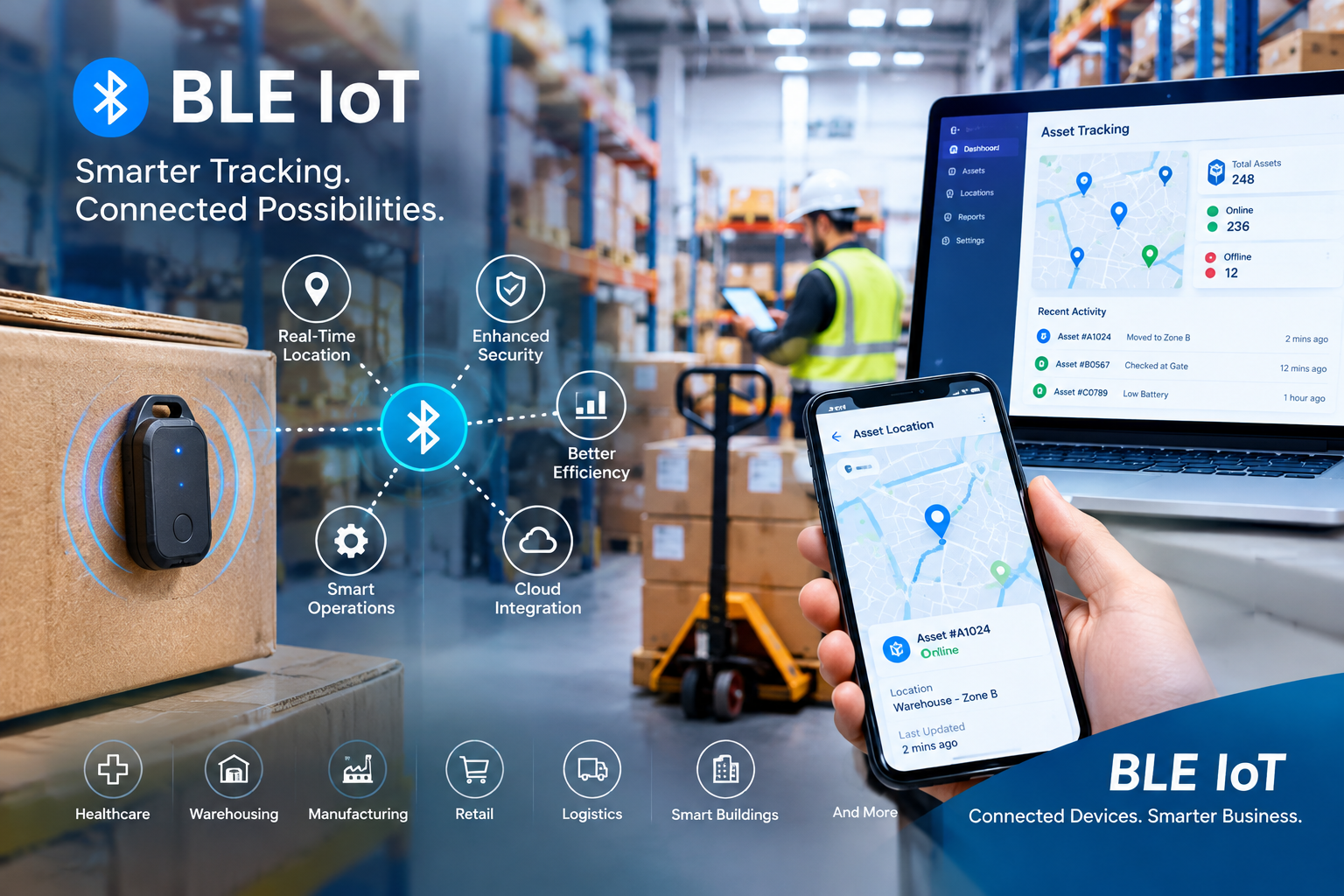
Businesses across manufacturing, healthcare, logistics, retail, and warehousing are increasingly using connected technologies to understand where their assets are, how they move, and how efficiently they are being utilized.
From medical equipment and industrial tools to inventory containers and warehouse assets, tracking physical resources manually can create operational challenges.
Bluetooth Low Energy (BLE) is emerging as a practical connectivity technology for asset tracking applications because it supports low-power wireless communication and can work with compact Bluetooth-enabled devices.
When combined with IoT gateways, cloud platforms, mobile applications, and analytics, BLE can help businesses build connected asset monitoring ecosystems.
In this article, we explore how BLE asset tracking works, its business applications, and the technologies involved in developing scalable Bluetooth IoT solutions in 2026.
What Is BLE Asset Tracking?
BLE asset tracking uses Bluetooth Low Energy technology to identify, monitor, and track physical assets through wireless signals.
A typical BLE tracking solution may include:
- BLE beacons or asset tags
- Bluetooth-enabled gateways
- Mobile applications
- IoT cloud platforms
- Location monitoring software
- Analytics dashboards
- Alerts and notifications
BLE tags can broadcast identification information that compatible gateways or mobile devices detect.
The collected information can then be transmitted to a central platform for monitoring and analysis.
For example, a warehouse may attach BLE tags to equipment or inventory containers to help employees identify their locations within the facility.
How Does a BLE IoT Tracking System Work?
A BLE asset tracking system generally follows this process:
BLE Tag → Bluetooth Gateway → IoT Platform → Data Processing → Dashboard
BLE Tags
Small Bluetooth-enabled devices are attached to assets. They transmit signals that can be detected by compatible devices.
Bluetooth Gateways
Gateways receive BLE signals and forward relevant information to an IoT platform through an available network connection.
IoT Cloud Platform
The platform processes device information, manages asset records, and stores tracking events.
Monitoring Dashboard
Authorized users can view asset information, historical movement, device status, and alerts.
Depending on the implementation, a mobile phone can also act as a BLE scanner or gateway.
Why Businesses Are Adopting BLE for Asset Tracking
1. Low-Power Wireless Communication
BLE is designed for applications where energy efficiency is important.
Battery-powered tags can be configured to transmit information periodically, depending on the required tracking frequency and battery-life expectations.
This makes BLE useful for devices that need to operate without frequent battery replacement.
2. Cost-Conscious Deployment
BLE-based tracking can be suitable for businesses looking to monitor multiple assets without deploying a dedicated GPS device on every item.
The overall cost depends on tag design, gateway infrastructure, software development, and installation requirements.
3. Indoor Tracking Applications
GPS can have limitations inside buildings.
BLE can support indoor proximity and location estimation when suitable receivers or gateways are deployed.
Businesses can use BLE-based systems to identify assets within rooms, zones, departments, or warehouse areas.
The achievable accuracy depends on the deployment environment, signal interference, receiver placement, and positioning method.
4. Integration With Existing Applications
BLE tracking systems can be integrated with:
- Inventory management software
- Warehouse management systems
- Enterprise resource planning platforms
- Mobile applications
- IoT dashboards
- Business analytics systems
This can help businesses connect physical asset information with their existing digital workflows.
Top Industry Applications of BLE Asset Tracking
Healthcare and Hospitals
Hospitals use a wide range of mobile equipment, including wheelchairs, infusion pumps, patient monitoring devices, and medical carts.
BLE asset tracking can help staff locate equipment and understand its utilization.
Potential benefits include:
- Equipment visibility
- Faster asset identification
- Reduced manual searching
- Maintenance tracking
- Better equipment utilization
Warehousing and Logistics
Warehouses manage large numbers of movable assets and inventory containers.
BLE tags and gateways can help monitor movement across designated areas.
Possible applications include:
- Pallet tracking
- Equipment monitoring
- Container identification
- Zone-based alerts
- Asset movement history
Manufacturing
Manufacturing facilities often need visibility into tools, machines, and production-related assets.
BLE IoT solutions can support equipment monitoring and help employees locate shared resources.
Retail
Retailers can use Bluetooth-enabled devices for inventory visibility, equipment tracking, and proximity-based applications.
BLE infrastructure may also support customer engagement features when implemented with appropriate permissions and privacy safeguards.
Construction
Construction companies frequently move tools and equipment between sites.
BLE tags can help maintain asset records and provide visibility into equipment detected at different locations.
BLE vs GPS for Asset Tracking
BLE and GPS serve different purposes.
| Feature | BLE Tracking | GPS Tracking |
|---|---|---|
| Typical use | Indoor and proximity monitoring | Outdoor location tracking |
| Power requirements | Can be low | Often higher |
| Infrastructure | Receivers or gateways may be needed | Satellite positioning |
| Indoor suitability | Suitable with proper deployment | Often limited |
| Common applications | Warehouses, hospitals, buildings | Vehicles, outdoor equipment |
| Cost structure | Tags plus infrastructure | GPS hardware and connectivity |
Some businesses combine BLE and GPS to support both indoor and outdoor asset visibility.
The Role of IoT Gateways in BLE Tracking
BLE gateways are important components of many large-scale tracking systems.
They receive Bluetooth signals from nearby devices and transmit the information to a central platform.
A gateway may support:
- BLE scanning
- Device identification
- Wi-Fi or Ethernet connectivity
- MQTT or HTTPS communication
- Local data buffering
- Secure communication
- Remote configuration
Gateway placement should be planned according to building layout, signal coverage, asset movement, and the desired tracking frequency.
How AI Can Improve BLE Asset Tracking
Artificial intelligence can add analytical capabilities to BLE-based asset monitoring systems.
Potential applications include:
Asset Utilization Analysis
Identify equipment that is frequently used or remains idle for extended periods.
Movement Pattern Analysis
Analyze historical tracking information to understand how assets move through a facility.
Predictive Maintenance
Combine asset location with sensor information to help identify maintenance requirements.
Operational Insights
Use historical data to identify recurring bottlenecks or inefficient asset allocation.
AI is most useful when supported by reliable data and a clearly defined operational objective.
Security Considerations for BLE IoT Systems
Connected asset tracking solutions should be designed with security in mind.
Important considerations include:
- Secure device provisioning
- Appropriate BLE pairing and security mechanisms
- Encrypted communication where applicable
- Gateway authentication
- Secure APIs
- Role-based access
- Cloud security
- Firmware updates
- Data privacy
BLE device identifiers and tracking records should also be managed carefully, particularly when they could be associated with individuals or sensitive business operations.
Challenges in BLE Asset Tracking
Although BLE offers useful capabilities, businesses should consider several technical challenges.
Signal Interference
Metal structures, walls, machinery, and other wireless devices can affect Bluetooth signal behavior.
Location Accuracy
BLE proximity does not automatically provide precise coordinates. More advanced positioning methods and careful infrastructure planning may be required.
Battery Management
Tag battery life depends on advertising frequency, hardware design, and operating conditions.
Device Compatibility
Different hardware and software configurations may require testing to ensure consistent behavior.
Scalability
A system designed for a small pilot may need optimization to support thousands of tags and multiple gateways.
Addressing these challenges during the design stage can improve deployment reliability.
How to Develop a Custom BLE Asset Tracking Solution
A structured BLE IoT development process can include:
Requirement Analysis: Identify assets, monitoring needs, and business objectives.
Hardware Selection: Choose suitable BLE tags, sensors, and gateways.
BLE Firmware Development: Configure advertising, communication, and power management.
Gateway Integration: Establish reliable data collection and cloud communication.
Mobile or Web Application Development: Build interfaces for asset visibility and management.
Cloud Integration: Store, process, and manage tracking information.
Testing: Validate connectivity, signal coverage, battery performance, and system reliability.
Deployment: Roll out the solution and monitor its performance.
Why Choose BLEIoT for Bluetooth IoT Development?
Developing a commercial BLE solution requires coordination between Bluetooth communication, embedded systems, mobile applications, gateways, and cloud platforms.
BLEIoT focuses on Bluetooth Low Energy and connected IoT development for businesses exploring smart devices and wireless product ecosystems.
Depending on project requirements, development services can include:
- BLE application development
- Bluetooth IoT solutions
- BLE firmware development
- Bluetooth device integration
- IoT gateway development
- Smart device connectivity
- BLE mobile app development
- IoT cloud integration
- Connected product development
- Custom Bluetooth solutions
The objective is to create connected systems that address practical business requirements while supporting future expansion.
Final Thoughts
BLE asset tracking is helping businesses connect physical assets with digital monitoring platforms.
From hospitals and warehouses to manufacturing facilities and retail operations, Bluetooth IoT solutions can improve asset visibility and support more informed operational decisions.
The combination of BLE tags, gateways, cloud platforms, mobile applications, and analytics creates opportunities for businesses to build smarter tracking ecosystems.
As connected products continue to evolve in 2026, BLE remains an important technology for developing low-power wireless applications.
The future of asset management is not just knowing what you own. It is knowing where it is, how it is used, and how it contributes to your operations.
SEO Keywords
- BLE asset tracking
- Bluetooth IoT solutions
- BLE IoT development
- Bluetooth Low Energy development
- BLE app development
- BLE beacon solutions
- Bluetooth asset tracking system
- IoT asset tracking
- BLE gateway development
- indoor asset tracking
- Bluetooth tracking technology
- custom BLE development
- IoT device development
- BLE firmware development
- Bluetooth IoT company
Meta Title
BLE Asset Tracking in 2026: Bluetooth IoT Solutions | BLEIoT
Meta Description
Discover how BLE asset tracking works in 2026. Explore Bluetooth IoT solutions for healthcare, warehouses, manufacturing, indoor tracking, and connected devices.
Suggested URL Slug
/blogs/ble-asset-tracking-bluetooth-iot-solutions/
Suggested Internal Linking
- BLE App Development
- Bluetooth Low Energy Development
- IoT Product Development
- BLE Firmware Development
- Custom IoT Solutions