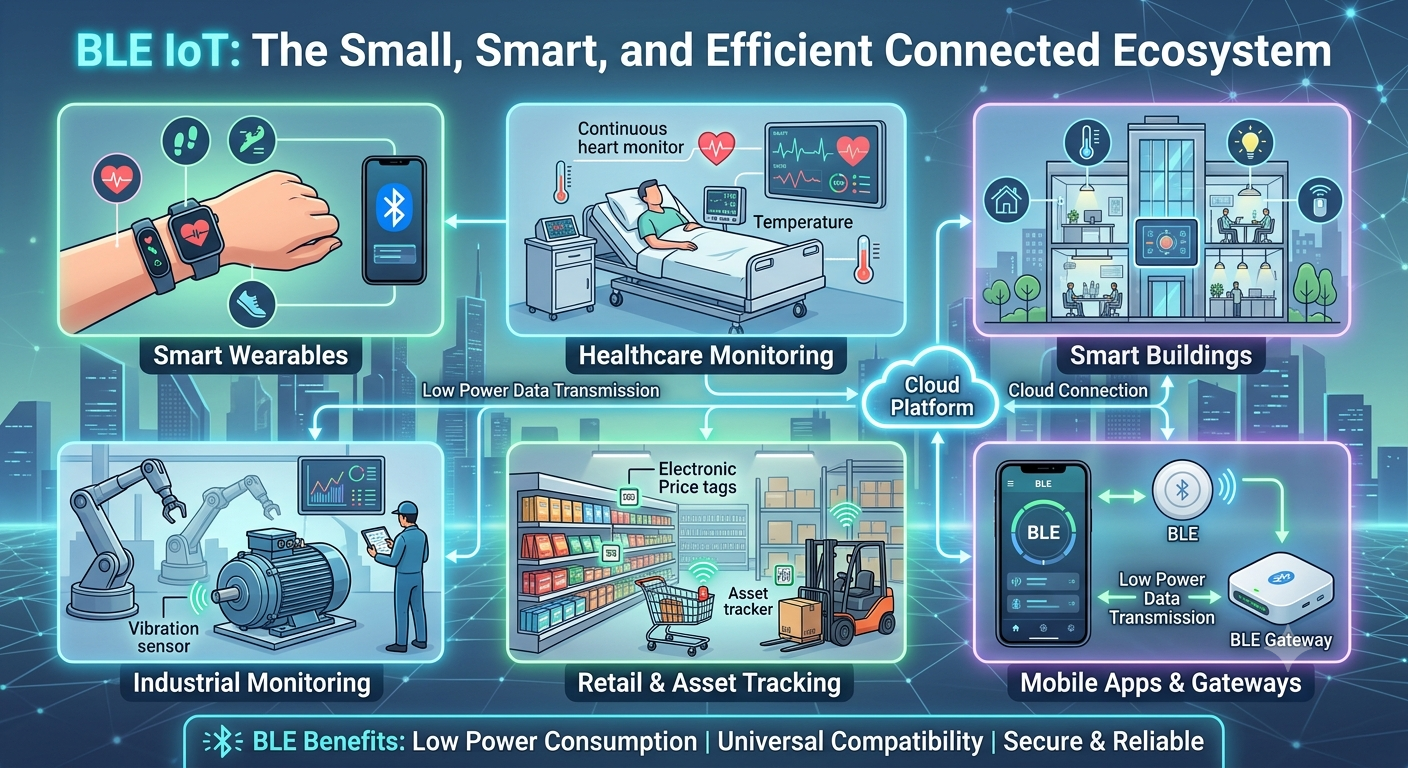
The world of connected technology is getting smaller, smarter, and more efficient.
From smart sensors and wearable devices to healthcare equipment, industrial monitoring systems, and smart buildings, businesses are looking for reliable ways to connect devices without adding unnecessary complexity.
One technology continuing to play an important role is Bluetooth Low Energy (BLE).
When combined with the Internet of Things (IoT), BLE can provide a practical connectivity layer for devices that need to communicate while keeping power consumption low.
What Is BLE IoT?
BLE IoT refers to using Bluetooth Low Energy technology as part of an Internet of Things ecosystem.
BLE allows compatible devices to exchange information wirelessly while being designed for low-power operation. IoT systems can then use gateways, smartphones, cloud platforms, and other network technologies to move and process that device data.
A typical BLE IoT architecture might look like:
BLE Sensor → Smartphone/Gateway → Internet → Cloud Platform → Dashboard
This approach can be useful when devices need to operate for long periods while collecting and transmitting information.
Why BLE Is Important for IoT Devices
Traditional connectivity technologies aren’t always suitable for every IoT application.
Many IoT devices are small, battery-powered, and designed to collect information continuously. Using a power-hungry communication technology could increase maintenance requirements and reduce battery life.
BLE offers several characteristics that make it attractive for these applications:
- Low power consumption
- Wireless connectivity
- Compact hardware requirements
- Smartphone compatibility
- Flexible device communication
- Support for sensor-based applications
This makes BLE particularly useful for applications where energy efficiency matters.
1. Smart Wearables
Wearable technology is one of the most visible applications of BLE.
Smartwatches, fitness trackers, medical wearables, and other connected accessories can use BLE to communicate with smartphones and other devices.
For example, a wearable may collect information from sensors and periodically transmit that information to a mobile application.
The application can then process the data, display insights, or synchronize it with a cloud platform.
2. Healthcare and Remote Monitoring
Healthcare is another area where connected sensors are becoming increasingly important.
BLE-enabled devices can help collect information from connected medical and wellness equipment and transfer it to a smartphone or gateway.
Potential applications include:
- Patient monitoring
- Fitness tracking
- Temperature monitoring
- Connected medical equipment
- Asset tracking
- Remote data collection
For healthcare applications, however, system reliability, security, privacy, and regulatory requirements must be considered carefully.
3. Smart Buildings
Buildings are becoming increasingly connected.
BLE sensors can be used to monitor environmental and operational conditions such as:
- Temperature
- Humidity
- Occupancy
- Equipment status
- Energy usage
- Room conditions
Data from these sensors can be sent to a centralized IoT platform where organizations can monitor building conditions and identify opportunities for automation.
4. Industrial IoT
Industrial environments contain thousands of assets that need to be monitored.
BLE can support IoT applications involving equipment monitoring, asset tracking, sensor data collection, and worker-related systems.
For example, a BLE sensor attached to industrial equipment could collect information and send it to a nearby gateway.
The gateway can then forward the information to an IoT platform for analysis.
This creates a connected chain:
Machine → BLE Sensor → Gateway → Cloud → Analytics
5. Retail and Asset Tracking
Retail businesses can also benefit from BLE-based IoT solutions.
BLE beacons and sensors can help businesses understand the location or movement of assets and equipment.
Potential applications include:
- Inventory monitoring
- Equipment tracking
- Location-based experiences
- Store analytics
- Asset management
When combined with cloud software, businesses can gain greater visibility into physical assets.
BLE + IoT + Mobile Apps
One of the strongest advantages of BLE is its relationship with smartphones.
Modern smartphones can communicate with BLE devices without requiring specialized hardware for every use case.
This makes mobile applications an important component of many BLE IoT systems.
A mobile application can:
- Discover nearby BLE devices.
- Establish a connection.
- Read sensor information.
- Send commands to the device.
- Process or display data.
- Synchronize information with a cloud platform.
This allows businesses to create connected-device experiences without requiring users to interact directly with complex hardware.
The Role of Gateways in BLE IoT
BLE devices don’t always connect directly to the internet.
Instead, a gateway can act as a bridge between BLE devices and internet-connected systems.
For example:
BLE Devices → BLE Gateway → Wi-Fi/Ethernet/Cellular → Cloud
This architecture can be particularly useful in industrial, commercial, and large-scale IoT environments.
Gateways can collect information from multiple BLE devices and transmit it to a central platform.
Security Should Be a Priority
Connectivity creates opportunities, but it also introduces security considerations.
BLE IoT solutions should be designed with security in mind from the beginning.
Important areas include:
- Device authentication
- Secure pairing
- Data encryption
- Access control
- Firmware security
- Secure cloud communication
- Device lifecycle management
Security shouldn’t be treated as an afterthought.
A connected device can become part of a larger digital ecosystem, so every communication layer needs appropriate protection.
BLE IoT and the Future of Smart Devices
The future of IoT isn’t simply about connecting more devices.
It’s about connecting devices more intelligently.
BLE can serve as an efficient communication layer for many battery-powered sensors and smart devices, while gateways and cloud platforms provide connectivity, processing, analytics, and management.
As businesses continue developing connected products, BLE IoT can play an important role in areas such as:
Smart Healthcare → Industrial IoT → Wearables → Smart Buildings → Retail → Asset Tracking
Conclusion
BLE and IoT are becoming increasingly useful together because they address two important requirements of connected-device ecosystems: efficient local communication and intelligent data management.
BLE can connect sensors and devices with low-power communication, while IoT platforms can transform the resulting data into useful information and automation.
For companies developing connected products, choosing the right BLE architecture, mobile application, gateway, cloud infrastructure, and security strategy can make a significant difference.
The next generation of smart devices won’t just collect data.
They’ll communicate, learn, and become part of intelligent connected ecosystems.